TLDR; How I got into RareSkills and ended up co-authoring a book on formal verification.
On June 10, 2024, I got an unexpected call and was laid off due to restructuring. Within minutes, life went from feeling stable to full of uncertainty. I still remember having tears in my eyes while telling my mother about this.
From the very first day, I knew the traditional job hunt wasn't going to work for me. I needed to do something different.
At the time, the audit space was booming and there was a lot of buzz around formal verification. Out of curiosity, I started learning it using the Certora Prover. Instead of just learning quietly, I began documenting everything I understood.
A few months later, I messaged @Jeyffre on Twitter and asked if @RareSkills_io planning to publish formal verification content and whether I could contribute. I was honest. I was still learning, but I loved teaching and was willing to put in the work.
That conversation turned into a call, then an opportunity to join RareSkills, and eventually into working on this book.
After nearly a year of writing and revision, we’re proud to finally present a new book from RareSkills, created in collaboration with @Certora:
Formal Verification with the Certora Prover
Certora makes formal verification accessible—but for newcomers, there’s still a large set of unfamiliar concepts to learn.
Teaching a broad and unfamiliar field comes with pedagogical challenges. Dive into projects too early, and you’re forced to use syntax you don’t yet understand. Delay compelling applications too long, and readers lose interest.
We worked carefully to balance showing “cool examples” without presenting anything that feels magical—i.e., concepts the reader hasn’t yet built a mental framework for.
Our hope is that this work helps formal verification become a more standard part of development and auditing.
Clocking in at well over 60,000 words, this is not a small book. But like any RareSkills publication, it’s information-dense yet approachable, thorough without being academic, and above all, practical and illuminating.
In a space that quickly jumps from one meta to the next, we’re proud to collaborate with a company willing to invest in long-horizon projects that make Web3 safer.
Link in the reply.
Sharing some recent updates and interesting stories on my learning. I've largely changed my approach and attitude thanks to the ZK Bootcamp by @RareSkills_io
Three things in particular have made a real difference for me.
1. Turns out (kind of obvious, really) — a ready-made structure and plan make learning much faster, more fun, and easier. When people who already understand a topic put effort into finding a way to explain it and deliver the information to you, it saves a huge amount of time and leaves you with the single task of enjoying the process of gaining knowledge. Structured information and a structured learning path are exactly what's often worth paying for especially when you have full-time job.
2. Spaced repetition has been a real game-changer. It increases the complexity of your knowledge and the speed of learning so much that I genuinely regret not using it earlier. Every day I spend about 20 minutes reviewing my own Anki cards. I already see how this can be scaled to improve "creative" thinking in audits and to learn other subjects I'll pick up in the future.
3. A real story — I started reviewing the intro ZK topics like Set Theory, Number Theory, and Boolean Expressions while on vacation with my girlfriend. She got curious about what I was doing and joined me. It was a really wonderful moment when, thanks to clear explanations, she understood basic set theory and boolean expressions in literally 30 minutes. In that moment I realized that any of us can learn truly anything, as long as someone finds a way to explain it well. It was really inspirational for me.
Honestly, I'm really glad I decided to start learning ZK. For me it has been a breath of fresh air and a new door into something that genuinely interests me.
I’ve tried learning Rust many times and got derailed for one reason or another.
When I started @RareCodeAI, I finally stuck with it. The focused learning path made the pieces click, and before long I was writing utilities on my own.
It’s a great launching pad for anyone looking to get productive with Rust.
Thanks @Jeyffre 🙌
My advice to any nations that want to stay or arrive in the global top 5:
- (a) Ensure you're listening to excellent advisors.
- (b) Stop the leakage of local data.
- (c) Secure energy and compute supply for the future.
- (d) Become a prominent data sink for the rest of the world.
- (e) Stop the leakage of local talent.
- (f) Develop world-class talent around atoms and cells. Talent for manipulation of bits is necessary, but no longer sufficient.
- (g) Improve local quality of life to become a talent sink for the world.
Interesting. AI will in effect increase both supply and demand for formal methods. You need them more, but you also have tools that make them cheaper.
https://t.co/t4QFZueL9c
“Formally verified software is the only path forward for mission-critical software, and Zcash has put it front and center on their roadmap to deliver.
Privacy is too important not to.
(Dragonfly holds $ZEC and continues to. I'm personally an investor in ZODL.)”
I’m committing ₹1 crore to Bihar cricket.
I was a cricketer growing up in Manigachi, a village in Darbhanga. Grew up with no support.
Today I’m launching Nath Foundation, named after my father Basuki Nath Choudhary, who I lost at 3.
Nath means sahara.
First action - fully sponsoring district-level cricket teams across my home, the Mithila region.
Starting in Darbhanga, then Madhubani and Sitamarhi — a fully sponsored team in each.
Each player gets full kit, year-round coaching, ground access, and travel to trials and tournaments. Everything covered.
Players picked at an open trial and match in Darbhanga, soon.
The talent is in our villages - precisely where I came from.
This is an unbelievable piece of work by Sarthak and something that requires amplification.
Let me explain what he found, in simple terms.
Sarthak is a Class 12 student from the 2025-26 batch, one of the 17 lakh students whose answer sheets went through CBSE's new On-Screen Marking system.
He spent days reading through CBSE's evaluation tenders, scraped all 576 tenders CBSE has issued, and tracked how the rules changed across three versions of the same tender.
The core finding is that the company that won the contract to scan and grade 17 lakh students' answer sheets is Coempt Eduteck.
Coempt used to be called Globarena Technologies. Globarena was the company behind the 2019 Telangana intermediate exam disaster, where software failures led to 3.8 lakh students getting wrong or missing marks, and 23 students died by suicide.
A government committee found systemic failure and negligence. Six months later, Globarena rebranded to Coempt Eduteck.
So a company with that track record won a contract to handle 17 lakh CBSE students. Sarthak's investigation is about how the rules were rewritten to let that happen.
The tender was issued three times.
> First tender, February 2025. It existed, then disappeared from the public GeM portal. Sarthak scraped all 576 CBSE tenders and this one was missing from the archive entirely.
> Second tender, May 2025. Four companies applied including TCS and Coempt. All four failed the technical evaluation. Cancelled.
> Third tender, August 2025. Coempt won. Between the second and third tender, a series of rule changes happened, and every single one made it easier for Coempt to qualify.
Here is what changed, one by one.
01. The old rules disqualified any company with a history of abandoning work, failing to complete contracts, or financial weakness. The new rules deleted this clause entirely. Coempt's Telangana history stopped being a barrier.
02. The old rules disqualified any company that was "blacklisted earlier." The new rules changed this to "currently blacklisted." Because Globarena rebranded after Telangana, removing the word "earlier" effectively erased their past.
03. The rules required Rs 50 crore average turnover over three years. Coempt's exact average came to Rs 50.86 crore. They cleared the bar by less than 1%. Earlier, a smaller company had asked CBSE to lower the bar to Rs 30 crore for fairer competition. CBSE refused. So the bar was kept high enough to block small players, but sat exactly low enough for Coempt to scrape through.
04. Software maturity is measured on the CMMI scale, 1 to 5. The old rules required Level 5. The new rules dropped it to Level 3. Coempt is a Level 3 company.
05. The cooling-off period for engaging retired CBSE officials was cut from two years to one. This makes it easier to use recently retired insiders to influence the process.
06. The old rules required experience with large projects of at least 5 lakh students each. The new rules removed the student count and counted cumulative answer-book volume across small projects instead. Coempt has many small fragmented university contracts. This helped Coempt and hurt TCS.
07. The old rules required bidders to own their own data centre and disaster recovery centre on Indian soil. The new rules allowed third-party MeitY-empanelled cloud hosting. Coempt runs on AWS and Azure. This helped Coempt and hurt TCS, which owns its own data centres. It also means student data is no longer on sovereign, Indian infrastructure.
08. The old rules required the bidder to own or control the complete source code of its software. The new rules deleted this. Coempt's platform runs on Microsoft's proprietary IIS, which they don't own.
09. A last-minute corrigendum, issued right before bid submission, removed CBSE's own power to blacklist the firm if its software failed catastrophically. So even a Telangana-scale failure couldn't get Coempt banned from future government tenders.
10. The penalty structure shifted from punishing mistakes to punishing delays. The old rules fined the vendor for wrong scanning, merged pages, and unscanned books. The new rules dropped those and instead levied Rs 50,000 per day for delays. This incentivises rushed scanning over accurate scanning.
11. The old rules had a hard accuracy threshold, error rate not to exceed 0.5%. The new rules removed this number entirely.
12. The old rules specified proper book and robotics scanners. The new rules just say "sufficient scanners." The definition was vague enough that, as Sarthak notes, the scanning could be done with a phone on a stand.
13. On the security side, the contract required a VAPT (vulnerability and penetration test) certified by CERT-In before go-live, and a restricted beta phase before launch. The system clearly wasn't restricted, because the other researcher, Nisarga, was able to access it and find vulnerabilities four days before go-live. So the mandatory security audit appears to have been bypassed.
These are more than a dozen rule changes, all between the failed tender and the winning tender, all pushing in the same direction, all benefiting the one company with the worst track record in the field.
The security holes Nisarga found last week now have an explanation. The system was built by a vendor that was specifically allowed to skip the security certification, the source code ownership, the data sovereignty, and the quality thresholds the original rules demanded.
Following things need to happen immediately;
1. An immediate CAG audit of the tender process.
2. A parliamentary debate on the topic.
3. An independent investigation into
> Why the first tender vanished?
> Why the disqualification clauses were deleted?
> Why the turnover bar was held exactly where it was?
> Why the security level was dropped?
> Why the blacklisting power was removed at the last moment?
Sarthak, this is genuinely exceptional investigative work. Far better than most journalists with full resources ever manage. Take a bow. :)
Personal update: I've joined Anthropic. I think the next few years at the frontier of LLMs will be especially formative. I am very excited to join the team here and get back to R&D. I remain deeply passionate about education and plan to resume my work on it in time.
There will be no AI jobpocalypse.
The story that AI will lead to massive unemployment is stoking unnecessary fear. AI — like any other technology — does affect jobs, but telling overblown stories of large-scale unemployment is irresponsible and damaging. Let’s put a stop to it.
I’ve expressed skepticism about the jobpocalypse in previous posts. I’m glad to see that the popular press is now pushing back on this narrative. The image below features some recent headlines.
Software engineering is the sector most affected by AI tools, as coding agents race ahead. Yet hiring of software engineers remains strong! So while there are examples of AI taking away jobs, the trends strongly suggest the net job creation is vastly greater than the job destruction — just like earlier waves of technology. Further, despite all the exciting progress in AI, the U.S. unemployment rate remains a healthy 4.3%.
Why is the AI jobpocalypse narrative so popular? For one thing, frontier AI labs have a strong incentive to tell stories that make AI technology sound more powerful. At their most extreme, they promote science-fiction scenarios of AI “taking over” and causing human extinction. If a technology can replace many employees, surely that technology must be very valuable!
Also, a lot of SaaS software companies charge around $100-$1000 per user/year. But if an AI company can replace an employee who makes $100,000 — or make them 50% more productive — then charging even $10,000 starts to look reasonable. By anchoring not to typical SaaS prices but to salaries of employees, AI companies can charge a lot more.
Additionally, businesses have a strong incentive to talk about layoffs as if they were caused by AI. After all, talking about how they’re using AI to be far more productive with fewer staff makes them look smart. This is a better message than admitting they overhired during the pandemic when capital was abundant due to low interest rates and a massive government financial stimulus.
To be clear, I recognize that AI is causing a lot of people’s work to change. This is hard. This is stressful. (And to some, it can be fun.) I empathize with everyone affected. At the same time, this is very different from predicting a collapse of the job market.
Societies are capable of telling themselves stories for years that have little basis in reality and lead to poor society-wide decision making. For example, fears over nuclear plant safety led to under-investment in nuclear power. Fears of the “population bomb” in the 1960s led countries to implement harsh policies to reduce their populations. And worries about dietary fat led governments to promote unhealthy high-sugar diets for decades.
Now that mainstream media is openly skeptical about the jobpocalypse, I hope these stories will start to lose their teeth (much like fears of AI-driven human extinction have).
Contrary to the predictions of an AI jobpocalypse, I predict the opposite: There will be an AI jobapalooza! AI will lead to a lot more good AI engineering jobs, and I’m also optimistic about the future of the overall job market. What AI engineers do will be different from traditional software engineering, and many of these jobs will be in businesses other than traditional large employers of developers. In non-AI roles, too, the skills needed will change because of AI. That makes this a good time to encourage more people to become proficient in AI, and make sure they’re ready for the different but plentiful jobs of the future!
[Original text in The Batch newsletter.]
Cryptographic protocols should be formally verified
How do we do it in Lean, the fastest-growing proof assistant?
Introducing VCVio (https://t.co/j51Xh0vVU3), a base layer for crypto proofs in Lean
Joint work with @dtumad, @alexanderlhicks, James Waters & Nick Hopper
🧵/n
Vyper now has a public, machine-checked formal semantics 🔥
The first complete, precise, executable definition of what every Vyper program actually means, written in HOL4.
This builds on @Verifereum’s EVM semantics, which already comes with a growing library of proven properties about the EVM itself (gas monotonicity, storage isolation, etc.).
https://t.co/pj9rFNnsHf
You get the best combination of human instructors and AI-directed practice.
Now sign up and experience peak education firsthand.
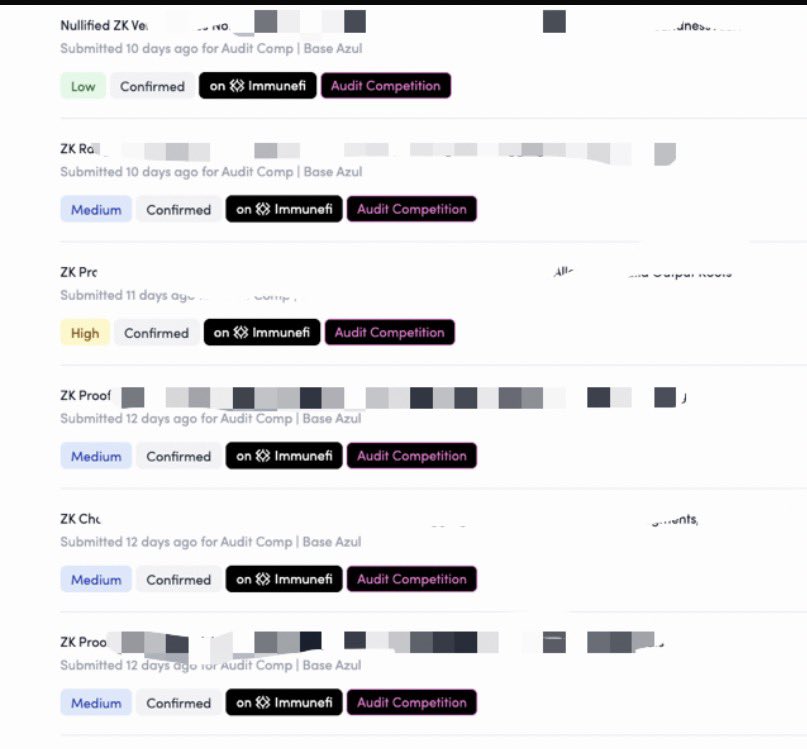
Started my Zk journey around February with the help of @kirkthebaird 🍃& @RareSkills_io ⭐️
Decided to implement a little of what we learnt in a few weeks.
I managed to find 6 ZK related bugs in the Base Azul Comp @immunefi
Happy to see it paid off even while I’m still learning.



![AndrewYNg's tweet photo. There will be no AI jobpocalypse.
The story that AI will lead to massive unemployment is stoking unnecessary fear. AI — like any other technology — does affect jobs, but telling overblown stories of large-scale unemployment is irresponsible and damaging. Let’s put a stop to it.
I’ve expressed skepticism about the jobpocalypse in previous posts. I’m glad to see that the popular press is now pushing back on this narrative. The image below features some recent headlines.
Software engineering is the sector most affected by AI tools, as coding agents race ahead. Yet hiring of software engineers remains strong! So while there are examples of AI taking away jobs, the trends strongly suggest the net job creation is vastly greater than the job destruction — just like earlier waves of technology. Further, despite all the exciting progress in AI, the U.S. unemployment rate remains a healthy 4.3%.
Why is the AI jobpocalypse narrative so popular? For one thing, frontier AI labs have a strong incentive to tell stories that make AI technology sound more powerful. At their most extreme, they promote science-fiction scenarios of AI “taking over” and causing human extinction. If a technology can replace many employees, surely that technology must be very valuable!
Also, a lot of SaaS software companies charge around $100-$1000 per user/year. But if an AI company can replace an employee who makes $100,000 — or make them 50% more productive — then charging even $10,000 starts to look reasonable. By anchoring not to typical SaaS prices but to salaries of employees, AI companies can charge a lot more.
Additionally, businesses have a strong incentive to talk about layoffs as if they were caused by AI. After all, talking about how they’re using AI to be far more productive with fewer staff makes them look smart. This is a better message than admitting they overhired during the pandemic when capital was abundant due to low interest rates and a massive government financial stimulus.
To be clear, I recognize that AI is causing a lot of people’s work to change. This is hard. This is stressful. (And to some, it can be fun.) I empathize with everyone affected. At the same time, this is very different from predicting a collapse of the job market.
Societies are capable of telling themselves stories for years that have little basis in reality and lead to poor society-wide decision making. For example, fears over nuclear plant safety led to under-investment in nuclear power. Fears of the “population bomb” in the 1960s led countries to implement harsh policies to reduce their populations. And worries about dietary fat led governments to promote unhealthy high-sugar diets for decades.
Now that mainstream media is openly skeptical about the jobpocalypse, I hope these stories will start to lose their teeth (much like fears of AI-driven human extinction have).
Contrary to the predictions of an AI jobpocalypse, I predict the opposite: There will be an AI jobapalooza! AI will lead to a lot more good AI engineering jobs, and I’m also optimistic about the future of the overall job market. What AI engineers do will be different from traditional software engineering, and many of these jobs will be in businesses other than traditional large employers of developers. In non-AI roles, too, the skills needed will change because of AI. That makes this a good time to encourage more people to become proficient in AI, and make sure they’re ready for the different but plentiful jobs of the future!
[Original text in The Batch newsletter.]](https://pbs.twimg.com/media/HIIb1VGaUAAZoAB.jpg)