The core of your Achilles tendon is mostly the same tissue you had at 17.
A Danish team dated tendon tissue from 28 people using carbon left in the air by the 1950s and '60s nuclear bomb tests. The tendon core matched the air from roughly the first 17 years of life. Muscle samples matched recent years, because muscle keeps rebuilding itself. (Heinemeier et al., FASEB J 2013)
That's one tendon, and the study only sampled its core. But it helps explain why a tweaked tendon in your 40s hangs around for months.
We're not doctors, but we read research all day, so I went looking for rehab trials that tested loading a sore tendon.
In a 2015 Copenhagen trial, 58 people with chronic Achilles pain did 12 weeks of either eccentric heel drops twice a day or heavy slow calf work three times a week. Both groups improved by about the same amount and still had the gains a year later. The heavy slow group made it to 92% of their sessions, compared with 78% for the heel drop group. (Beyer et al., Am J Sports Med 2015)
If a tendon is nagging you, I'd take three things from that trial:
1. Get it checked first, since a tear needs a different plan than a cranky tendon.
2. Pick the program you'll stick with. Both worked equally well, and more people kept up with the heavy slow one.
3. Give it the full 12 weeks before you judge it.
I'd bet on boring slow reps over anything you can inject. How long did your last tendon flare take to settle down?
People who kept training their free arm while the other one sat in a cast for 4 weeks lost almost no strength in the casted arm. The group that didn't train lost about 22%.
Researchers call it cross-education. You train one side, and the opposite side holds on to strength it would otherwise lose. They think most of it runs through your nervous system.
We're not doctors, but we read research all day, and this one is for anyone still rolling in their 40s who keeps getting hurt one side at a time. These are the 3 trials I found with hard numbers:
1. Andrushko 2018. 16 college students wore a cast on one forearm for 4 weeks. Half of them did slow-lowering wrist curls with the free arm 3 times a week. Casted-arm wrist strength dropped 2.4% in the training group and 21.6% in the group that didn't train. Muscle size held up too.
2. Magnus 2013. 51 women over 50 with a broken wrist. Everyone got normal rehab, and half also strength-trained the good hand at home 3 times a week. At 12 weeks the broken side gripped 17.3 kg vs 11.8 kg. By 26 weeks the gap was no longer significant.
3. Harput 2019. 48 people after ACL surgery. Starting 4 weeks after surgery, two groups trained the healthy leg 3 times a week for 8 weeks. Both got more quad strength back in the surgery leg than the rehab-only group, at 12 and 24 weeks.
How I'd use it after an injury:
Train the healthy side with the same movement, because the effect stayed with the muscle that was trained. In the cast study, wrist curls saved the wrist flexors and did nothing for the extensors.
Start early. Both injury trials started within the first month.
Three sessions a week was the schedule in all three trials.
These are small trials, and the cast study used healthy students with no actual injury. The wrist fracture edge faded by 26 weeks, and the ACL groups didn't hop any farther or score better on the knee questionnaire.
Clear any training around an injury with your doctor or physio first, especially after surgery.
My take: sitting on the couch while one limb heals throws away strength you could keep. When you got hurt last, did anyone tell you to keep training the other side?
3% of people on Wegovy reported hair loss in the weight-loss trials. On placebo it was 1%.
Zepbound's number was bigger for women: 7.1% vs 1.3% on placebo.
Both labels tie the hair loss to the weight coming off. I looked for a vitamin trial that reverses it and couldn't find one.
Did you notice shedding, and how many months in did it start?
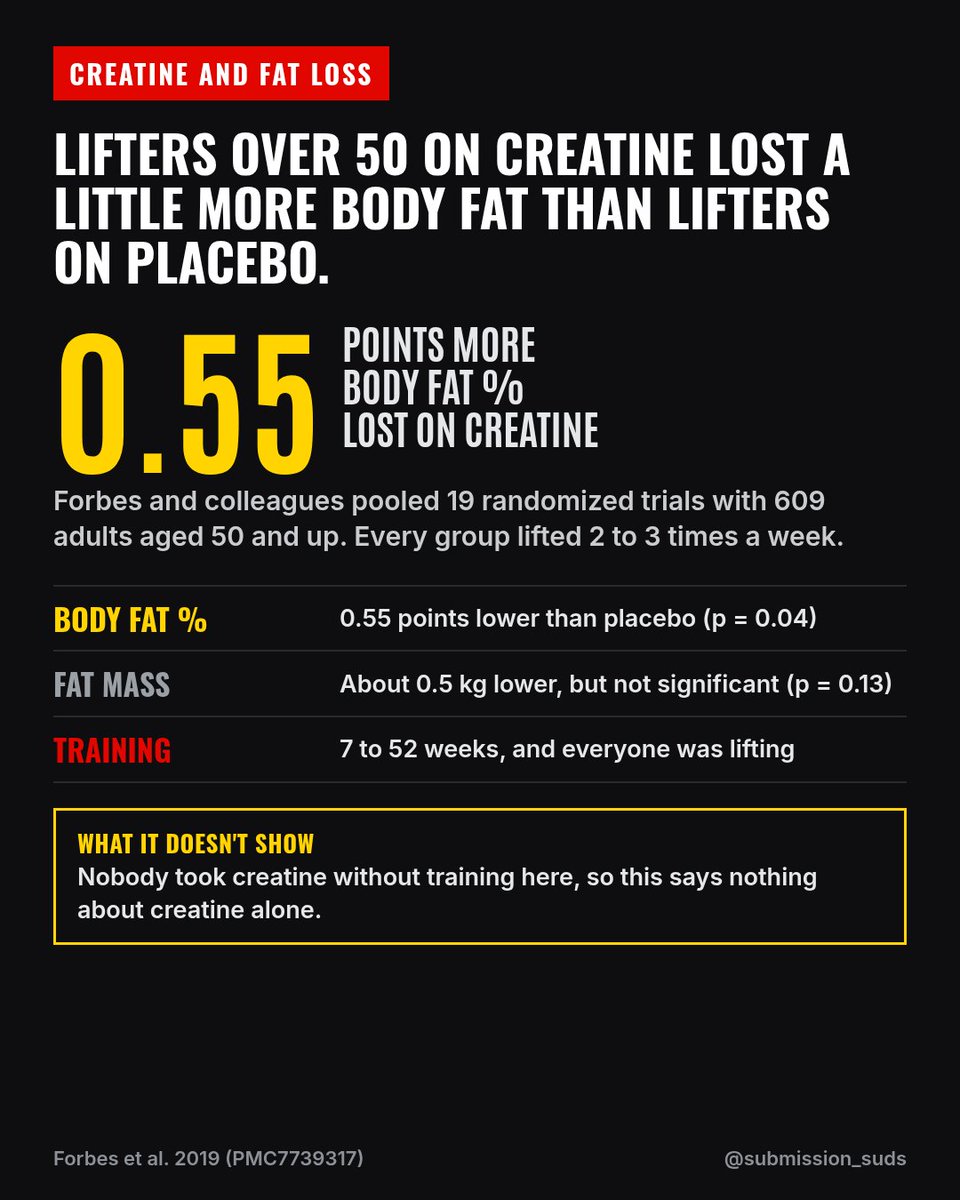
Lifters over 50 who took creatine lost a little more body fat than lifters on a placebo.
I went through the 2019 meta-analysis by Forbes and colleagues: 19 randomized trials, 609 adults, everyone lifting 2 to 3 times a week.
• Body fat dropped 0.55 percentage points more on creatine
• Fat mass came out about 0.5 kg lower, but that gap wasn't statistically significant
• Nobody got this from creatine alone, because every group was training
It won't melt fat. It might help you hold onto the work you're putting in.
If you're cutting right now, are you keeping creatine in or dropping it?
@arielhelwani mikey's leg locks will travel. the real test is the first time someone stands up and punches instead of engaging the guard, that's where every grappler's mma story starts
@ufc@KaylaH@paramountplus kayla on top for five rounds is a nightmare for anybody, but nunes only needs one clean exchange on the feet. best style clash on the card
@BrownleeMa41419@MMAFighting Abdullaev going from a 19-second Contender Series knockout straight into Mairon Santos is the one I'm watching. Dulatov vs Chokheli should be fun too.
@ChannelJak76249 Not at all. The law looks at how a product is labeled and marketed, so a creatine tub sold with muscle-building claims could fall under it. My point was that creatine isn't banned by name, and a plain tub with no weight-loss or muscle claims is a separate case.
Everyone saying California banned creatine for teens is wrong.
Governor Newsom signed AB 2030 on September 28. It takes effect January 1, 2027. What it covers is over-the-counter diet pills and dietary supplements that are labeled or marketed for weight loss or muscle building, sold to anyone under 18 in California.
Creatine is not banned. The law lists creatine as one factor a court can weigh when it decides whether a product counts as a muscle-building or weight-loss supplement. Label claims, marketing, and how a store shelves or groups the product matter too. A plain creatine tub sold without muscle-building claims is a different case from a pre-workout stacked next to fat burners.
Adults are not affected. Online sellers shipping into California have to verify the buyer's age through a database, or require an adult with photo ID to sign for the package. A seller who breaks the rule can face a civil fine of up to $500 per violation.
If you're the parent of a high school wrestler or grappler in California, this is the part to know. Starting in 2027, some muscle-building supplements will be harder for teens to buy on their own. That is an age-of-sale rule, not a science ruling on creatine.
We're not doctors. Talk with your kid's doctor before you decide anything about creatine for a teenager.
What have you been hearing at the gym about this law?
@rooflife123@hormonedietdoc Partly, yes. DXA counts the water inside muscle as lean mass, and creatine pulls water into muscle early on. The review that 1.4 kg comes from (22 trials) also found more chest press and leg press strength, which water alone doesn't explain.
Tired and sleepy are two different things. 😴 In 606 sleep-disorder patients, fatigue and sleepiness went together only moderately. Depression was the strongest predictor of fatigue, yet a poor marker of sleepiness. You can be worn out without being sleepy. 🧠 #Fatigue
https://t.co/8Nagt7kq60
Snoring through fight camp can be sleep apnea, and in this trial of adults with obesity, liraglutide cut breathing pauses about twice as much as placebo did.
12.2 fewer times an hour where breathing stopped or went shallow. That's what liraglutide did for sleep apnea over 32 weeks. Placebo got 6.1.
SCALE Sleep Apnea had 359 adults with obesity and moderate to severe sleep apnea who couldn't or wouldn't use CPAP. Weight fell 5.7% vs 1.6%.
This is liraglutide, the older daily shot, not tirzepatide.
The broken-wrist trial was all women over 50. For women that age who are thinking about adding creatine to their lifting, these are the tested picks we'd start with:
https://t.co/Lm9PcwV8Ov