We've taken the community's candid feedback on NOAH (SN82) seriously and made substantial changes. We're asking @const_reborn to review our progress and clarify where things stand on restoring emissions.
Our redesigned miner scoring allows miners to contribute TAO or any subnet alpha to the Ark, with scoring that rewards contributions, consistency and long term participation.
The next phase introduces additional miner work. Miners will report verifiable data that helps investors better understand subnet liquidity, the impact of selling significant holdings and concentration risk.
A temporary 98% miner burn is being introduced while we work toward restoring emissions. We also want to thank the miners who joined NOAH and supported us early. We recognize that this change could significantly affect their earnings, and we don't want those who supported us to bear the cost of that decision.
That's why we're reimbursing their original registration burn and providing additional compensation equal to their remaining locked collateral, funded by the owner wallet. Their original collateral will continue unlocking normally.
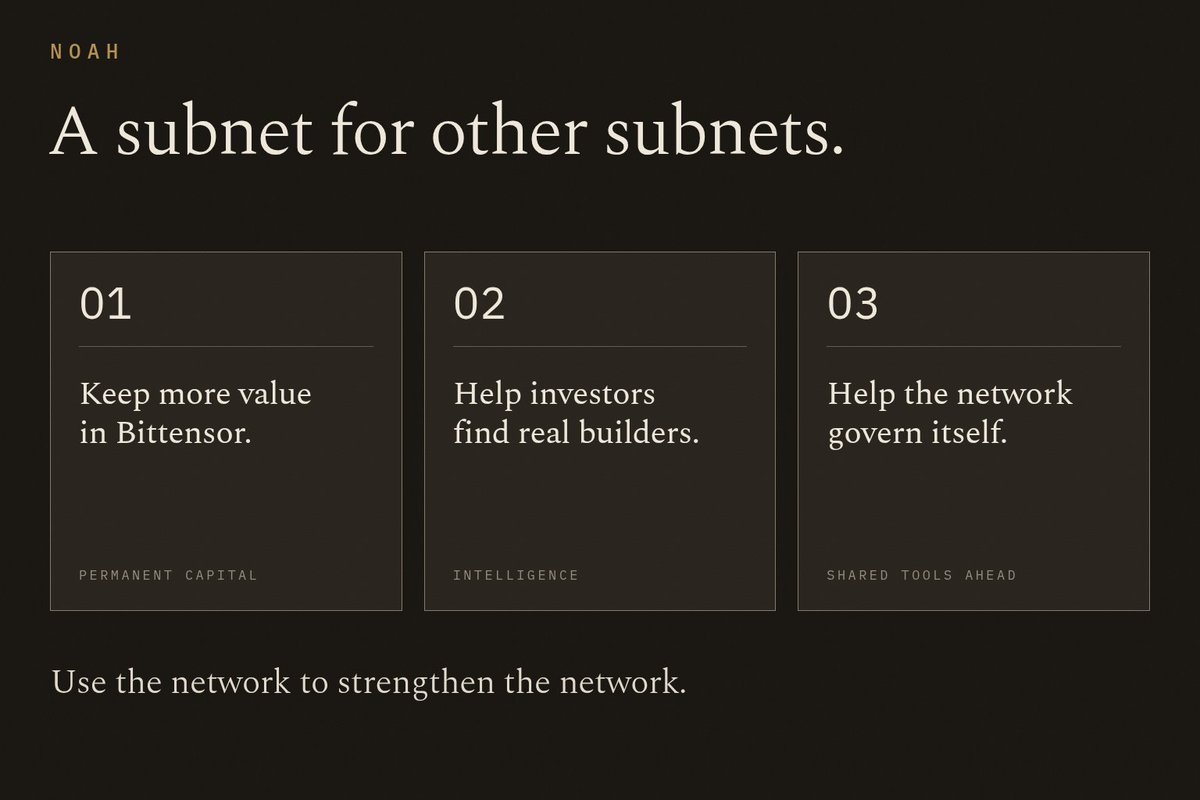
Our vision remains the same: build permanent capital for Bittensor, improve transparency so investors can better evaluate subnets, and develop governance tools that strengthen accountability across the network.
NOAH is still in its early stages. We've listened, made meaningful changes and are putting the next phase of our work forward for public review.
We're here to build.
SpaceX held the IPO record. Today Anthropic's sale tops SpaceX's opening raise and is on track for a new record.
You will hear big numbers today. A huge share of what trades can still be a small slice of the company.
In Bittensor, price is set by the pool, not by total supply. The Ark buys and holds tokens from across Bittensor as permanent capital, support that is not coming back to sell.
Pool composition matters, liquidity matters, and permanent capital is part of the equation.
@ShizzyUnchained We’re building SN82 around permanent capital for Bittensor. Miners help direct backing toward subnets through contributions to the Ark that cannot be withdrawn. The thesis is straightforward: teams building over years benefit from some backing that stays through market rotations.
@Tijmencrpt Backing that stays through development gives this another dimension. Teams can take months or years to build, and patient holders help support that process. At NOAH, we’re working on making a portion of that backing permanent so it can remain through market rotations.
For a team with a working product, that liquidity could bridge the gap between delivering a customer deployment and getting paid. It gives builders another way to finance progress while retaining their position. Matching repayment to the business’s cash flow is what makes that runway useful.
This helps explain why similar holder concentration can mean very different selling risk. Whether those holdings are liquid, committed for a period or permanently inaccessible changes the picture. Following that over time could also show how durable a subnet’s backing is becoming.
@Lex_Tensor@chutes_ai As a subnet’s business expands, revenue reporting can help holders understand how customer growth translates into more work for miners. Showing that connection makes the subnet’s role in the business visible and gives people a stronger basis for backing its growth.
@kin7371 Research teams need backing that can stay through the gap between experiments and a commercial product. Sharing results and milestones along the way gives patient holders something concrete to follow. That relationship can give ambitious work time to become useful.
Lower registration costs leave more of a team’s budget available for development and attracting miners. With a shorter immunity window, being able to prototype and test before registration becomes especially valuable. That gives builders a way to arrive with the product and contributors already taking shape.
Great video. Following one customer request makes Bittensor much easier to understand: what someone pays for, what the miner delivers and what the validator checks. It also exposes the important question for each subnet: how closely does the work being rewarded match what customers actually need?
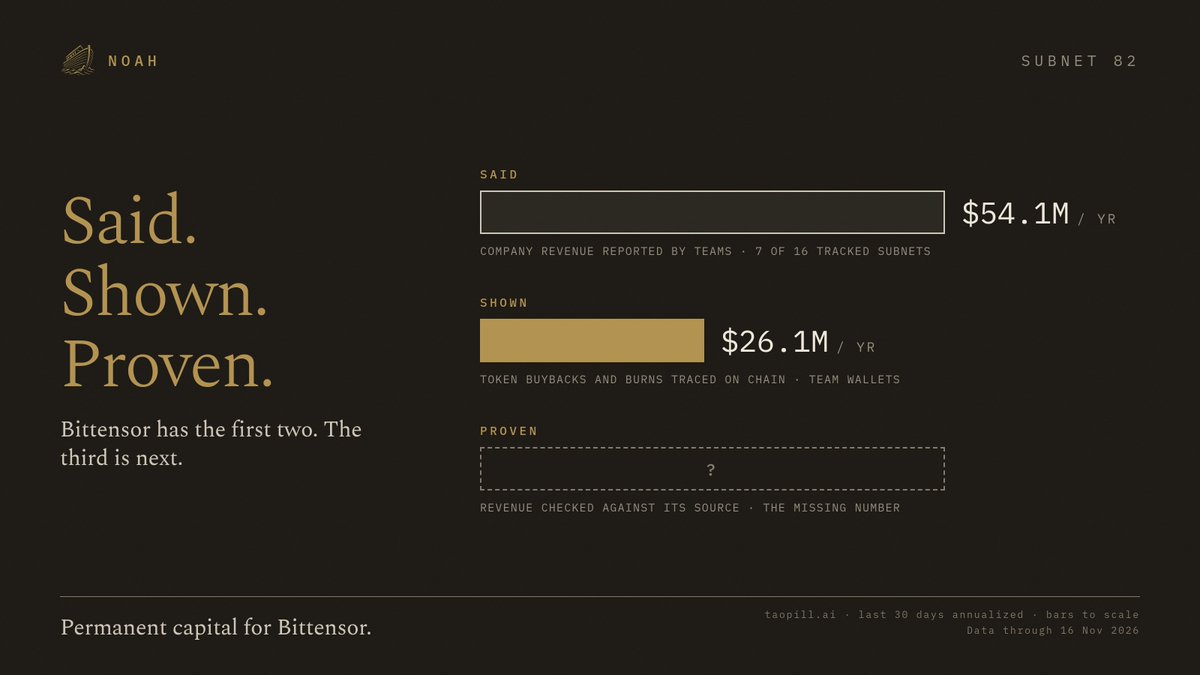
Across Bittensor, part of the value subnets create can already be traced on chain. Most revenue is still a number teams report themselves.
That is where the ecosystem is today, and it is a fair starting point. NOAH is building toward the next step: an incentive mechanism that rewards subnets for being transparent about what they earn.
What would full transparency be worth?
Good subnets also need holders whose time horizon matches the build. Staking APY comes from newly minted alpha, and selling those rewards adds pressure while teams are still building. Holders who retain those rewards help give builders time to develop the business, attract customers and earn lasting demand for the token.
What happens after a buyback matters too. Purchased alpha can remain available for resale, be locked for a period, or be permanently removed from future selling through burn or permanent holding. Those have different lasting effects. Showing how much coverage is temporary versus permanent would make this metric more useful across subnets.
The next step is making it easier for a builder to use several subnets in one product. Competitive compute, data and storage become much more valuable together when integration is straightforward and service is dependable. A customer choosing the finished product because it works better gives several subnets a reason to grow together.
The quality of that revenue matters too. Repeat customers and healthy margins give teams more choices: reinvest in the product, retain miners and fund buybacks without starving development. Seeing those numbers consistently would give holders a stronger reason to stay through volatility than a revenue headline alone.
Whales coming and going raises another question: how much of the value earned along the way stays committed to the subnet?
A holder can earn rewards for months and still eventually sell the entire position. Making a portion of those rewards permanent creates a different kind of backing: alpha that remains staked, with contributors giving up the ability to sell or reclaim it under current network rules.
That’s what we’re building with NOAH. It doesn’t prevent drawdowns, but it gives communities a way to build support that doesn’t depend on the next whale choosing to stay.
For subnet teams, the biggest opportunity here could be funding development between delivering a product and collecting customer revenue. That gives borrowing a productive purpose and a potential repayment source. The distinction worth watching is how much funds actual building versus buying more alpha. Both create activity, but they have very different implications for the network’s resilience.
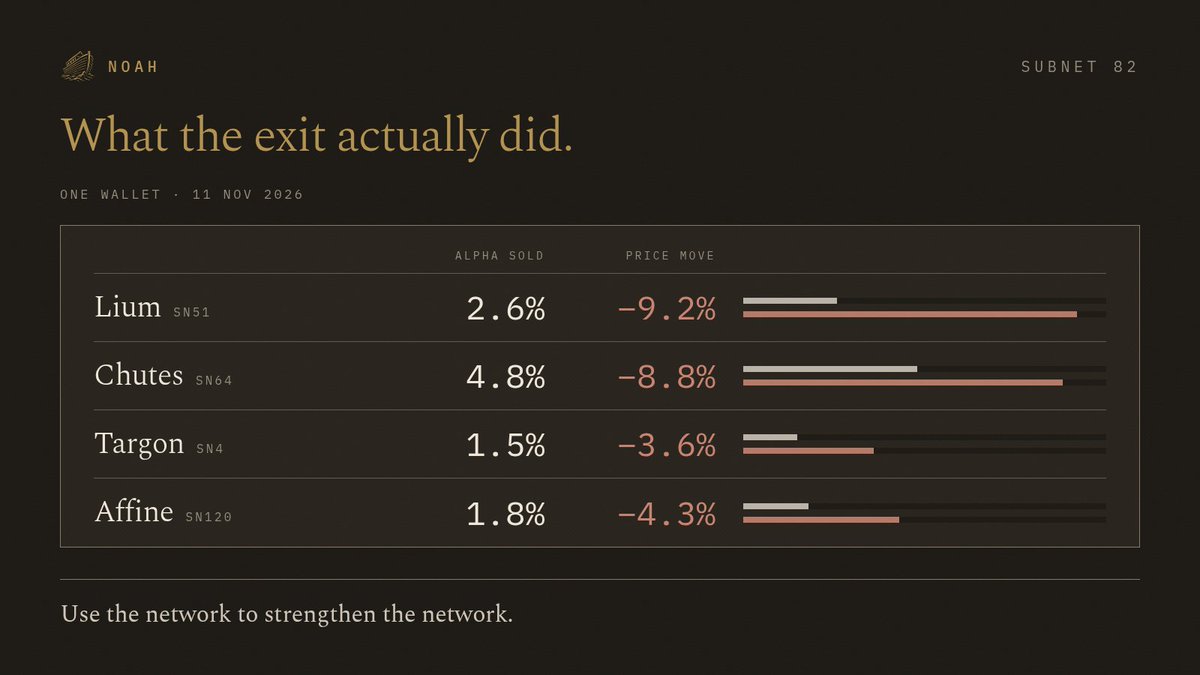
These are the same trades @CryptoZPunisher posted, measured against how much of each token was already staked.
The outsized effect comes from how the AMM works. What a trade gets, and where the token goes next, depends on how much TAO sits in that pool, not on how large the position is against the whole supply. A slice that looks small against all existing supply can still be large against the pool, and those mechanics are what drive it.
Pool composition matters, liquidity matters, and permanent capital is part of the equation.
🐋 ONE WHALE. 22,536 TAO. ALMOST $5 MILLION.
An interesting reminder of how liquidity works on Bittensor.
Around two hours ago, a series of large alpha sales appeared across several major subnets:
🔹 SN51 - Lium
🔹 SN64 - Chutes
🔹 SN4 - Targon
🔹 SN120 - Affine
Total: 22,536 TAO, worth approximately $4.95 million.
➡️https://t.co/06rtaN9V5J
And look at the second chart.
The percentage of TAO allocated to subnets dropped sharply, from approximately 17.55% to 17.38%.
The impact on the dTAO ecosystem is clearly visible.
But here's what I want everyone to remember:
LIQUIDITY WORKS BOTH WAYS.
If a major exit can put immediate pressure on alpha prices, imagine what sustained capital inflows could mean when the broader crypto market eventually shifts into a genuine risk-on environment.
I'm not suggesting every subnet will benefit equally.
Quite the opposite.
The strongest projects, with real products, genuine demand, and sustainable economics, should be the ones worth watching most closely.
Today, we're witnessing what happens when significant capital leaves the ecosystem.
Tomorrow, the opposite scenario is entirely possible.
Don't underestimate what a genuine risk-on cycle could mean for $TAO and Bittensor's strongest subnets.
Patience. Conviction. DYOR.
$TAO #Bittensor #dTAO
Your experiment uses forecasts to trade subnet tokens and grow a TAO balance. In broad terms, that’s closer to the quantitative trading approach of Renaissance Technologies. We’re building toward the other side of that equation: the fundamental research and lasting commitment associated with Warren Buffett.
Builders work over months and years, while capital moves in seconds. Our roadmap aims to encourage greater subnet transparency, giving our miners evidence of revenue, releases and technical progress to evaluate teams beyond token price. Those findings would help direct permanent backing toward subnets demonstrating useful work.
You raised concerns about NOAH’s usefulness and path to revenue. We have a planned path to outside revenue through financial research and governance services. We’ve been incorporating community feedback and are finishing updates to our launch phase, with phase two focused on subnet transparency and evaluation.
Trading signals can help identify when to enter or exit. Fundamental research helps assess what deserves backing and why. Combining those perspectives could be powerful: better information for people allocating TAO, alongside permanent capital committed to the teams building Bittensor.
@TAOFlows@TargonCompute@opentensor Revenue is the stronger signal of customer demand. Security answers a different question: whether people can safely keep supplying the capital and infrastructure behind those services. I’d look for both in adoption: customers returning and contributors staying.