More than 41,800 people have been killed in a year of Israel’s genocide against Palestinians in Gaza.
The health ministry in Gaza has confirmed the identities of more than 34,000 of them. Here are their names.
Hey everyone, I'm a wildlife ecologist studying free-roaming domestic cats and how urban environments influence their behavior and ecological impacts on native wildlife. Here to answer all your wildlife-related questions! As always, stay curious! #BlackMammalogistsRoleCall
Janelle Monáe wore custom #VeraWangHAUTE to the 2024 Met Gala “Sleeping Beauties: Reawakening Fashion.”
Janelle chose a custom crystal adorned halter gown with opalescent laser cut paillettes, hand strung crystalline beads and featuring sustainably recycled plastic bottles that have been hand molded into organically shaped flowers. Styled by @mandelkorn
#VeraWang #VeraWangGang #JanelleMonae #MetGala
states making it illegal to be unhoused while privately owned prisons exploit inmates with forced labor for pennies… united states capitalism relies on wealth disparity & exploitation… dystopia is NOW
How do we increase green space in our cities in an equitable fashion so residents (both human and wild) can be healthier, happier, and safer from climate change’s effects?
First, we must acknowledge that the inequity exists. https://t.co/xA05qa0VEz
THEE HOT GIRL SUMMER TOUR IS HERE and I’m bringing my girl GLORILLA WITH ME 🔥🔥🔥🔥🔥General Public tickets go on sale this Friday, March 22 at 10am your local time. Get ready hotties it’s about to be a timeeee 👏🏽👏🏽👏🏽 Can't wait to see y'all! ☀️ #hotgirlsummertour
https://t.co/AotTWplh5m
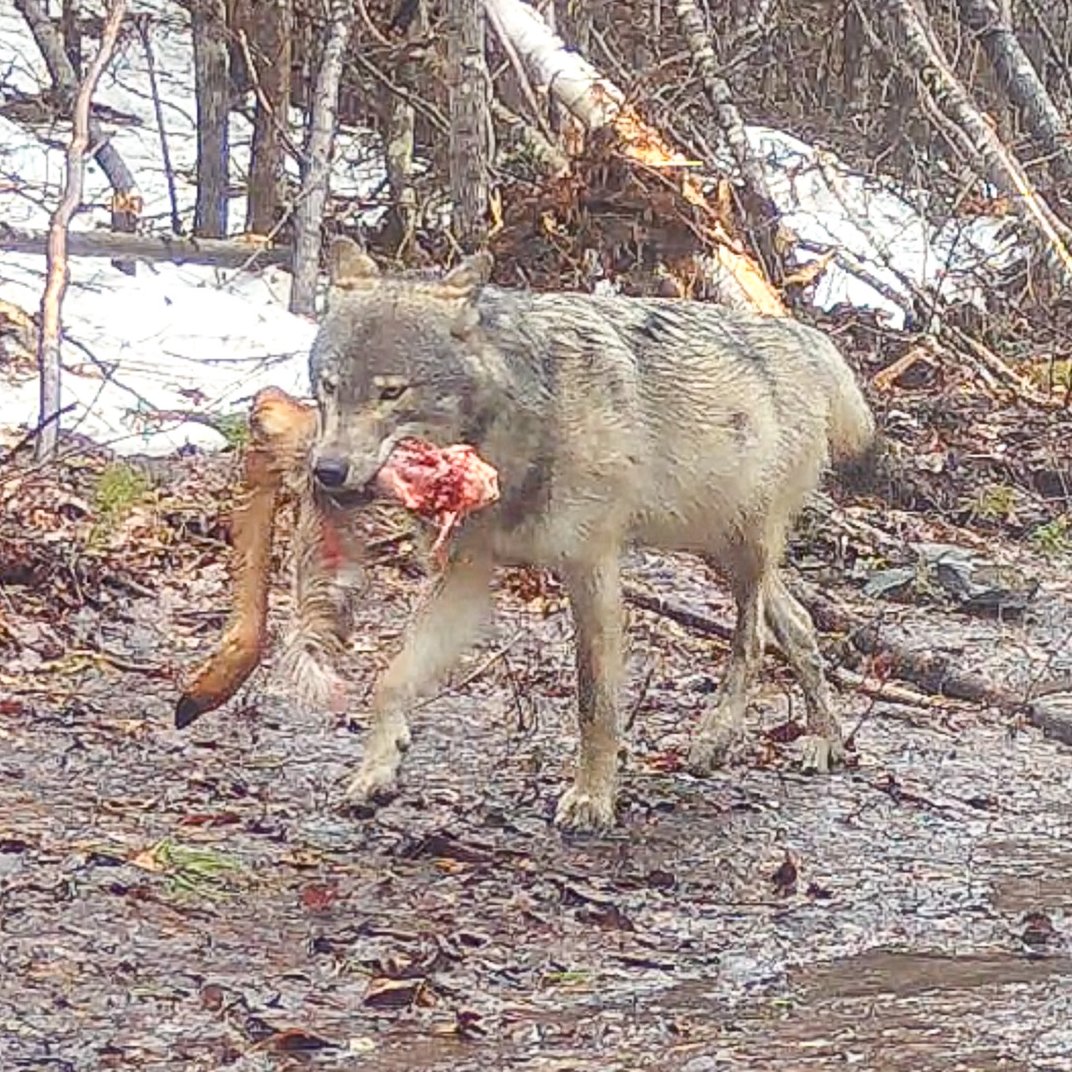
After a kill, wolves gorge and generally consume as much as they can as quickly as they can. The result: wolves often look like they have a basketball in their stomachs because they are so full.
And just how much food can wolves cram into their stomachs after a kill?
A researcher in Alaska documented a wolf that had 15 pounds (7 kg) of food in its stomach while a researcher in Minnesota documented a wolf with 22 pounds (10 kg) of food in its stomach. Another study reported a wolf with 19 pounds (9 kg) of food in its stomach.
Based on this and other observations, it appears wolves can consume ~25% of their body weight in one sitting. And why are wolves in such a hurry to eat their kills?
A couple reasons: once they make a kill, wolves are competing with numerous scavengers that descend on kills and want a piece. If you have ever seen a recent wolf-kill during winter, you cannot miss the flurry of ravens and eagles just waiting for their opportunity to eat.
Those birds might not seem like much competition but they can make a dent in a carcass quickly. Per one study, an individual raven can eat and/or cache 1.1-4.2 lbs (0.5-2.0 kg) of food per day from large kills.
While the exact amount of food ravens remove from a wolf-kill is hard to determine precisely, one study noted that ravens removed 82 lb (37 kg) of food per day wolf-killed prey.
Another study estimated ravens removed 31 lbs per day (14 kg) from carcasses put out to simulate wolf kills (and determine how much ravens can eat). However, the researchers noted that they very likely underestimated how much ravens removed and considered it plausible, based on raven biology, that ravens could remove up to 95 lbs (43 kg) per day.
Obviously, the amount of food ravens remove from a carcass will be related to the size of the prey killed, the number of birds present, the number of wolves at a carcass, and wolf feeding behaviors. Either way, it is clear that wolves are competing with their feathered foes for food.
The other reason for eating quickly is that wolves are often competing with each other for access to kills and therefore food. Wolf packs are not necessarily nice, polite families that doll out an equal amount of food to each member once a kill occurs. Instead, pack members, especially subordinates, are competing with one another for food.
Thus, it is advantageous for wolves to eat as much as they can when they get access to a carcass as a means to secure food.
As a side note: one of the main reasons young wolves are thought to disperse from their packs is due to intense aggression from other pack members, usually the breeding pair, when it comes to accessing kills.
Eventually young members reach the conclusion that the grass is greener on their own than with their pack and so they set off for the open road.
Lastly, wolves, especially breeding wolves, will consume kills quickly so they can transport food back to the dependent pups at dens and rendezvous sites and provision them. And it is sometimes easier to carry 20 lbs of food in your belly than in your mouth when doing so, or at least so it seems!
Anyway, all this to say: when you are watching a trail camera video of course and a wolf looks “pregnant”, it generally is not pregnant but rather has just gorged itself on a kill.
Sources referenced in this post:
1. )Peterson and Ciucci. 2003. The wolf as a carnivore in the book Wolves: Behavior, Ecology, and Conservation.
2.) Vucetich et al. 2004. Raven scavenging favours group foraging in wolves. Animal Behavior.
3.) Henrich and Pepper. 1999. Influence of competitor on caching behavior in the common raven. Animal Behavior.
4.) Promberger. 1992. Wolf and Scavenger. Master’s thesis, Ludwig Maximillians Universitat, Germany.
5.) Kaczensky et al. 2005. Effect of raven scavenging on the kill rates fo wolf packs. Wildlife Biology.
6.) Mech. 2020. Unexplained patterns of grey wolf natal dispersal. Mammal Review.
7.) Gable et al. 2023. Differential provisioning roles, prey size, and prey abundance shape the dynamic feeding behavior of gray wolves. Communications Biology.