The Theoretical Electrocatalysis Group is looking to recruit two PhD students. Please consider applying if you are interested in scientific programming, machine learning or electrocatalysis. Deadline: April 11. More details at: https://t.co/zroD6i6qCw
New pre-print on @arxiv describes our implementation of the Coulomb kernel truncation method in the Vienna ab-initio Simulation Package. We apply this implementation to perform DFT calculations of charged surfaces and molecules!
https://t.co/rKBt18ZPr6
Thank you, @CheEnggIITB! The Theoretical Electrocatalysis Group (https://t.co/EmTZ0jk781) will focus on developing electronic structure and machine learning methods to understand electrocatalysis at the atomistic level.
Welcoming Prof. Sudarshan Vijay @sudarshanv01 to ChemEngg @iitbombay as Asst Professor. An alumnus of BITS Pilani, PhD frm DTU, & postdoc at UC Berkeley, his research focuses on computational electrocatalysis & electronic structure code development. We wishes him the best 💐
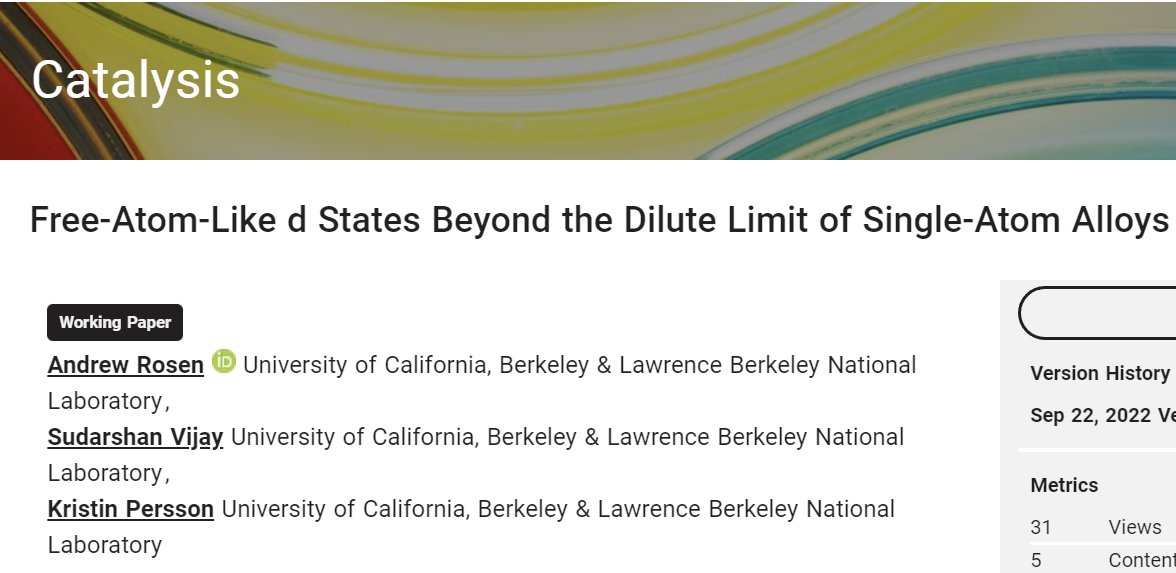
... and it's live! If you want to hear about the mysteries of "free-atom-like" electronic states in single-atom alloys and intermetallics, check out our work in @ChemicalScience! #MyFirstChemSci
https://t.co/NSfgSiqxGe
Huge thanks to co-authors @sudarshanv01 and @KPatBerkeley!
New pre-print on @ChemRxiv with @sudarshanv01 and @KPatBerkeley!
What if metallic compounds had electronic states not like typical inorganic solids but more like that of a free atom or molecular metal complex? Turns out, such examples may not be so rare!
https://t.co/t593g7Xu3V
Very interesting Editor's Pick on the binding of adsorbates to transition metal surfaces and the limits of widely used scaling relations from @sudarshanv01, Georg Kastlunger, @karen_chan_ecat, & Jens Nørskov @DTU_CatTheory. #catalysis
Read it here!
https://t.co/ue4CxCxja8
New paper! Ab initio study of CO2 reduction on FeNC single-site catalysts: CO2 adsorption and its dipole are critical and tunable descriptors of activity
https://t.co/qLMTmzTFAJ