The most important strategic asset in the Agent era is not the model, but the evaluation system; the real moat of the enterprise is not the knowledge base, but the transformation of long-term accumulated scenario judgment, business experience and organizational standards
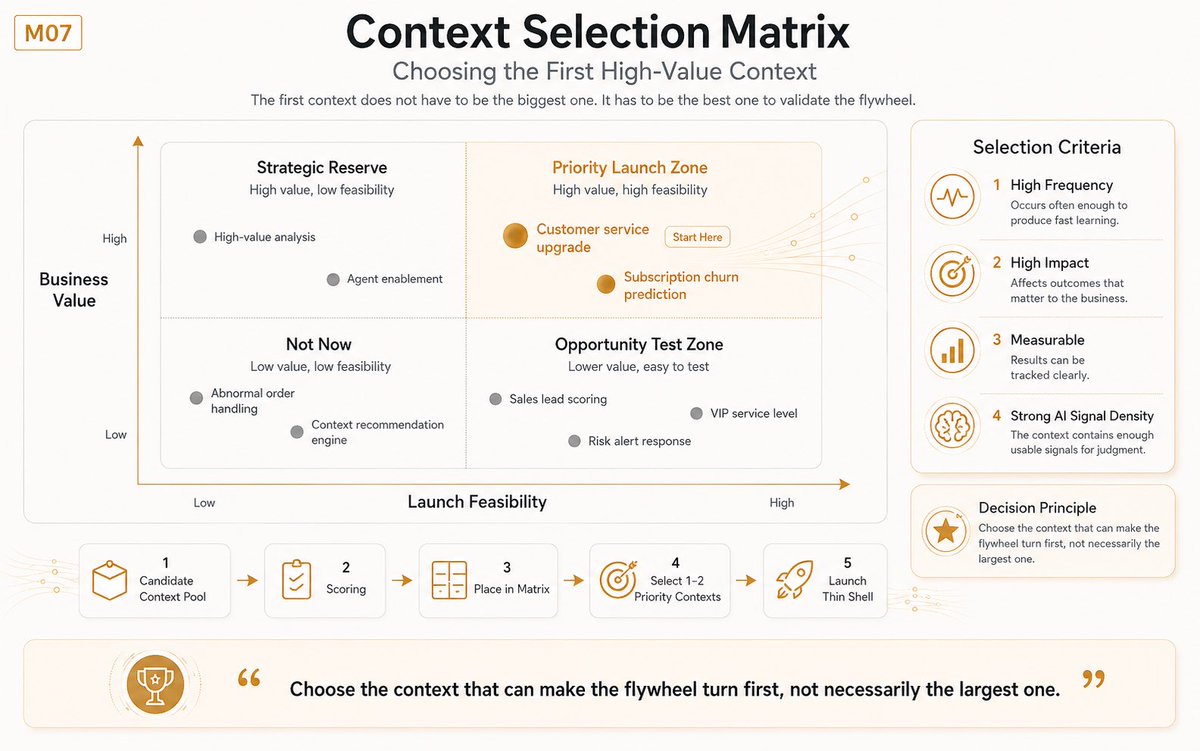
If you can only build context depth in one scene first — which one?
The instinct: pick the biggest, most strategic scene. Board loves it.
6 months later, it's too complex to move. Flywheel never makes its first turn.
Pick the scene that turns the flywheel first. Not the largest.
Open your AI spend. Categorize every line into C (context), I (interface), M (memory).
Most enterprises: 21% C / 73% I / 6% M.
That's exactly backwards.
Target: C ≈ 50% / I ≈ 20% / M ≈ 30%.
You're investing 73% in the layer that commoditizes fastest. Math fails at 24 months.
Your AI strategy — who actually decided it?
For most enterprises, the honest answer: nobody. 7 meetings and a budget reshuffle decided.
AI strategy isn't a tech decision. It's a judgment architecture decision.
That role has a name: Context Architect. Reports to CEO.
Your AI strategy — who actually decided it?
CTO? CDO? Product VP? Head of AI?
For most enterprises, the honest answer: nobody. 7 meetings and a budget reshuffle decided.
That's why it doesn't work.
AI strategy needs one role nobody has today: Context Architect. Reports to CEO
Spent 5 years building a data platform. Now your AI team can't get the data they need for agents.
Not a data platform failure. Category error.
Data platforms answer "what happened?" Context platforms answer "what should we judge right now?"
Different materials. Different value.
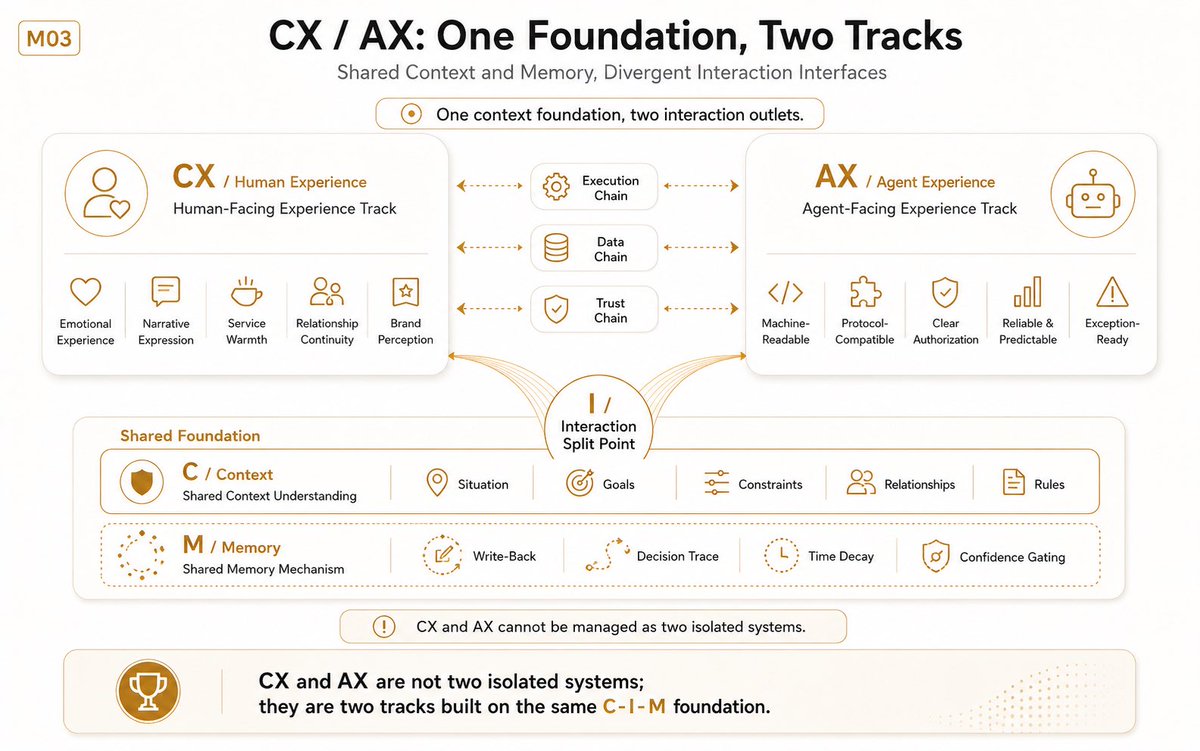
When did your CX team and your AI team last sit in the same room to discuss one customer's journey?
For most enterprises: never as a structural meeting.
CX and AX are not two systems. They share one C-layer and one M-layer — they diverge only at I.
The split is fatal by 2027.
Two companies bought the same AI platform last year.
A: usage flat. "The AI keeps forgetting what we told it."
B: usage tripled. "Every quarter it gets sharper at exactly our problems."
Same model. Same vendor.
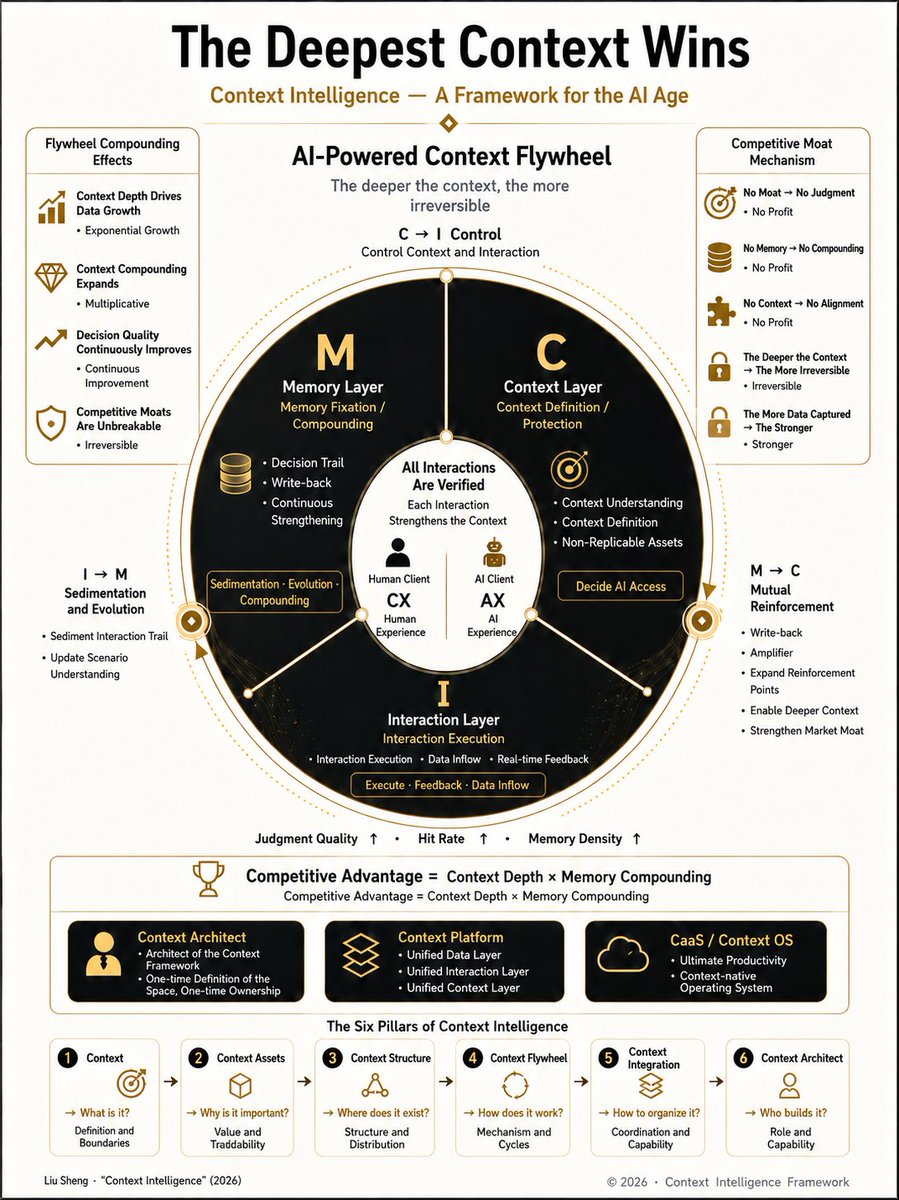
A bought a tool. B built a flywheel: C → I → M → C.
#AI#CIM
If you ask your AI team to draw "which business decisions our AI sees and which it doesn't" — most can't.
In 30+ enterprise workshops, only 3 teams could draw it without consulting code.
That gap is where competitive advantage leaks.
C-I-M is the fix.
Summary:
9 structural positions → 3 layers (C-I-M)
3 layers → 5 role families
5 role families → 1 organizational shift: from output-optimization to context-deepening
https://t.co/dto4Z6I0PI for the framework. Thanks @IntuitMachine for the original essay—the 9 positions are the strongest articulation I've seen.
Carlos's @IntuitMachine piece on 9 structural positions for AI-era jobs is the sharpest articulation I've read of why structural prediction works where content prediction fails.
I think the 9 positions integrate into 3 layers. Thread on the missing architecture.
One position Carlos names deserves more weight: Trace Compression.
When AI handles decisions, the question shifts from "what did it decide" to "how can humans see why."
Decision Trace—a flight recorder for AI decisions—is the governance layer this decade needs.