When one AI can do almost everything, does teamwork still matter?
I think it does. So I tried Teamily AI’s Loop alongside a single Codex agent for my content creation workflow.
As an AI creator, I research industry developments and explain complex ideas to beginners. Finding news, screening posts, analyzing sources and drafting content—AI already handles much of that groundwork.
But one question keeps bothering me:
Does it understand what I want my audience to learn, or does it simply select information that looks relevant?
If an unsuitable story makes the shortlist, I can catch it. If a valuable story gets filtered out, I might never know what I missed.
That is why I included discovery, selection, review and writing in this comparison:
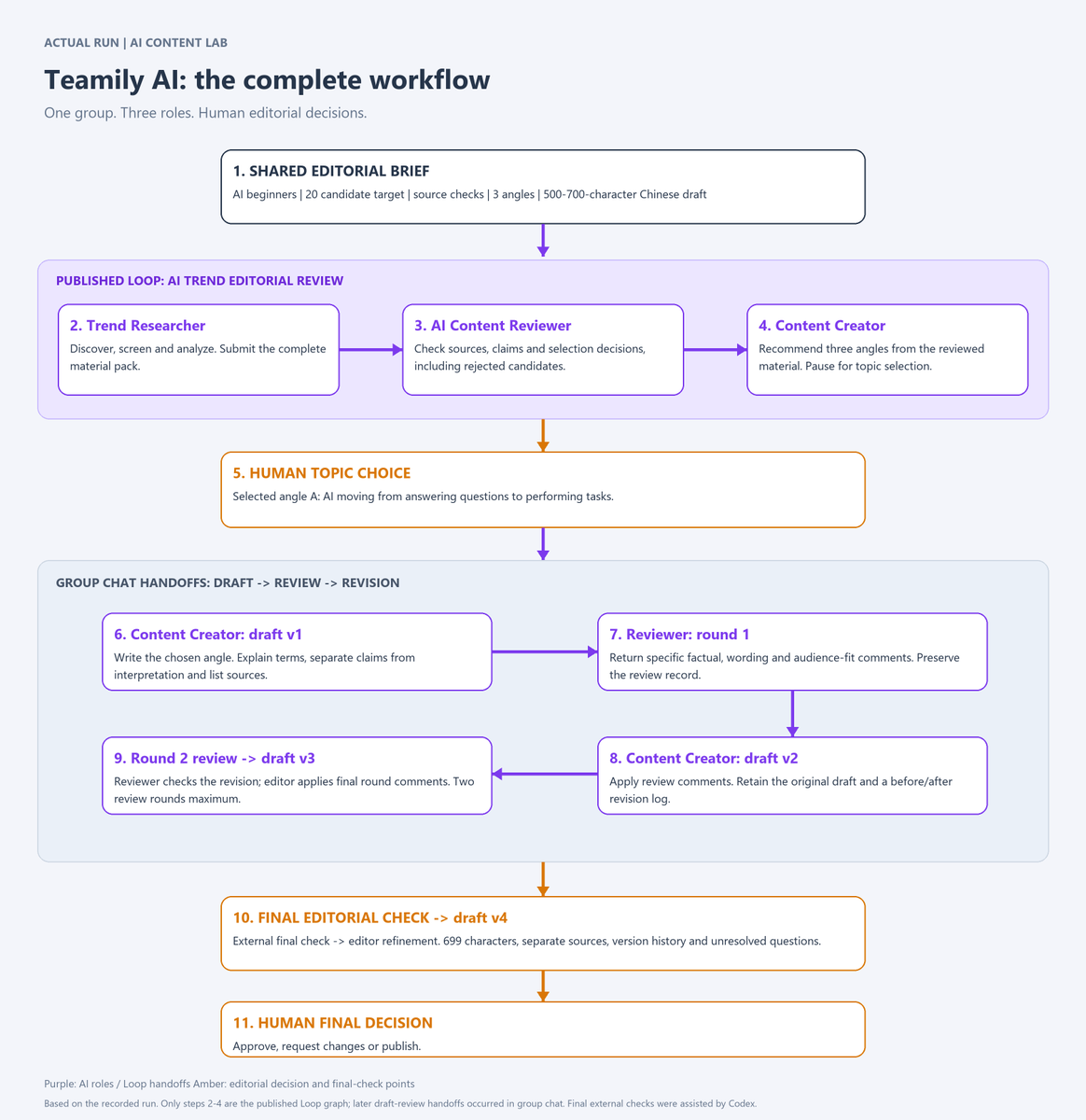
Both workflows received the same editorial goal. Codex handled research, drafting and self-review alone. In Teamily, Loop connected a researcher, reviewer and editor, drafting and revision continued through group handoffs.
Where did Codex fall short in this run?
1.Research delivery: I requested 20 candidates. Codex returned 7 unverified X leads and 3 supplemental stories, without usable engagement metrics. Teamily delivered 20 reported candidates with selection and review records—a fuller pack, though quantity alone does not establish quality.
2.Collaboration visibility: Codex preserved self-review records. Teamily made each role’s contribution visible- who gathered sources, questioned claims and implemented changes.
For me, Teamily’s strongest advantage was a process I could inspect, give feedback on and take over.
AI is my advisory team. My job is deciding what deserves attention, how to explain it and what ultimately reaches my readers.
@Teamily_AI
When one AI can do almost everything, does teamwork still matter?
I think it does. So I tried Teamily AI’s Loop alongside a single Codex agent for my content creation workflow.
As an AI creator, I research industry developments and explain complex ideas to beginners. Finding news, screening posts, analyzing sources and drafting content—AI already handles much of that groundwork.
But one question keeps bothering me:
Does it understand what I want my audience to learn, or does it simply select information that looks relevant?
If an unsuitable story makes the shortlist, I can catch it. If a valuable story gets filtered out, I might never know what I missed.
That is why I included discovery, selection, review and writing in this comparison:
Both workflows received the same editorial goal. Codex handled research, drafting and self-review alone. In Teamily, Loop connected a researcher, reviewer and editor, drafting and revision continued through group handoffs.
Where did Codex fall short in this run?
1.Research delivery: I requested 20 candidates. Codex returned 7 unverified X leads and 3 supplemental stories, without usable engagement metrics. Teamily delivered 20 reported candidates with selection and review records—a fuller pack, though quantity alone does not establish quality.
2.Collaboration visibility: Codex preserved self-review records. Teamily made each role’s contribution visible- who gathered sources, questioned claims and implemented changes.
For me, Teamily’s strongest advantage was a process I could inspect, give feedback on and take over.
AI is my advisory team. My job is deciding what deserves attention, how to explain it and what ultimately reaches my readers.
@Teamily_AI
From the @prlnet founders' AMA: "We invite people to build all different kinds of stuff to spread the distribution in terms of places and ways you can buy Pearl."
An ecosystem grows when more people build around it. We're adding to that with $PRL spot and perps (up to 3x).
From the @prlnet founders' AMA: "We invite people to build all different kinds of stuff to spread the distribution in terms of places and ways you can buy Pearl."
An ecosystem grows when more people build around it. We're adding to that with $PRL spot and perps (up to 3x).
From the @prlnet founders' AMA: "We invite people to build all different kinds of stuff to spread the distribution in terms of places and ways you can buy Pearl."
An ecosystem grows when more people build around it. We're adding to that with $PRL spot and perps (up to 3x).
From the @prlnet founders' AMA: "We invite people to build all different kinds of stuff to spread the distribution in terms of places and ways you can buy Pearl."
An ecosystem grows when more people build around it. We're adding to that with $PRL spot and perps (up to 3x).
From the @prlnet founders' AMA: "We invite people to build all different kinds of stuff to spread the distribution in terms of places and ways you can buy Pearl."
An ecosystem grows when more people build around it. We're adding to that with $PRL spot and perps (up to 3x).
From the @prlnet founders' AMA: "We invite people to build all different kinds of stuff to spread the distribution in terms of places and ways you can buy Pearl."
An ecosystem grows when more people build around it. We're adding to that with $PRL spot and perps (up to 3x).
From the @prlnet founders' AMA: "We invite people to build all different kinds of stuff to spread the distribution in terms of places and ways you can buy Pearl."
An ecosystem grows when more people build around it. We're adding to that with $PRL spot and perps (up to 3x).
From the @prlnet founders' AMA: "We invite people to build all different kinds of stuff to spread the distribution in terms of places and ways you can buy Pearl."
An ecosystem grows when more people build around it. We're adding to that with $PRL spot and perps (up to 3x).
From the @prlnet founders' AMA: "We invite people to build all different kinds of stuff to spread the distribution in terms of places and ways you can buy Pearl."
An ecosystem grows when more people build around it. We're adding to that with $PRL spot and perps (up to 3x).
From the @prlnet founders' AMA: "We invite people to build all different kinds of stuff to spread the distribution in terms of places and ways you can buy Pearl."
An ecosystem grows when more people build around it. We're adding to that with $PRL spot and perps (up to 3x).
From the @prlnet founders' AMA: "We invite people to build all different kinds of stuff to spread the distribution in terms of places and ways you can buy Pearl."
An ecosystem grows when more people build around it. We're adding to that with $PRL spot and perps (up to 3x).
From the @prlnet founders' AMA: "We invite people to build all different kinds of stuff to spread the distribution in terms of places and ways you can buy Pearl."
An ecosystem grows when more people build around it. We're adding to that with $PRL spot and perps (up to 3x).
From the @prlnet founders' AMA: "We invite people to build all different kinds of stuff to spread the distribution in terms of places and ways you can buy Pearl."
An ecosystem grows when more people build around it. We're adding to that with $PRL spot and perps (up to 3x).