@Andric1961 The intention may be noble — or perhaps not. But at that point, journalism turns into activism. And in 2026, there is no shortage of people willing to do activism for free. Why should anyone pay for it?
@Andric1961 The trap: Some colleagues already know exactly which historical and moral story they want to tell. Facts are fitted to it, contradictions dropped. And sooner or later comes the familiar line: “We must be careful not to support the wrong people.”
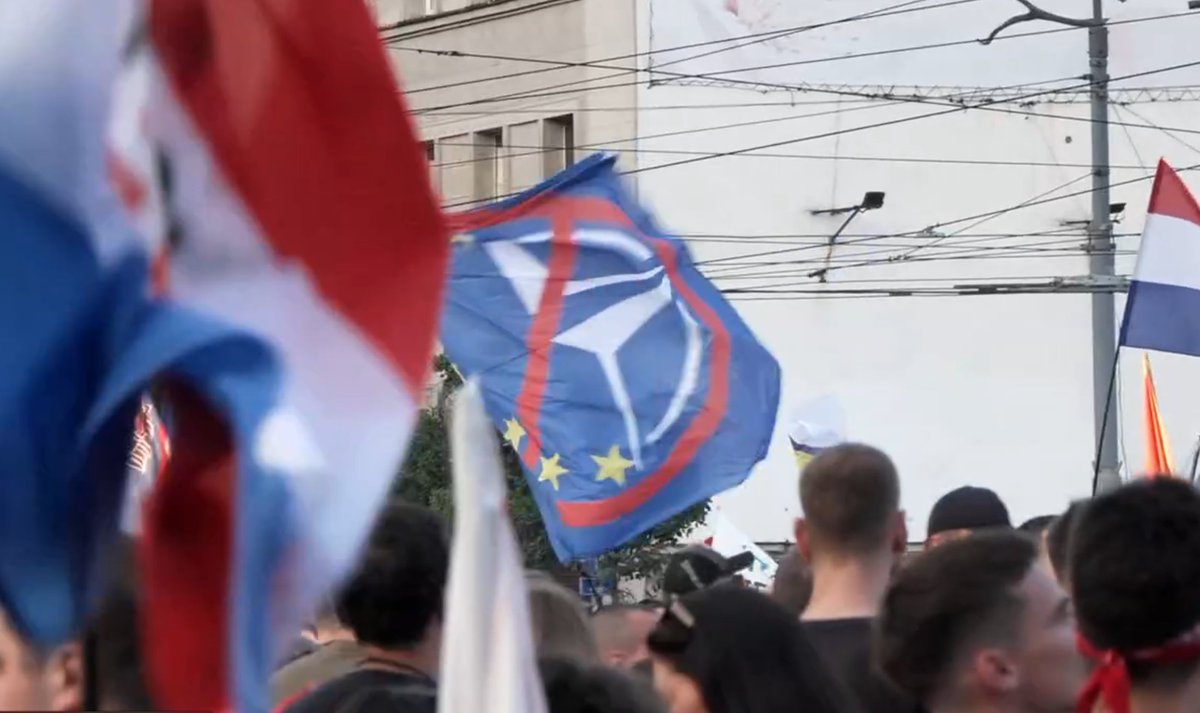
Perhaps this reminder was not needed after all. At the Slavija protests in May 2026, this flag carried a clear message: no EU, no NATO. It did not speak for everyone — but the number of EU flags I saw was exactly zero.
It will be interesting to see how Informer and Kurir frame Zelensky’s visit to Belgrade. The greater risk for Vučić may lie less in Moscow than at home — though few politicians are more practiced at walking this particular tightrope.
Meanwhile, Russia is active too. Two months ago, when Zelensky’s planned visit was postponed at short notice, these rather unsubtle love letters from Moscow were all over Belgrade — a little reminder of where the gas comes from.
Border delays make travel across the Western Balkans increasingly unpredictable. For travellers, it’s deeply frustrating; for trade and industry, an economic burden. Trucks lose an estimated 26 million hours yearly at the region’s borders, according to the World Bank.
Travellers waited up to ten hours in temperatures above 35°C at Croatia’s border with Montenegro, with similar reports from crossings into Bosnia and Serbia. In May, I spent more than four hours at the Serbia–Croatia border despite holding an EU passport.
EES is adding delays, but the deeper problems are chronic: too few lanes, slow processing, poor traffic management and infrastructure that can no longer cope with peak demand. https://t.co/R6meDgbUuT
Fact check: A routine diplomatic statement from 2022 is limited evidence that “Serbia loves Iran.” Belgrade maintains ties with Tehran, partly because Iran does not recognise Kosovo. Whether this makes Serbia unsuitable to host the OSCE PA is a separate question.
The new Belgrade–Budapest high-speed link is a major step forward. But Zagreb’s main station in 1996 recalls what was lost: direct international trains to Belgrade, Skopje and beyond. Today, there is not even a direct Zagreb–Belgrade train https://t.co/uBYVsT4y69 via @YouTube
@Andric1961 … but it follows decades of decline. I still remember the comfortable overnight trains from Munich to Zagreb, Belgrade and even Skopje in the 1990s and early 2000s. What I would really like to see now is the restoration of a direct Zagreb–Belgrade–Skopje rail link.
@Andric1961 Conclusion: People can change. They can also pretend to have changed. Or perhaps they were simply revealing who they had been all along. In Vučić’s case, that question may still be open.
@Andric1961 One of history’s ironies is that, at the time, Dodik was seen in the West as a moderate and a promising alternative to the nationalist establishment. That view was reflected in Foreign Minister Kinkel’s visit to Banja Luka — with badly needed financial support from Germany.
@SkenderVakuf You put Merz and Trump on the same level? Your local politicians must all be saints — never under pressure, never constrained by coalitions, never forced to compromise, and apparently governing in perfect peace and harmony.
Serbia 2026: A minister endorses ethnic cleansing. Her party leader and Deputy PM defends her.
A small piece from my archive, 2002: The same Ivica Dačić stands on stage as Milošević addresses an SPS rally from prison. Twenty-five years of continuity?