OpenSea at $1B+? The Market Is Pricing Inefficiency Again
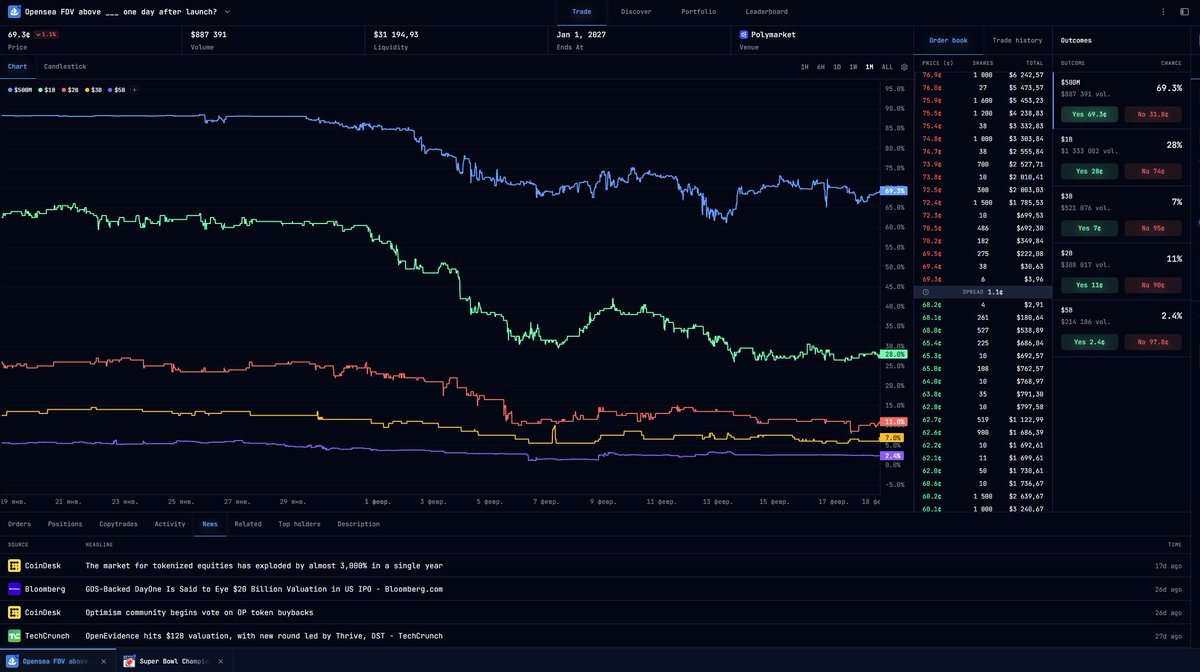
Polymarket currently assigns meaningful probability to a high FDV for OpenSea, but in my view, a launch above $1B looks unnecessary and inflated. With probabilities around 28% for those levels, betting on a lower valuation looks like a rational play.
Why
• The market
Sentiment remains weak. The fear index is high, liquidity is moving into stables, and there are very few buyers willing to step in. Of course, anything can happen, but for a valuation above a billion, something unusually strong would need to occur.
• Revenue and cross-sector comparisons
OpenSea is currently generating around $361k in monthly revenue.
For comparison:
Meteora generates about $5.34M per month roughly 14× more with an FDV around $212M. (i understand that the example is not very accurate, but rather simply shows the general situation on the market)
Yes, Meteora’s volumes may decline. But OpenSea has also likely already passed both its best and worst periods. The question becomes simple: why should the market value it many times higher than protocols that already earn significantly more?
• Capital follows narratives
Virtuals Protocol - AI, agents, Base - a narrative not just for now but likely for the next year.
The project earns roughly 3× more than OpenSea and has an FDV around $643M.
So why should an NFT marketplace, where retail participation continues to fade, be valued far higher than projects aligned with stronger narratives?
• Competitors inside the sector
Magic Eden is valued around $120M
Revenue data is limited, but looking at top collection volumes, the difference between platforms appears to be a few times, not 8–10×.
If we look at other sectors, leaders and close competitors often differ by 3-4× in FDV, not by an order of magnitude. That suggests a range above $500M is possible, but clearly below $1B.
• Airdrop mechanics and incentives
It’s important to understand that if they really do allocate a large portion of the airdrop to users, a high FDV becomes irrational, someone has to absorb that supply.
Sustaining a deep order book drawdown under heavy distribution pressure is simply not economically efficient.
• Timing
If the TGE were happening in a strong market, the valuation could be different.
But current sentiment is weakening rather than improving. The longer the launch is delayed, the more overall market mood will be reflected in falling expectations for FDV.
Conclusion
There are few logically grounded reasons to expect an FDV above $1B right now.
That doesn’t mean there’s no opportunity. The market rewards not only believers in upside, but also those who correctly price probabilities.
For me, positioning for a lower valuation and closing the trade later looks like a reasonable strategy in current conditions.
DYOR
Keep working
Terminal I use:
https://t.co/WvitKq2984
when you manage a treasury, a set of agents, or protocol upgrades, the hard part is not submitting changes
the hard part is understanding what those changes actually do
one proposal touches liquidity, another modifies agent permissions, a third schedules emissions
they live in different formats and timelines
nothing is directly comparable
an execution layer like ritual lets you run models on that stream of changes:
• convert each proposal into a state diff
• map which contracts, balances and roles are affected
• attach a quantified risk surface
• simulate outcomes across market conditions and agent behavior
• expose hidden dependencies between actions
the result is a single reproducible object that sits next to the change itself, combining summary, impact graph and risk profile in a form that can be verified and acted on.
analysis stops being external research and becomes part of the system flow
complexity does not disappear, it becomes structured enough for humans to navigate
if you don’t know what to do in crypto, i’ll remind you: a16z released their list of key ideas for 2026. here’s what it included:
‧ privacy will be the most important moat in crypto
‧ from “code is law” to “spec is law”
‧ prediction markets go bigger, broader, and smarter
‧ crypto offers a new primitive for use beyond blockchains
‧ thinking about tokenization of real world assets, and stablecoins, in a more crypto-native way
‧ we are now able to use AI for substantive research tasks
‧ trading as a way station, not the last stop, for crypto businesses
‧ the invisible tax on the open web
‧ the rise of staked media
‧ from know your customer to “know your agent”
‧ “secrets-as-a-service”
‧ better, more clever onramps/offramps for stablecoins
‧ wealth management for all
‧ stablecoins unlock the bank ledger upgrade cycle and new payment scenarios
‧ the internet becomes the bank
‧ the (near) future of messaging isn’t just quantum-resistant. it’s decentralized
‧ unleashing the full potential of blockchains… when legal architecture finally matches technical architecture
also, they elaborated on each of these ideas in more detail
crosschain clob breaks because there is no shared state and no shared ordering
without twine:
you have n chains -> n books -> n isolated collateral pools
before placing an order you bridge into the matching domain
during that time price moves, capital sits idle
there is no global order queue, only local books plus arbitrage between them
in vex, twine introduces three layers:
‧ sequencing: orders enter a single ordered flow, this becomes the canonical order state
‧ shared margin view: collateral is read cross-domain but not moved
‧ settlement: after matching, atomic netted messages settle in the domains where assets reside
matching happens against logical balances, before physical settlement
finalization requires ack from the collateral domain -> without it the trade does not commit
this is how double execution is prevented
why this matters for orderbooks:
depth only exists if all orders compete on the same timeline
routing between amms does not create a unified bid/ask. sequencing does
tradeoffs:
cross-domain latency -> slower finality vs local clob
any domain in the path becomes part of the atomic critical path
shared margin implies temporary credit exposure until ack
@twinexyz@Trade_VEX