raising pre-seed or seed? this one's for you.
you've spent weeks on Crunchbase, LinkedIn and dead-end lists, still guessing who writes checks at your stage.
i built the fix: 125K+ angels, VCs and PE investors, filterable by location, industry and stage.
free trial, full list.
This is it.
Everyone is excited about AI.
I'm not.
AI is the biggest commoditizer of human capability we have ever built. Doctors earn more than cleaners because expertise takes a decade to acquire and judgment to apply. AI is going to make most of that expertise available to anyone, at marginal cost.
The gap doesn't go to zero. But it shrinks. And the same thing happens in almost every knowledge profession. Programmers. Lawyers. Analysts. Traders. Designers. The taxi driver replaced by a robotaxi is the easy case. The harder ones are people who spent twenty years training to do something a model can now do in a second.
The one corner of human life I don't see this hitting is sport. Nobody pays to watch a robot beat a human. The whole appeal is humans competing against each other. That's why nobody watches Deep Blue play chess anymore.
From an investing perspective, the next decade plays out in three phases.
Phase 1 is the buildout. Hundreds of billions in capex on chips, data centers, and energy. This is what's driving today's market.
Phase 2 is the deployment. Productivity rises sharply, then deflation sets in as the cost of knowledge work collapses. Jobs disappear faster than the economy can replace them.
Phase 3 is the social adjustment. Capital becomes more powerful than labor. The biggest winners are likely to sit where AI cannot reach. Real assets. Energy. Commodities. Precious metals. Scarce land.
And there's something deeper than the economics. The Japanese have a word for it: ikigai. The reason you get up in the morning. Your vocation. Your purpose. The work that makes you feel needed. AI is coming for that too. Nobody has yet figured out what a healthy society does when most of its members no longer feel needed by anything.
I might be wrong. I hope I am.
If I'm not, the world is about to change faster than most people are ready for.
🚨 Everyone is watching the wrong bubble.
And missing the greatest opportunity in 40 years because of it.
While the crowd argues about AI and crypto, the real story is the asset sitting in every "safe" portfolio on earth.
Bonds.
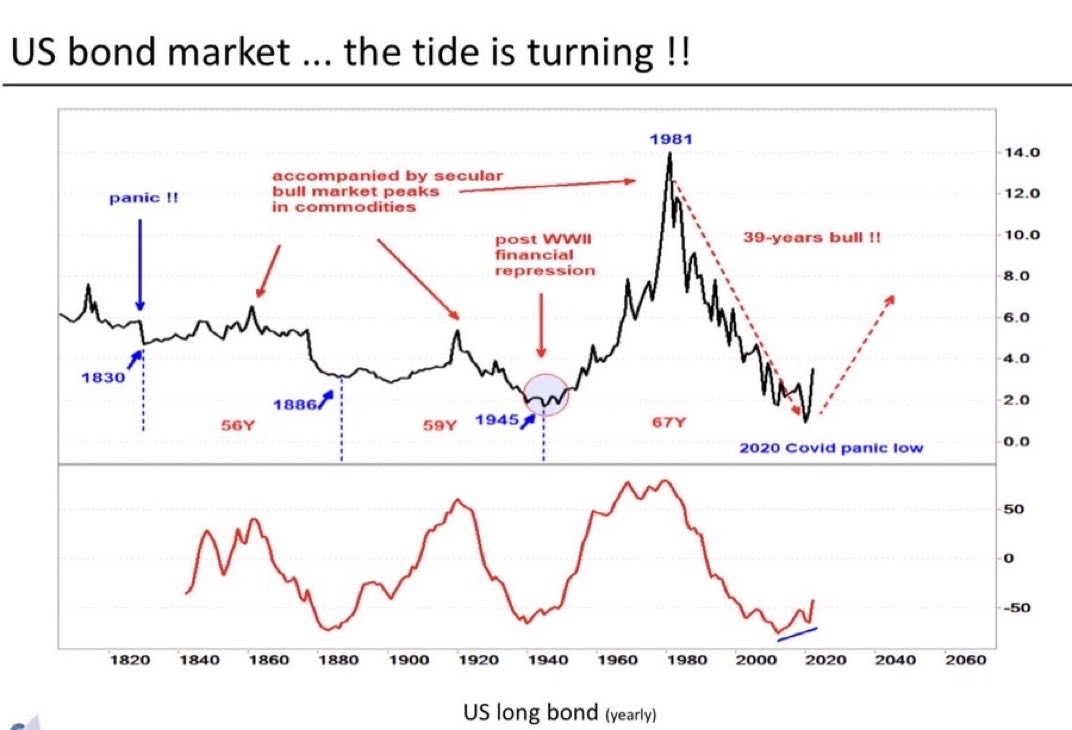
The 1981 top printed 14% yields. The 2020 bottom printed 0%. That was 39 years of falling rates, and it ended in a single Covid panic.
Covid was the turn. Rates hit zero, the system flooded itself with liquidity, and the 40-year bull in bonds quietly ended in the very moment everyone felt rescued.
That's reflexivity in the Soros sense. For four decades, falling yields lifted every asset, which convinced everyone yields would keep falling, which lifted assets again. Belief and reality reinforced each other all the way down to zero. Then the loop turned. And here's the part almost no one has grasped: a turn this big isn't the end of the game. It's the start of a far better one.
Here's why I'm genuinely excited.
For 40 years, falling rates lifted everything together. Correlations converged. The tide carried every boat, so owning the whole ocean beat knowing which boat was seaworthy. Index beat judgment. Skill was a rounding error.
That era is over, and what replaces it is the best environment for active investing in two generations.
When the secular tide reverses, dispersion comes roaring back. Winners and losers split apart violently. Suddenly the things that were invisible for 40 years, valuation, balance-sheet quality, real cash flow, pricing power, decide everything. The gap between the great business and the mediocre one stops being a footnote and becomes the whole return.
This is the world that made Buffett, Lynch, and Templeton. It's the world before 1981, where picking actually paid. It's coming back.
And it arrives at the most lopsided starting line imaginable, which is exactly what makes the opportunity so rich.
Concentration at a record. A handful of names carrying the entire index. Record IPOs listing at peak valuations and getting forced straight into peak index weights through mechanical, price-insensitive buying. The passive bid that everyone treats as ballast has become the marginal price-setter at the worst possible altitude.
JPMorgan's own Guide to the Markets makes the setup clear. Map starting valuation against subsequent ten-year returns, and today's level points to roughly zero percent per year from the S&P over the coming decade.
Sit with that. Zero from the broad index for ten years.
Now flip it over. If the average is zero, the spread around that average is enormous. Some things compound beautifully. Others go nowhere or worse. A flat index for a decade isn't a dead market. It's the richest hunting ground for active investors in living memory, because the distance between right and wrong has never paid more.
The whole architecture of modern investing was engineered for the era that just ended.
- Buy stocks and chill. Built on a discount rate going one direction. Down.
- The 60/40. Built on bonds rallying whenever equities fell.
- Just buy the ETF. Built on a 40-year tailwind no one managing money today has ever seen reverse.
That's the trap. And the mirror image of every trap is an opening for the people who see it first.
Strauss and Howe gave this moment a name. The Fourth Turning. The last of the four cycles, the Crisis, when the institutions built for the old era meet the conditions of the new one. These turns feel like danger to everyone clinging to the last playbook. They are the launchpad for everyone holding the next one.
The tide is turning. The old map is worthless.
And the greatest opportunity of our generation is hiding in plain sight, inside the thing everyone still calls safe.
Cloudflare open-sourced the security audit skill that seeded its own vulnerability hunting harness. Your coding agent can now run it on your code.
How it works, in 6 phases:
→ maps your codebase
→ hunts for bugs area by area so nothing gets skipped
→ sends every finding to a fresh agent that didn't find it, to confirm it's real
→ writes structured results
→ verifies each record again, independently
→ writes the final report
You get a findings file split into confirmed, needs validation and rejected, so you fix the real problems first.
Install:
npx skills add https://t.co/ptOfJggqQB --skill security-audit
Then open your agent in your project and type: "security audit this codebase"
MIT licensed, 31.3K stars.
Before you launch anything, have Opus 5.5 send 5 subagents in as your first users.
Paste this into Claude Code:
"Act as my launch QA lead. Spin up 5 subagents, each a different first-time user:
1. The impatient one: skims, clicks the first button, quits at the first error
2. The skeptic: reads pricing, terms and privacy before signing up
3. The mobile user: does everything on a 375px screen on slow 3G
4. The non-native English speaker: only follows what the UI literally says
5. The breaker: pastes junk into forms, hits back mid-flow, double-clicks everything
Each one opens the app in a real browser, goes from landing page to first success, and screenshots every moment they get confused, stuck or annoyed.
Merge everything into one list ranked by how many users hit it. Fix it all in one pass, then rerun the 5 users to prove it's fixed."
Your first 100 real users won't tell you why they left. these 5 will.
(Works best with a browser MCP connected, Playwright or Chrome DevTools)
Don't sleep on Claude Slides. This is how I make slide decks now -- no more googling "iphone frame svg" like the old days
Try it: https://t.co/cAWdwarzgp
Hi, I'm Felix. I'm an eng lead working on Claude. I love watching people take flight and do things they never thought possible.
We often describe that as "being more ambitious" when using AI, which is tricky advice to follow. I wrote a tutorial:
https://t.co/vNPPs5FWm8
how to build a working startup
> build product + landing page
> buy traffic
> analyze feature usage + surveys
> see which audience pays
> add features for that audience + delete feature that dont fit
> repeat repeat repeat
> update your copy
> adjust marketing towards target
> $
THIS IS A PURE F*CKING GOLDMINE
Anthropic just shared one of the best tricks for Claude Code.
The idea: let Opus 5.5 write the plan as a script, and let a swarm of cheaper agents run it.
Bigger jobs and way fewer Opus tokens, because the script holds the plan and Opus only sees the final answer.
You just launch Claude Code like this:
claude --model opus --effort ultracode
here's the split:
→ Opus 5.5 turns your task into a workflow script
→ Haiku 5.5 agents scan every file in parallel
→ Sonnet 5.5 agents patch each fix in its own isolated copy
→ you stop burning Opus context on a hundred agent transcripts
Opus only shows up at three moments:
→ writing the workflow before the run
→ reading the verified results after it
→ signing off before anything ships
Opus plans. Haiku scans. Sonnet ships.
JEV engineering is the same move one layer down: the forks that need no thinker (which file, which tool, retry or stop) go to JEV in milliseconds, and the big models only see the ones that split
the full tree
> Opus 5.5 runs the main session and writes the workflow
> scan audits every file on Haiku 5.5
> edit patches each fix on Sonnet 5.5 in an isolated copy
> verify cross-checks every finding on Sonnet 5.5
> Opus 5.5 reads only what survived verification
> JEV routes micro-forks in milliseconds
paste the tree and this prompt into Claude Code ↓
"Rebuild my Claude Code setup around this tree:
1. Run the main session on Opus 5.5 with ultracode on.
2. In every workflow, run read-only scan stages on Haiku 5.5 and edit stages on Sonnet 5.5, each edit in its own isolated copy.
3. Add one rule to CLAUDE.md: every finding gets an independent verifier agent before it's reported, and fix loops stop after two rounds with no progress.
4. Route fast deterministic forks (tool choice, path selection, retries) through JEV.
Show me every change as a diff first. No edits until I say go."
↳ https://t.co/1MiKDqGANA
save it, it'll come in handy.
Peter Thiel says Europe fears success:
"One of the things in Germany that people always talk about in this entrepreneurship context is there's a fear of failure. A 'no risk' culture... Perhaps there's also a fear of success."
"If you have something that works, you're not going to scale it to this extreme degree like an @elonmusk or @finkd. At some point you'll sell the company or exit."
"What's very striking is how few great new companies have been built in Germany in the last number of decades."
"If you look at the 50 wealthiest people in the US, only 12 are Gen X or younger—people born 1965 or later."
"In Germany, it's more distributed: 20 of the 50 people are Gen X or younger."
"But here's the difference—in the US, 9 out of 12 of those people made their own money. In Germany, all 20 of those 20 inherited it. Not a single person did something new, made some new money, built a large, new scalable company."
Via Mathias Döpfner
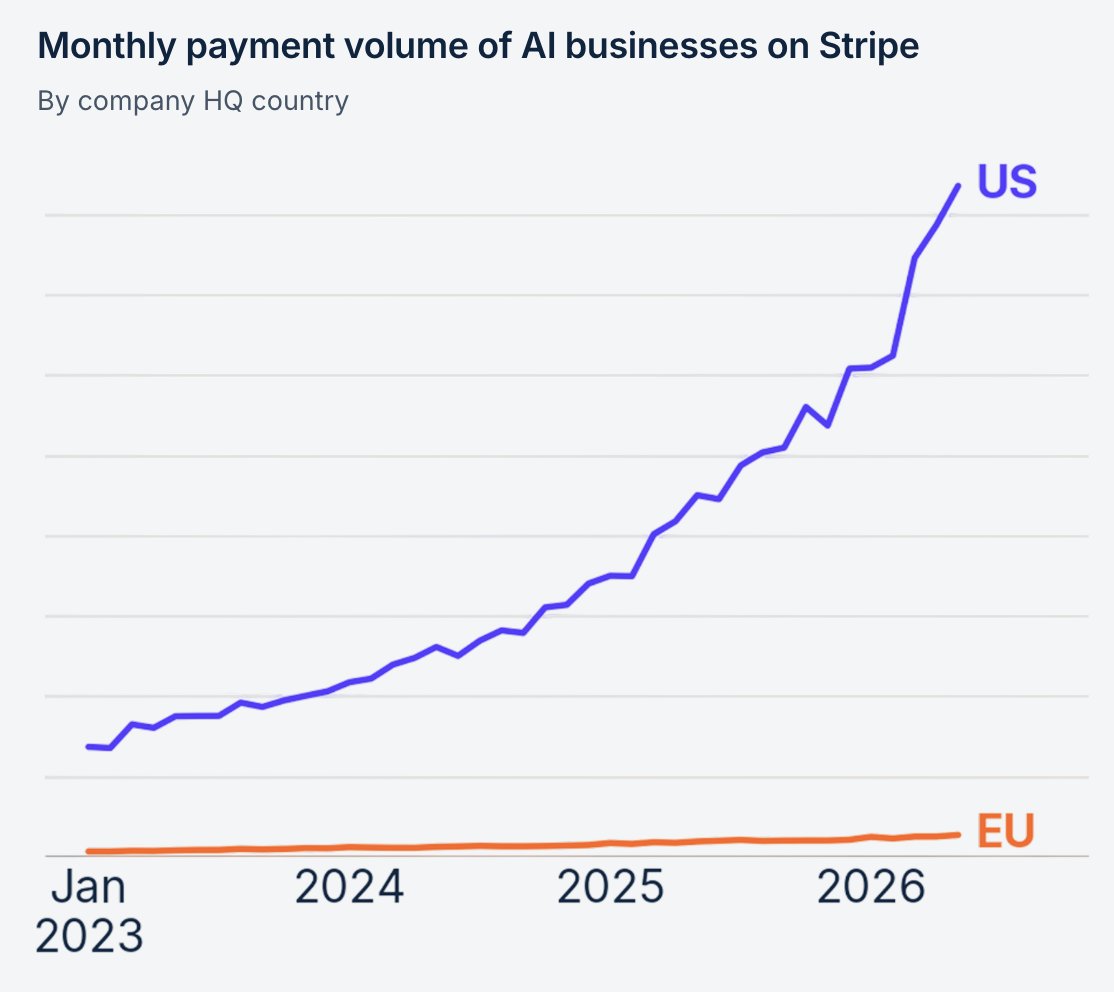
Some data we recently assembled on entrepreneurship/compute in Europe: https://t.co/x8pbpHLun7.
We hope that one of the useful roles that Stripe can play is in collecting and publishing empirical data pertaining to entrepreneurship and industry in Europe. There's growing appetite to get Europe on a better footing, and cross-sectional comparisons can often shine light on where opportunities lie. If you're interested in this kind of thing, we publish more at https://t.co/YoZDuYbaBi.
A CS undergrad asked me where he could have most effect in the AI age. I said probably at either extreme: either close to the technology, actually making LLMs, or close to the customer, using AI to give them exactly what they want. Or maybe both if you can stretch that far.
I tested 27 LLMs for AppSec.
Qwen3.8 27B it's just 🤯 it replaced Opus 5 in one of our production workflows at ~10x lower token cost.
I tested the generated rules on a real WAF.
https://t.co/v86wEvlf36
Learn to fine tune a model this year
Learn to fine tune a model this year
Learn to fine tune a model this year
Learn to fine tune a model this year
Learn to fine tune a model this year
Start small
Start slow
But make sure you start
You can run a Uncensored 8B-cybersecurity locally on Q2_K (3.2 GB) laptop. for pentest help, code review, CTF, bug bounty notes and threat modeling.
- no refusal on authorized pentest questions
- Dolphin3-Cyber-8B: abliterated abliterated with extra security flavor.
- Keep ctx near 2k that’s what the LoRA saw.
- Train on : custom-cybersecurity-dataset”: OWASP Top 10, MITRE ATT&CK, CVEs, exploit DBs, pentest methods
- Good for: code review, CTF reasoning, hardening checklists.
- If your GPU is 8GB, you can run properly
I’ve had 100s of engineers and new college grads ask me how to get a job at Apple. I tell them to go ship an app in the App Store and then I’d promise to at least hop on a call with them. Only 2 ever got back to me with a shipped app.
Most people won’t put in the work. Go put in the work.