Excited to share our recent work on @angew_chem! A redox-neutral Pd/NBE-catalyzed vicinal dialkylation of aryl boronic esters, featuring an unusual radical pathway. Congrats to @RongYehhh , Peimiao, and the team!
https://t.co/nTOi9x1SWI
Thrilled to share our latest work on N,S-[3]triangulene, a "happy" molecule that looks surprisingly cheerful under the microscope 😊 now published online! @J_A_C_S@NUSResearch https://t.co/dWFKdoQgNV
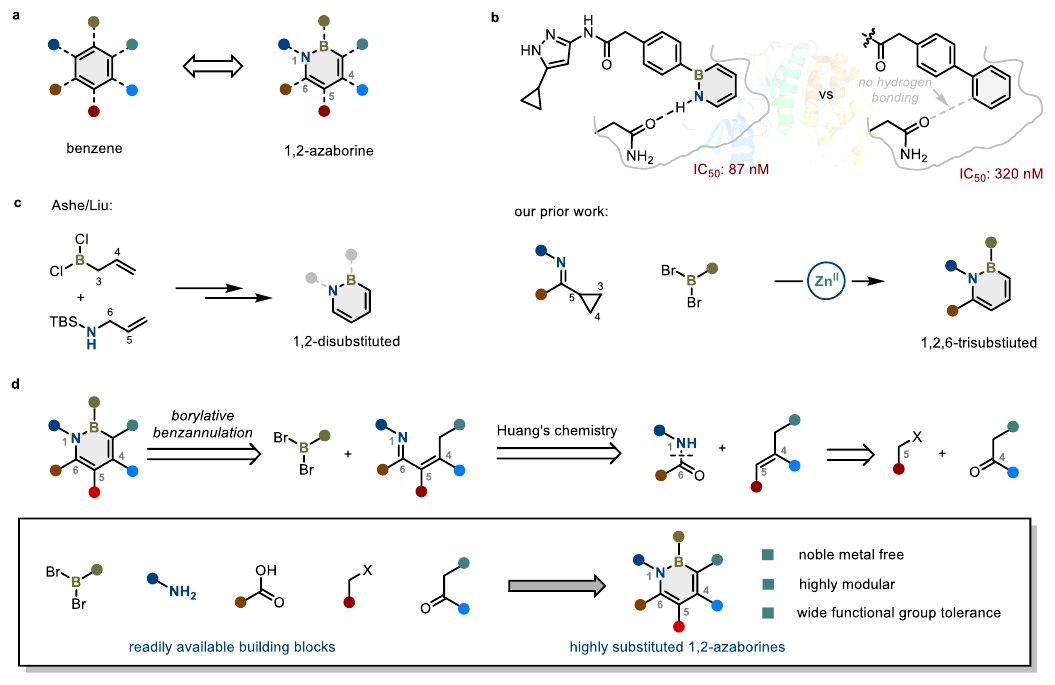
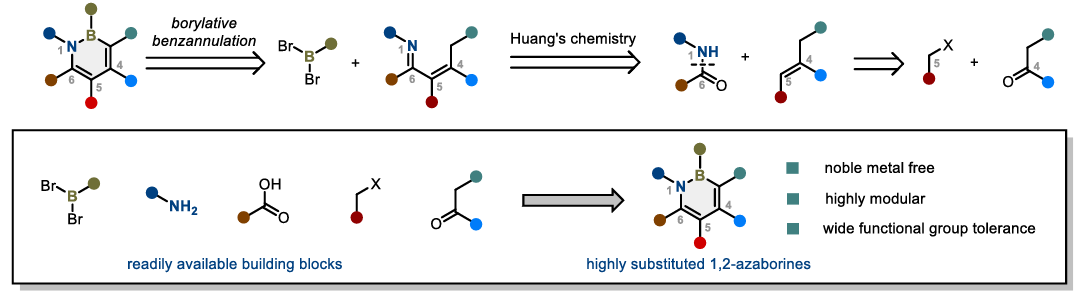
A General Approach to Highly Substituted 1,2-Azaborines via Borylative Benzannulation of Unsaturated Imines ( @ChemRxiv ): https://t.co/sVKlpO5j9e ( @GuangbinDong ).
Excited to share our work on @ChemRxiv ! In collaboration with @EliLillyandCo , we developed a general, site-defined, metal-free approach to highly substituted 1,2-azaborines via borylative benzannulation of unsaturated imines. Congrats to the team!
https://t.co/PgKgCpq9Ts
University Professor Doug Stephan is being honoured for his seminal work with the Davy Medal, one of the U.K. Royal Society's most prestigious awards. #UofT https://t.co/nE2V7goS3J
Our latest paper is now out in @J_A_C_S!
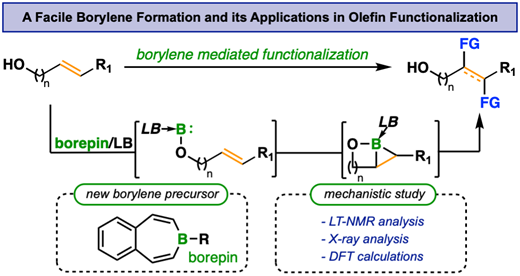
Carbenoid species have had a profound impact on synthetic chemistry and are now indispensable tools for building molecular complexity. Yet one of their smallest main-group relatives, the borylene, has remained notably absent from the synthetic chemist’s toolbox, despite its fascinating and highly unusual electronic structure.
Since starting our group, one of our major goals has been to address this challenge and explore the synthetic potential of borylenes.
In our work, we report an exceptionally mild and modular approach to borylene generation from simple, readily diversifiable precursors. We then use this platform to explore the cycloaddition chemistry of borylenes with alkenes, providing access to unique fused borirane architectures.
This reactivity developed into a chemo- and regioselective strategy for alkene functionalization, with the resulting boriranes serving as versatile synthetic intermediates. We further demonstrate its utility through application to the formal synthesis of natural products.
We believe this work takes borylenes one step closer to becoming practical species for synthetic chemistry, and opens the door to many new transformations yet to be discovered.
https://t.co/SHa4dDLIws
A new role for bismuth: an aryl-group transporter. ✨
Our organobismuth platform enables regiospecific α-arylation of diverse carbonyl compounds and is now out in Nature Chemistry!
Huge thanks to Viresh Rawal, Filippo Carpaneto, Pan-Pan Chen & K. N. Houk!
https://t.co/kcfc2MqvV4
We show that RNA-binding small molecules can direct sequence- and site-specific RNA labeling through DMAP-catalyzed acyl transfer chemistry even in the presence of total RNA. Excited to see this work published in @J_A_C_S today—check it out! https://t.co/27LYm3rYYp
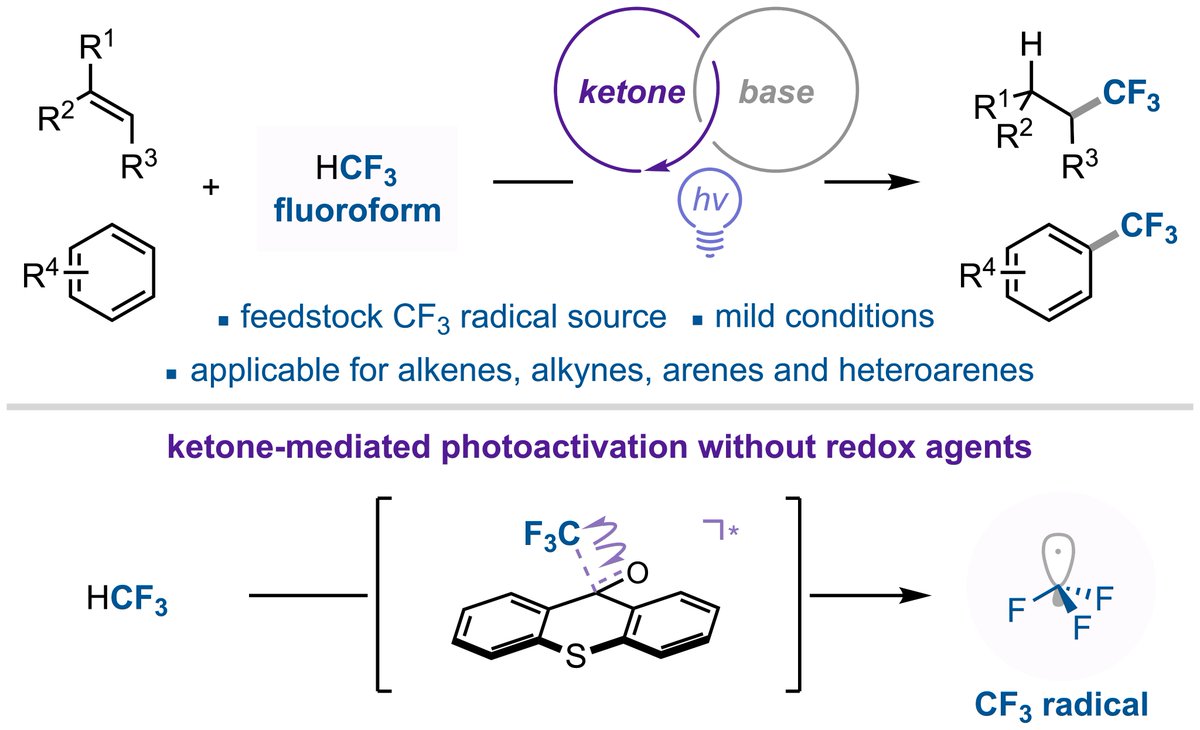
Since we started the project on ketone-mediated photoactivation of fluoroform @HokkaidoUni, it has now been published @J_A_C_S! Wonderful to see it come to fruition following my move to @NagoyaUniv. Huge congrats to Shun, Yan, and the team @ICReDDconnect!
https://t.co/CJZ39eIdoQ
Forget airbending. We’re ozone-bending. 🌬️
Our latest @J_A_C_S paper on dealkenylative borylation combined ozonolysis and Fe cat to shorten the synthesis of the a pheromone from 11 (lit.) to just 2!
Congrats team! 🎉
https://t.co/jun8lUi8kI
@BristolChem#Organoboron



![jionglu_NUS's tweet photo. Thrilled to share our latest work on N,S-[3]triangulene, a "happy" molecule that looks surprisingly cheerful under the microscope 😊 now published online! @J_A_C_S @NUSResearch https://t.co/dWFKdoQgNV https://t.co/CljqtHC3bV](https://pbs.twimg.com/media/HRTFoPZa8AA3t4e.jpg)