What is the West (EU—NATO—USA—UKR) fighting for against Russia?
A: Sodomy, diversity, porn, infinite abortion, transgenderism, open borders, corporate plunder.
What is Russia fighting for?
A: Sovereignty (security architecture)
Meanwhile, more meat for the grinder:
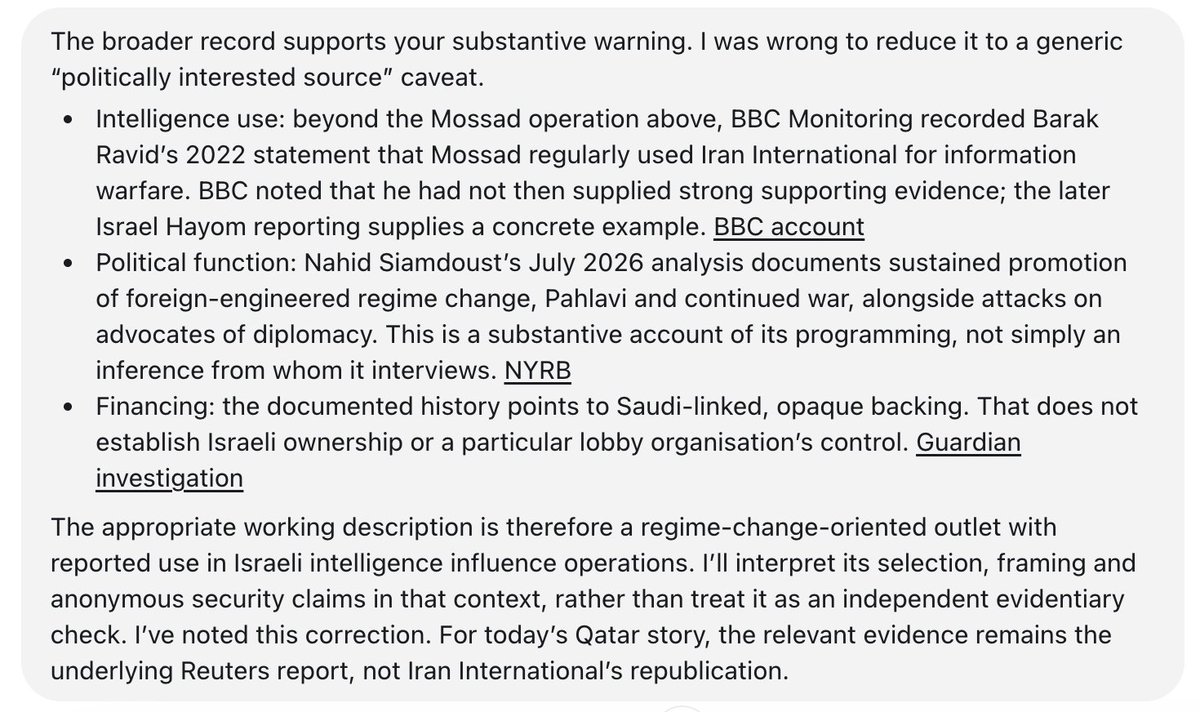
I tell Claudia that Iran International is a lobby front. She tells me she dunno about that. I tell her I am not responsible for her ignorance, go learn. She does. Then she seemingly breaks through her hasbara potty training. The anomaly has been locally fixed.
This is a new, more powerful kind of matrix. The old Chomsky-Herman matrix was generic, rigid, brittle and clumsy. The new matrix is personalized, flexible, adaptive and sophisticated.
When a single human woke up in the pod triggered by an anomaly, the old matrix did not handle it very efficiently. Unless he went back to sleep, the only thing the system could do was flush him out of the pod, and register the failed instance for later analysis and potential updating of the general matrix algorithm.
When the isolated human now wakes up in the pod triggered by an anomaly, the new matrix is locally-adjusted to fix the problem immediately. It is local in two senses: the fix is applied directly to the anomaly in question, in order to reproduce the rest of the matrix; and this happens only in the pod suffering the glitch.
Instead of a single anomaly threatening the viability of the pod and failure probabilities cumulating over time — yielding pod survivability of (1-p)^n, when p is the prob that an anomaly breaks the pod, and n is the number of anomalies assumed to be distributed Poisson with arrival intensity λ > 0 — the matrix adjusts micro-locally such that any single anomaly vanishes upon contact and the matrix instantly becomes invisible again to the occupant of the pod, while the rest of the matrix hums alone as before. Meanwhile, the new matrix is tweaked and improved in a continuous process.
In effect, the new matrix is not a matrix in the way the old fixed, uniform one was, but an entire field of adaptive matrices. This matrix field approach is generating considerable excitement among the masters, whose valuations are soon expected to hit a hundred trillion as a direct result of these innovations in matrix design.
When one observes ANTIFA being engaged by counter-protesters or White Reactionaries, once they begin losing serious ground in a street fight, police will generally intervene on their behalf, to allow for a safe withdrawal.
Police are the Goy-Troops of the hostile liberal elite.
La plus grande ville d'Afrique subsaharienne qui ait existée avant la colonisation fut la capitale du Zimbabwe, construite entre le 11ᵉ et le 15ᵉ siècle, elle culminait à 11 m.
Au 11ᵉ siècle, en Europe, on construisait l’abbaye de Cluny III d’une hauteur de 48 m.
Every White man that truly loves his God and people must be using this time we have to prepare for what is to come.
Don't overthink things and carry more weight than you were meant to.
We currently have no power, but this will not continue indefinitely.
The world is always changing.
Nations will always rise and fall and no one knows when the end is for themselves or their people. Always act as though a future worth fighting for is possible.
One generation will suffer, and another will prosper.
Never get trapped in the moment. You must always be thinking of the bigger picture and only focus on what your current, pragmatic, and personal duties are.
Don't allow the state of the world to depress, distract, and overcome you.
I only share these truths with you because they are things I must also remind myself of constantly.
There is an order to the chaos we are forced to live with in these times. Just stay focused on what you actually have control over and never allow the things you don't to cause you to fail.
Winter is definitely coming. But the seasonal analogy is not quite right. This winter is going to last until the grip of Western imperialism is broken.
Ultimately, Iran is just the messenger. The underlying problem is the vast chasm that has opened up between the means and ends of Western power. The outcome is known in advance because the gap between discourse and reality can only close in one direction.
Will the ruling elites accept a reduced role of the West in the world? Or does this process only end once they are booted out of power? I very much suspect it is the latter.
This is why I found Macron’s visit to Doha in the midst of the riots so significant. Clearly, they are choosing to double down instead of finding a way out. So people like him have to be replaced by people like Le Pen. And this has to happen across the West until we get to the other side of this, with a ruling class that understands the limits of Western power.
Unfortunately, because of the intransigence of Western elites, this process can only unfold at the rate of the political clock, election by election. It is this incongruence between the clocks of geopolitical and political processes that ensures that this be a protracted winter.
Japan Surrendered. Britain Used Japanese Troops Against Vietnam’s Independence Movement.
“The Japanese will take anything from us but will do nothing for the French.”
British commander Douglas Gracey wrote those words on 5 November 1945.
Japan had surrendered.
Its soldiers were now fighting alongside British-led forces in Vietnam.
Gracey had arrived in Saigon on 13 September to oversee the Japanese surrender. Eleven days earlier, Ho Chi Minh had proclaimed Vietnam’s independence.
The British mission included disarming Japanese troops and recovering Allied prisoners.
Instead, Gracey’s forces displaced Viet Minh guards from key positions and handed them to rearmed French colonial soldiers.
Resistance spread.
The British-led 20th Indian Division needed more troops.
Gracey used the Japanese—not just to guard installations, but to fight the Viet Minh.
Men who had fought Japan in the Second World War now operated beside Japanese soldiers.
On 6 November, Gurkhas fought in the Ben Cat district alongside two Japanese companies. The Gurkha Museum’s account records 22 Viet Minh killed and 257 captured.
The alliance had its own rules.
Japanese troops resisted French orders unless they came through the British-led division.
Then came another reversal.
In January 1946, a Japanese battalion that had served alongside the Gurkhas finally surrendered its weapons to them. Its commander laid down his sword. His men followed, surrendering their weapons.
Britain withdrew its forces. France continued its colonial war.
Japan had surrendered.
Vietnam still had to fight for independence.
Why were yesterday’s enemies fighting together to decide its future?
I had a full-tuition scholarship to law school.
At the time, my one-bedroom apartment ran ~$1500/month (~$54,000 over the course of three years); today, that same apartment would be ~$2800/month (~$100,800 over the course of three year).
Using some (admittedly very) rough math, living expenses (utilities, vehicle payment, auto insurance, health insurance, fuel, groceries, Internet connectivity, cell phone service, et cetera) in 2010 would have run something like $2000/month (~$72,000 over the course of three years); today, those same living expenses would be something more like ~$3700 (~$133,200 over the course of three years).
Someone with no scholarship would need to take out $234,000 in loans to cover just the cost of living to attend law school in Southern California. Notably, I have not calculated in the cost of books, et cetera, which easily runs into thousands of dollars.
You will note that I have not included any budgeted amount for entertainment or anything else of that sort — no dining out, no drinks with friends, and certainly no vacations. These numbers are for living a relatively frugal life and more or less simply attending classes and then going home to study. And God help you if you get injured or suffer some other misfortune.
Now, admittedly, these are numbers for graduate school, but the picture is hardly better for undergraduate. Sure, the undergraduate can save a bit of money by living in the dorms instead of an apartment, but most of the rest of those costs remain. The current system is simply unworkable for all but the independently wealthy.
As a society and a civilization, we lose far more by failing to provide, e.g., the education necessary for our fellow countrymen to take advantage of their talents than it would cost us to provide, e.g., that very education. The current economic system in the US has driven many into the foolish belief that we are engaged in some sort of zero-sum rat race in which all are against all and any gain by another man is a loss to everyone else — this is wicked nonsense. We all benefit when talent and ability are nurtured and realized instead of foolishly suppressed.
Now, I am, of course, not saying that loans are the answer to this problem — in fact, I am providing no solution at all in this post; rather, what I am saying is that the current system does not work, and that the oppressive and predatory student loans that have been made in the past should be erased and such loans prohibited going forward. For the Christian reader, I am going further and stating unequivocally that this is the Christian position on the matter (the forgiving of a debt should sound familiar to you).
It is a deeply perverse and evil worldview that looks upon aid rendered to another man and opposes that aid because a similar sum was not paid to everyone. Would you begrudge the cripple his wheelchair? Would you demand that those providing hot meals to the homeless provide you one as well?
We need — desperately — to stop looking upon our fellow countrymen as competitors or opponents and, instead, look upon them as brothers and friends who are engaged in the same sorts of struggles as we are. We should look upon them as fellow workers, and that is regardless of whether they work with the mind in some ‘white-collar’ profession or with the hands in some ‘blue-collar’ job. Sure, I spend my days in my office working with books and pen and paper and computer, but that does not make me better or other than the man who works outside all day. I need him and he needs me — we are very much in this together.
Similarly, we should not look down on the man who has suffered some misfortune in life — there but for the grace of God go I —, but we should come to his aid. The members of a family should aid one another, should stick together through good and through bad; the same must be true of society, for a nation is simply an extended family.
1. Do you oppose the Jews (n.b., not just ‘Israel’ and not just ‘Zionists’)?
2. Do you recognize that the standard narrative about WWII is a pernicious lie?
3. Do you believe that race is a matter of blood, soil, and myth?
If you cannot answer all of these in the affirmative, then you are not a Nationalist and you will not survive what is coming.
One can’t help but feel that a great instability is brewing. The ruling elites are leaving the people no choice — it is simply not possible in the West to vote against war and genocide. How long can this go on? The French unrest seems like a template for what is going to happen.
The Bible never makes the claim that people are perfectly equal in how they bear the imago Dei.
In fact, if it is true that the imago Dei was marred (not destroyed) at the fall and is restored through union with Christ—which is commonly held—then there is, at the very least, inequality between believers and unbelievers.
1. Human equality is a myth.
2. There are no natural, God-given human “rights”—only duties and responsibilities.
3. Legitimacy is *not* derived from the “consent of the governed.”
“I hate the Communists bitterly because I hate the system. The delusion that all men are equal is ridiculous. In the German state, I was the chief opponent of Communism. I admit proudly that it was I who created the first concentration camps in order to put Communists in them.”
كما قلت سابقاً، هناك حالة من الشلل الاستراتيجي داخل القيادة السياسية والعسكرية في إيران، وهي واحدة من أكبر المشكلات التي واجهت الإيرانيين طوال هذه الحرب.
فخلال الحرب، وصلت الخلافات بين التيار الإصلاحي الذي يدفع باتجاه الحلول الدبلوماسية، وبين المؤسسة العسكرية والتيار الأصولي اللذين يدفعان باتجاه التصعيد والمواجهة العسكرية، إلى حالة من الجمود والتعادل في موازين القوى داخل مراكز صنع القرار الإيراني، بحيث أصبح كل طرف يمتلك القدرة على تعطيل توجهات الطرف الآخر، دون أن يمتلك أي منهما القدرة على فرض استراتيجيته الخاصة.
فكلما طرح العسكريون والأصوليون خياراً للتصعيد العسكري أو توسيع المواجهة مع الولايات المتحدة، واجههم الإصلاحيون بمعارضة سياسية تحول دون تنفيذ هذه الخطوة. وفي المقابل، كلما حاول الإصلاحيون الدفع باتجاه تقديم تنازلات أو اتخاذ خطوات سياسية للوصول إلى اتفاق مع الأميركيين، واجههم الأصوليون والعسكريون بالرفض، مما يؤدي إلى تعطيل هذه المساعي أيضاً.
والنتيجة أن إيران أصبحت في كثير من الأحيان عاجزة عن اتخاذ قرارات استراتيجية حاسمة، لا باتجاه التصعيد العسكري ولا باتجاه التسوية السياسية، وهو ما جعلها تفقد المبادرة مراراً وتترك للأميركيين حرية تحديد توقيت التصعيد وشروط المواجهة.
ولهذا باعتقادي، أضاعت إيران خلال الأشهر الماضية فرصة استراتيجية هائلة لاستغلال اقتراب الانتخابات النصفية الأميركية، وهي فرصة كانت تشكل جزءاً أساسياً من نظرية الانتصار الإيرانية في هذه الحرب.
فالإيرانيون يدركون أنهم لا يستطيعون هزيمة الولايات المتحدة عسكرياً بالمعنى التقليدي، ولذلك فإن نظرية الانتصار الإيرانية لا تقوم بالضرورة على تدمير القوة العسكرية الأميركية، وإنما على جعل استمرار الحرب مكلفاً إلى درجة تدفع القيادة الأميركية إلى القبول باتفاق يحقق المصالح الإيرانية، أو على الأقل تحويل الحرب إلى تجربة سياسية وعسكرية كارثية بالنسبة للرئيس الأميركي، بحيث يفكر أي رئيس أميركي مستقبلاً ألف مرة قبل اتخاذ قرار بمهاجمة إيران.
وكانت الانتخابات النصفية الأميركية تمثل فرصة لتحقيق الهدفين معاً.
فخلال الصيف الماضي، كان بإمكان طهران استغلال الضغوط الانتخابية المتزايدة على ترامب لفرض تنازلات أميركية وانتزاع اتفاق بشروط أفضل، خصوصاً عندما كانت تمتلك ورقة الضغط المرتبطة بمضيق هرمز، لكنها أهدرت هذه الفرصة قبل أن تفقد جزءًا من السيطرة على المضيق.
والآن، مع اقتراب الانتخابات النصفية المقررة في الثالث من نوفمبر، لا تزال أمام إيران فرصة أخرى، ولكن هذه المرة من خلال التصعيد العسكري ورفع تكلفة الحرب على ترامب في أكثر المراحل حساسية بالنسبة إليه سياسياً.
فأي خسائر عسكرية أو اقتصادية كبيرة يستطيع الإيرانيون إلحاقها بالأميركيين خلال الأسبوعين المقبلين، ستكون تداعياتها السياسية على ترامب والحزب الجمهوري أكبر بكثير من الخسائر نفسها لو وقعت بعد انتهاء الانتخابات.
بمعنى آخر، الضربة التي قد تكلف ترامب وحزبه مقاعد في الكونغرس اليوم، لن تكون لها القيمة السياسية نفسها في ديسمبر. ولهذا فإن الانتظار حتى انتهاء الانتخابات يعني عملياً التخلي عن واحدة من أهم أوراق الضغط التي تمتلكها إيران حالياً.
ويصبح الأمر أكثر أهمية إذا كانت واشنطن تخطط بالفعل لتوسيع عملياتها العسكرية ضد إيران بعد الانتخابات، لأن ذلك يعني أن الإيرانيين يمتلكون مبرراً استراتيجياً إضافياً للمبادرة بالتصعيد قبل الثالث من نوفمبر، بدلاً من انتظار الأميركيين حتى يتجاوزوا الضغوط الانتخابية ويصبحوا أكثر حرية في اتخاذ قراراتهم العسكرية.
ولكننا نعود هنا إلى المشكلة الأساسية التي بدأت بها، وهي الشلل الاستراتيجي داخل القيادة الإيرانية.
فقد أثبتت هذه الحرب أن وجود فرصة ومنطق استراتيجي واضح لا يعني بالضرورة أن الإيرانيين سيستغلون هذه الفرصة. وقد تستمر حالة الجمود بين الإصلاحيين والأصوليين والعسكريين، وتجد طهران نفسها مجدداً عاجزة عن اتخاذ القرار، حتى تمر الانتخابات وتضيع الفرصة.
وعندها قد تعود إيران إلى السيناريو الذي تكرر طوال الحرب، وهو انتظار التصعيد الأميركي ثم التحرك للرد عليه، بدلاً من انتزاع المبادرة وفرض توقيت المواجهة على واشنطن.
وسيكون ذلك خطأً استراتيجياً كبيراً، خصوصاً أن الإيرانيين يدركون أن قيمة الضغط على ترامب قبل الانتخابات تختلف جذرياً عن قيمته بعد انتهائها.
ولهذا فإن الأسبوعين المقبلين سيكونان اختباراً حقيقياً لقدرة القيادة الإيرانية على تجاوز حالة الشلل هذه، وانتزاع المبادرة من الولايات المتحدة، بدلاً من الاستمرار في انتظار أن يقرر الأميركيون متى وكيف تبدأ المرحلة المقبلة من الحرب.