Backend Interview Question:
Your API is slowing down.
What's your first move?
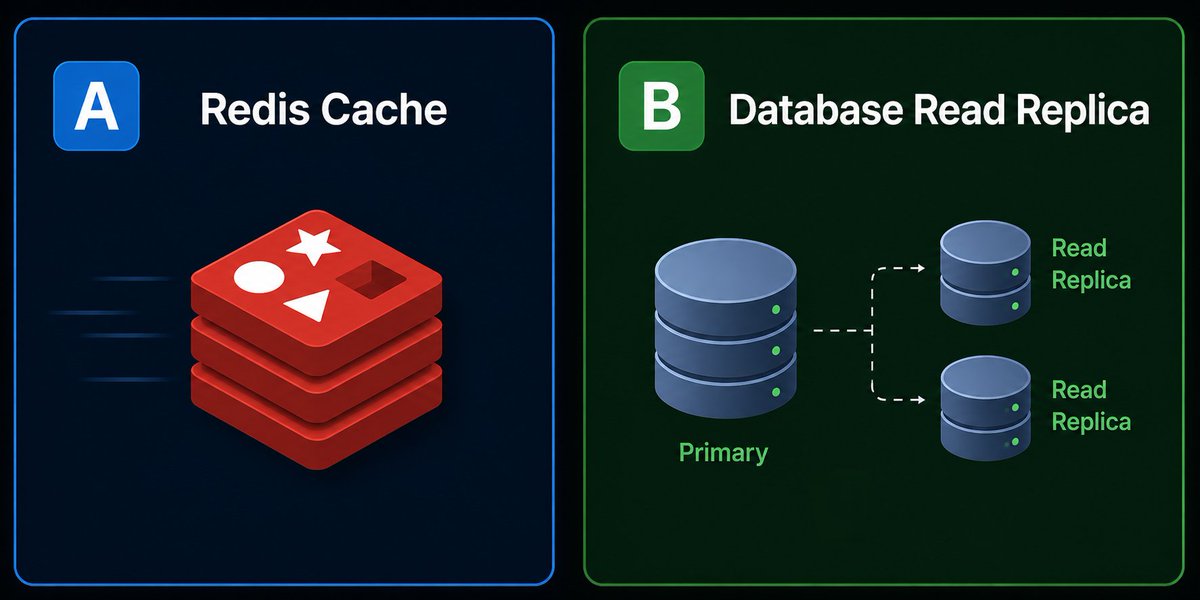
A) Redis Cache
B) Database Read Replica
Which one would you choose first?
And why?
Creatine, long celebrated for supporting muscle growth and athletic performance, is gaining recognition in neuroscience as a powerful aid for brain energy management—especially under demanding conditions like mental stress, intense cognitive effort, or sleep deprivation.
As the brain's primary energy currency, adenosine triphosphate (ATP) gets rapidly depleted during high-demand tasks. Creatine helps by facilitating the quick recycling of ATP through the phosphocreatine system, providing neurons with a more reliable energy buffer to sustain performance when demands spike.
Recent systematic reviews and meta-analyses of randomized controlled trials have quantified these effects. A 2024 meta-analysis (Xu et al., Frontiers in Nutrition) found that creatine monohydrate supplementation significantly improved memory performance, with a standardized mean difference (SMD) of 0.31 (95% CI: 0.17–0.44; equivalent to Hedges' g ≈ 0.30), alongside benefits in information processing speed and attention time in some measures. An earlier 2023 meta-analysis (Prokopidis et al., Nutrition Reviews) reported an overall SMD of 0.29 for memory enhancement in healthy individuals, with particularly strong effects in older adults (SMD = 0.88 in those aged 66–76 years).
While this 0.31 SMD reflects a modest-to-moderate standardized effect size (not a literal 31% raw improvement in every person or task), it indicates meaningful gains in memory, mental clarity, and processing efficiency—especially when the brain is challenged.
Benefits tend to be most evident in specific groups: older adults (who may have lower baseline brain creatine), vegetarians/vegans (with naturally reduced dietary intake), females, and those experiencing sleep deprivation or high mental fatigue. Emerging research is also exploring creatine's therapeutic potential for neurological conditions such as Alzheimer's disease, traumatic brain injury, depression, and mild cognitive impairment, though evidence remains preliminary and strongest for memory support.
Creatine isn't a miracle cure or standalone fix—it's best viewed as a supportive nutrient that bolsters brain resilience. Experts stress the need for more large-scale, long-term studies to clarify optimal dosing, duration, and broader impacts on neurological health.
[Xu C, et al. (2024). The effects of creatine supplementation on cognitive function in adults: a systematic review and meta-analysis. Frontiers in Nutrition, 11:1424972. doi:10.3389/fnut.2024.1424972]
Amazon Prime Video moved their video monitoring tool from microservices to a monolith in 2023. Costs dropped 90%.
The internet lost its mind. "Even Amazon is ditching microservices?"
Here's what happened
India has 2 main words for sugar:
Chini literally means “Chinese” in Hindi, because Chinese sugar was more refined
Shakkar from Sanskrit, means “gravel” or “grit,” from sugar crystals.
The Sanskrit root gave us sugar, sucre, azucar, sukkar, sucrose, saccharine etc.
MICROSOFT OPEN-SOURCED A PII DETECTION SDK
presidio detects and anonymizes sensitive data before it ever touches your model
the problem is real: names, emails, SSNs, credit cards, medical records all flowing through LLM pipelines unfiltered
presidio stops that
▫️ detects PII in text, images, and structured data
▫️ redacts, masks, or anonymizes before it hits the model
▫️ supports NLP, regex, rule-based, and transformer detection
▫️ runs on Python, PySpark, Docker, and Kubernetes
▫️ even handles DICOM medical images
in an era of GDPR, HIPAA, and AI compliance audits, this is infrastructure not optional
https://t.co/pcEkm4mMt7
Carl Jung's 10-Day Method For Making Wishes Come True.
A simple mental practice built around clarity, identity, and consistent behavior.
Try it for 10 days and notice what begins to shift:
- THREAD 🧵
Heart disease doesn't start with age.
It starts with inflammation, insulin resistance, and low nitric oxide.
Here are 6 science-proven tips to keep your heart young:
1. Eat a lot of beets.
Your past isn't in your hands
Your Future is not certain.
All you have is your Present.
Focus on your actions and work as hard as you can to live the life you dreamt of as a kid.
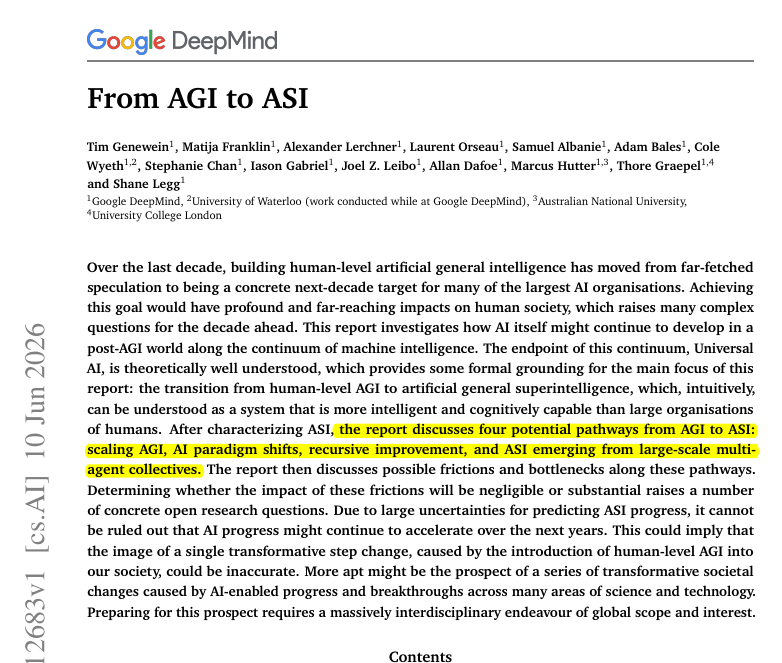
Beautiful paper from Google DeepMind.
Explains the pathways from AGI to ASI, and why that jump could happen through several routes.
The authors frame the AGI-to-ASI transition around 4 technical pathways:
- continued scaling of compute, model size, data, and test-time inference;
- algorithmic paradigm shifts beyond today’s transformer-based foundation-model stack;
- recursive self-improvement, where AI accelerates AI R&D and improves future systems; and
- multi-agent collective intelligence, where large populations of specialized agents coordinate into a superhuman group agent.
Scaling may work for a while, but it could hit limits in data, compute, energy, or weaker returns from making systems larger.
Recursive improvement is the most uncertain path, because AI could speed up AI research, but that loop may also slow if hard research problems need real-world testing, scarce hardware, or new ideas.
Multi-agent collectives may be the most underappreciated path, because a society of competent digital workers could outperform a brilliant individual model through specialization, speed, and coordination.
The big point is that ASI may not arrive as 1 sudden event, but as a chain of faster changes as AI helps create better AI and stronger scientific tools.
----
Link – arxiv. org/abs/2606.12683
Title: "From AGI to ASI"




![Rainmaker1973's tweet photo. Creatine, long celebrated for supporting muscle growth and athletic performance, is gaining recognition in neuroscience as a powerful aid for brain energy management—especially under demanding conditions like mental stress, intense cognitive effort, or sleep deprivation.
As the brain's primary energy currency, adenosine triphosphate (ATP) gets rapidly depleted during high-demand tasks. Creatine helps by facilitating the quick recycling of ATP through the phosphocreatine system, providing neurons with a more reliable energy buffer to sustain performance when demands spike.
Recent systematic reviews and meta-analyses of randomized controlled trials have quantified these effects. A 2024 meta-analysis (Xu et al., Frontiers in Nutrition) found that creatine monohydrate supplementation significantly improved memory performance, with a standardized mean difference (SMD) of 0.31 (95% CI: 0.17–0.44; equivalent to Hedges' g ≈ 0.30), alongside benefits in information processing speed and attention time in some measures. An earlier 2023 meta-analysis (Prokopidis et al., Nutrition Reviews) reported an overall SMD of 0.29 for memory enhancement in healthy individuals, with particularly strong effects in older adults (SMD = 0.88 in those aged 66–76 years).
While this 0.31 SMD reflects a modest-to-moderate standardized effect size (not a literal 31% raw improvement in every person or task), it indicates meaningful gains in memory, mental clarity, and processing efficiency—especially when the brain is challenged.
Benefits tend to be most evident in specific groups: older adults (who may have lower baseline brain creatine), vegetarians/vegans (with naturally reduced dietary intake), females, and those experiencing sleep deprivation or high mental fatigue. Emerging research is also exploring creatine's therapeutic potential for neurological conditions such as Alzheimer's disease, traumatic brain injury, depression, and mild cognitive impairment, though evidence remains preliminary and strongest for memory support.
Creatine isn't a miracle cure or standalone fix—it's best viewed as a supportive nutrient that bolsters brain resilience. Experts stress the need for more large-scale, long-term studies to clarify optimal dosing, duration, and broader impacts on neurological health.
[Xu C, et al. (2024). The effects of creatine supplementation on cognitive function in adults: a systematic review and meta-analysis. Frontiers in Nutrition, 11:1424972. doi:10.3389/fnut.2024.1424972]](https://pbs.twimg.com/media/HLuQ32aXEAAVky-.png)