« Ce qui fait la qualité de l’inventivité et de l’imagination du chercheur, c’est la qualité de son attention, à l’écoute de la voix des choses. Car les choses de l’Univers ne se lassent jamais de parler d’elles-mêmes et de se révéler, à celui qui se soucie d’entendre. » A.Gro
If you missed last week, Mastering Codex Remote for Engineering is now available as a blog post on our developer platform!
A great article for getting started and efficiently working with Codex on mobile!
https://t.co/nN13L2iBL3
« Ce qui fait la qualité de l’inventivité et de l’imagination du chercheur, c’est la qualité de son attention, à l’écoute de la voix des choses. Car les choses de l’Univers ne se lassent jamais de parler d’elles-mêmes et de se révéler, à celui qui se soucie d’entendre. » A.Gro
« Ce qui fait la qualité de l’inventivité et de l’imagination du chercheur, c’est la qualité de son attention, à l’écoute de la voix des choses. Car les choses de l’Univers ne se lassent jamais de parler d’elles-mêmes et de se révéler, à celui qui se soucie d’entendre. »
Si le Lemme de Yoneda est un outil d'analyse (il nous dit comment "sonder" un objet par ses relations), le co-lemme de Yoneda est un principe de synthèse (il nous dit comment reconstruire l'objet à partir de ces sondes).
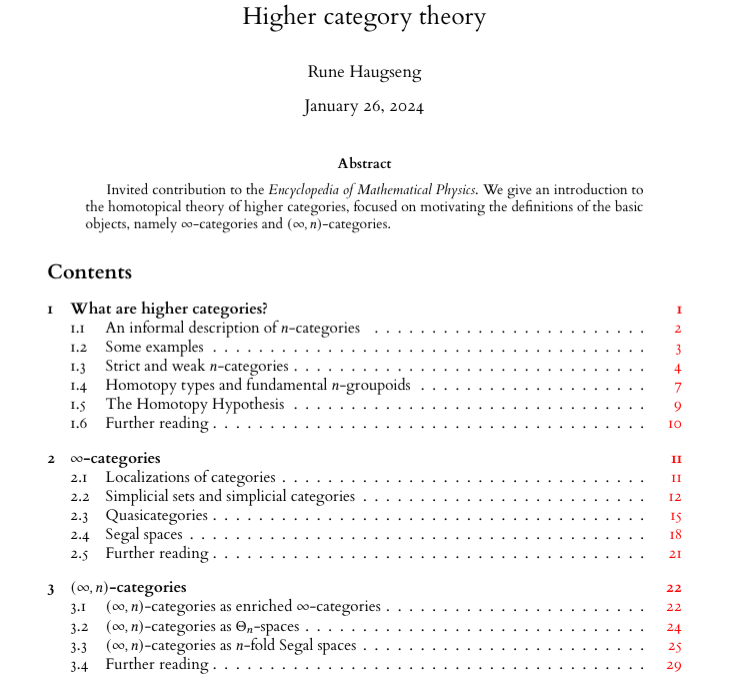
Since many of you loved the introduction to category theory, why not going a little further, with this great and short primer (33 pages) on higher category theory by Rune Haugseng.
🔗👇👇
We’ve used susceptibilities to steer training of small models, delaying induction circuits and selecting between modes of generalization (https://t.co/tZ6BDdNJTV). The above results in Pythia-1.4B are a prelude for patterning on LLMs. Coming soon!
While walking through the legendary 1973 black hole paper by Bardeen, Carter, and Hawking, I spent days convinced I had a sign error in my derivation, which is a very common occurrence for me. Minus signs and factors of two are the bane of my existence.
But, this sign error was persistent. No matter how I looked at it, the math just didn’t work out. Checked it over and over. My physicist friend Nirmalya Kajuri also @Kaju_Nut independently verified my reasoning.
Turns out the sign error is in the paper itself. Actually, there are two subtle errors which cancel each other out, leaving all the physics intact. That’s why it went unnoticed for fifty years.
The moral of the story is that we all make sign errors sometimes, even the greats! But it’s the idea that really matters.
https://t.co/cWH54PcWoM
Black holes have laws.
In 1973, Bardeen, Carter, and Hawking wrote down the framework that made that statement precise, and it later became black hole thermodynamics.
This is a 7-hour deep dive going through their reasoning step-by-step. The physics is intense, but if you want to see for yourself the actual ideas involved, not just a summary, this video is for you.
The video is timestamped, so you can easily jump around and pick up where you left off. Think of it like a book in video form.
There’s a link to the paper in the video description.
https://t.co/dV4l4GIRxg
Black holes are fascinating, a place where the geometry of spacetime pushes general relativity to its limits. Studying the physics of black holes is very rewarding, as it stretches your mind in all kinds of bizarre ways, and shows you a picture of reality that radically differs from what you’re used to.
That’s why I’ve spent the past few months making an in-depth video walkthrough of the famous 1973 paper “The Four Laws of Black Hole Mechanics” by Bardeen, Carter, and Hawking. If you want to learn about black holes, jumping into this paper and taking the time to explore it in depth is a great way to do so.
The paper is, of course, very dense with advanced equations. That’s why the video will be about seven hours long: two hours of prerequisite concepts, and five hours going through each line of the paper. That’s about half an hour per page, which is what it takes to explore these concepts in detail. No steps skipped! :)
I’m wrapping up the video now and am aiming to publish it next weekend. Here’s a link to the paper if you want to start reading ahead:
https://t.co/KJUSO16GfA