Journalist with @IndiaToday. Fly on the wall. Write mainly on HEALTH & PHARMA. Ex @ThePrintIndia @moneycontrolcom
@NewIndianXpress @ttindia @timesofindia
Away from public glare, #India recorded 187 new #HIV infections everyday, an #AIDS death every 15 minutes in 2023.
Also, there has been a steady rise in total infections since https://t.co/n7prPHushp this to understand the challenges the National #AIDS Control Programme faces.
Rising HIV cases, treatment over prevention, new hotspots — all’s not well with India’s AIDS programme
Sumi Sukanya Dutta @sumisukanya reports
Illustration: Prajna Ghosh @prajnaghosh9#ThePrintHealth
https://t.co/Rq7pzhX9LR
Reports of #PelletInjuries during the July 20 student protest crackdown have intensified scrutiny of the security response. With no official confirmation, medical findings and past experience have renewed questions over crowd-control tactics.
https://t.co/56vyuLmfeZ
Antibiotic/antimicrobial resistance/AMR is a situation where available antibiotics are not effective against disease-causing bacteria. In this @IndiaToday article I discuss with @SumiSukanya how viral infections are linked with AMR.
https://t.co/YyzildxEwE
Five women entered government hospitals in Kota to give birth. None of them came home.
Several weeks after the deaths faded from the headlines, @sumisukanya travelled back to their families.
We found husbands raising newborn babies alone. Children growing up without mothers. Families are still waiting for answers.
Our investigation traces a chain of failures, from a medicine manufacturer whose oxytocin batch allegedly contained no active ingredient, shoddy procurement decisions, weak hospital systems, and lack of government accountability.
WATCH: https://t.co/TiXqLe5gZj
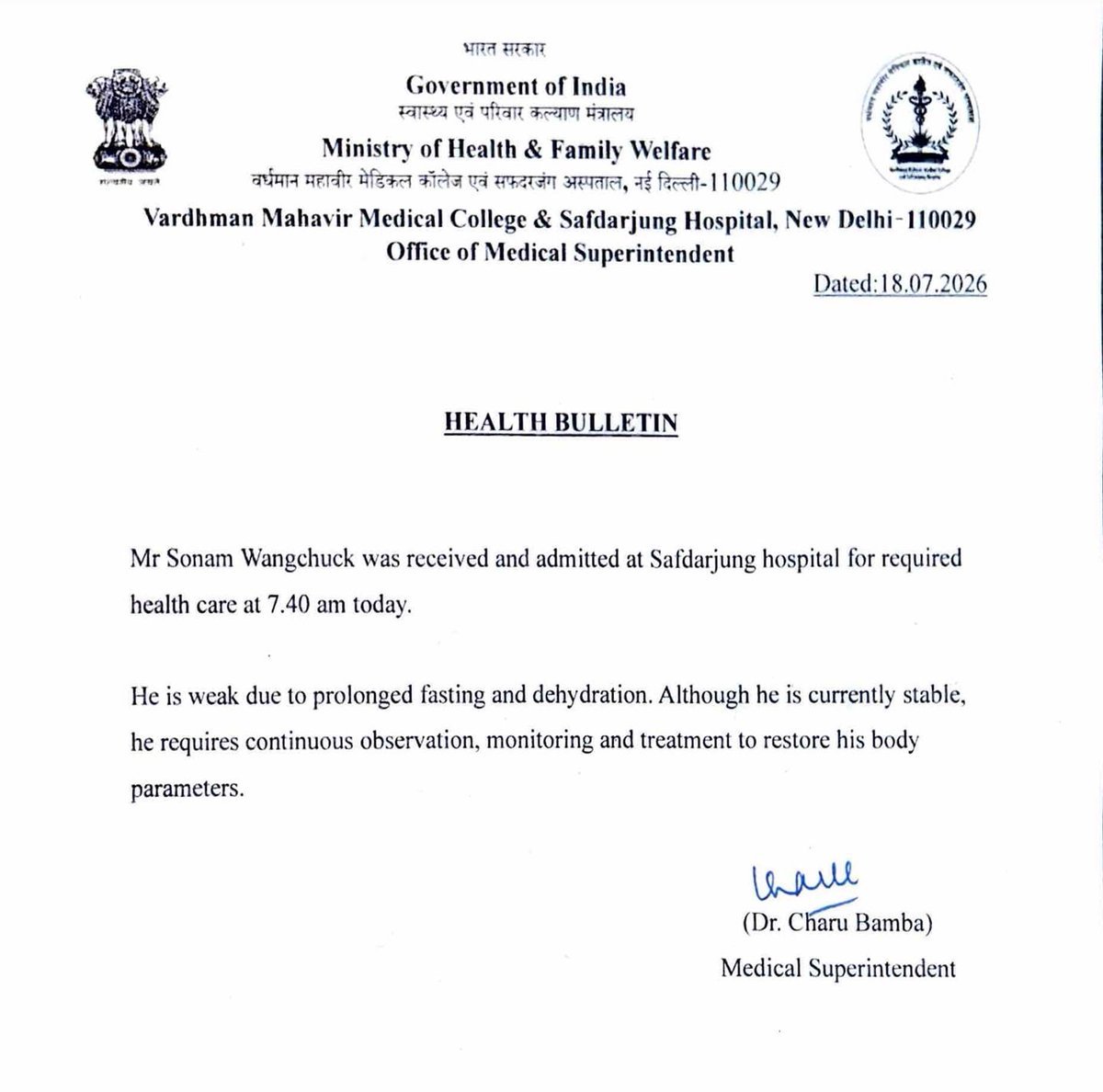
#Sonam Wangchuk remains under close medical observation after a prolonged fast.
Doctors have found dehydration, low potassium and rising ketone levels;may pose a risk to kidney function and other metabolic complications: @SJHDELHI
#Papaya leaf extract is extensively utilized in both traditional #Ayurvedic remedies and modern phytotherapy to treat low platelet counts in #dengue and #chemo. Read why the controversy over @TataMemorial evidence that it works
https://t.co/YBgVr1Ihlt
@theliverdrALT
There are headlines claiming the new weight-loss pill Orfoglipron has beaten Wegovy.
That's not the full story.
Here's what Orforglipron (Foundayo) actually achieved, why experts are excited about oral GLP-1 medicines, and what it could mean for India as the obesity drug race enters a new phase. @SumiSukanya reports.
Fresh dent on Made-in-India #drugs? At least three companies recall certain batches of their generic #semaglutide over quality issues. Comes months after me-too versions of blockbuster #semaglutide flooded the Indian market. Full details here
https://t.co/7ZQUZRjeoe
India gets its first plant-based Vitamin D3. Here's why that matters beyond veganism
The FSSAI has approved India's first plant-sourced vitamin D3 for supplements, fortified foods and nutraceuticals. The move widens options for vegetarian and vegan consumers as vitamin D deficiency remains common.
Read this informative article prepared by @SumiSukanya published in @IndiaToday. It has my quotes, alongside that of other experts.
https://t.co/UtAvH2ZvEF
An excellent article in @IndiaToday by @SumiSukanya highlighting how artificial pancreas (hybrid closed-loop) technology is transforming the management of type 1 diabetes.
Key takeaways:
• Integrates a continuous glucose monitor (CGM), an insulin pump, and an intelligent algorithm to automate insulin delivery.
• Improves Time in Range (TIR) while reducing episodes of hypoglycaemia and hyperglycaemia.
• Reduces the day-to-day burden of diabetes management, leading to a better quality of life for people with type 1 diabetes.
• Demonstrates how wider access to advanced diabetes technologies can improve outcomes and reduce healthcare disparities.
Thank you, Sumi Sukanya Dutta, for quoting me and highlighting this important advancement in diabetes care.
Read the full article here: https://t.co/e5cB5qgJTN
#ArtificialPancreas #Type1Diabetes #DiabetesTechnology #HybridClosedLoop #ContinuousGlucoseMonitoring #InsulinPump #Diabetology #Endocrinology #DiabetesCare #HealthcareInnovation
Oldest accurately dated Banyan found in Munger, Bihar
A banyan tree in Munger, Bihar, estimated to be around 700 years old, has been identified as the oldest accurately dated banyan tree, Ficus benghalensis, using radiocarbon dating, a method that relies exclusively on scientific evidence rather than historical records or local lore
Banyan trees, with their intricate root and branch networks, provide habitats for a variety of wildlife, including birds and insects. They have also played a significant role in Indian social and cultural life for centuries
🔗https://t.co/7bytcGXb5f
@IndiaDST
"Breakthrough' biomarker that can measure the "cost of being alive"? Liked the comparison with the claim of #cancer cure, selling it as something there is already a long queue for without an iota of science. Do watch https://t.co/O2g7P29bj5
#Temple#eternal#Entropy@deepigoyal
🚨 Launching a new medical device on Doctor’s Day.
🧙 It’s called Topi™.
✅ Topi™ is the world’s first non-invasive, AI-enabled, multimodal longevity platform designed to measure a novel biomarker called Pehnao™.
🚨 Pehnao™ cannot be measured using blood tests, imaging, genomics, proteomics, metabolomics, microbiome sequencing, wearable sensors, or clinical examination.
✅ It can only be measured using Topi™.
🫰In our preliminary studies, higher Topi™ Pehnao™ scores were strongly associated with increased susceptibility to health-tech marketing claims.
🚀 We are currently validating Topi™ in a multi-center, prospective, randomized, placebo-controlled, investor-funded study.
🔥 Detailed results will only be shared with individuals who wire USD 1 million to the lab before June 30th.
🫰 Excited for the future of precision medicine.
Entropy or hype? Temple's bold health claim meets a wall of scientific doubt
Deepinder Goyal said Temple has identified an 'Entropy' biomarker that tracks the body's real-time energy use. Doctors said the claim remains unproven without methodology, validation studies and peer-reviewed evidence.
An informative article prepared by @SumiSukanya published in the India Today has my quotes, alongside that of other experts.
https://t.co/4YWUEwTaRl
@IndiaToday
MISSING EVIDENCE
"Hyderabad-based senior neurologist Dr Sudhir Kumar told India Today the concept is intriguing, but the evidence presented so far falls short of proving the claims being made."
“The idea of developing a novel physiological metric from signals recorded over the temple region is certainly intriguing, and advances in wearable technology have the potential to improve our understanding of human physiology. However, extraordinary claims require extraordinary evidence,” he said.
"Dr Kumar pointed out that what has been shared publicly appears preliminary and cannot yet establish Entropy as a validated biomarker for metabolism, health, longevity or biological ageing."
"The neurologist noted that showing a correlation with calorimetry during exercise is only an initial step. A single statistical relationship does not automatically prove that a measurement is accurate, reliable or clinically useful."
"According to him, critical information remains unavailable. The biological basis of the metric, the methodology used to derive it, validation studies and peer-reviewed scientific data have not yet been publicly released."
"The temple region, where the device is worn, contains blood vessels, muscles, skin structures and nerve fibres. Signals collected there may indeed reflect physiological changes linked to stress, exercise or metabolism."
"However, Dr Kumar stressed that detecting a signal and proving the existence of a new biomarker are two very different things."
"He also warned about the danger of creating health scores that appear highly precise before they have been adequately validated."
“The key questions are not whether the signal changes with exercise, stress, or meditation, but whether it reliably measures what it claims to measure, whether it adds information beyond existing metrics, and whether acting on it improves health outcomes,” he said.
"Those answers, he added, can only come from rigorous research, peer review and independent replication."