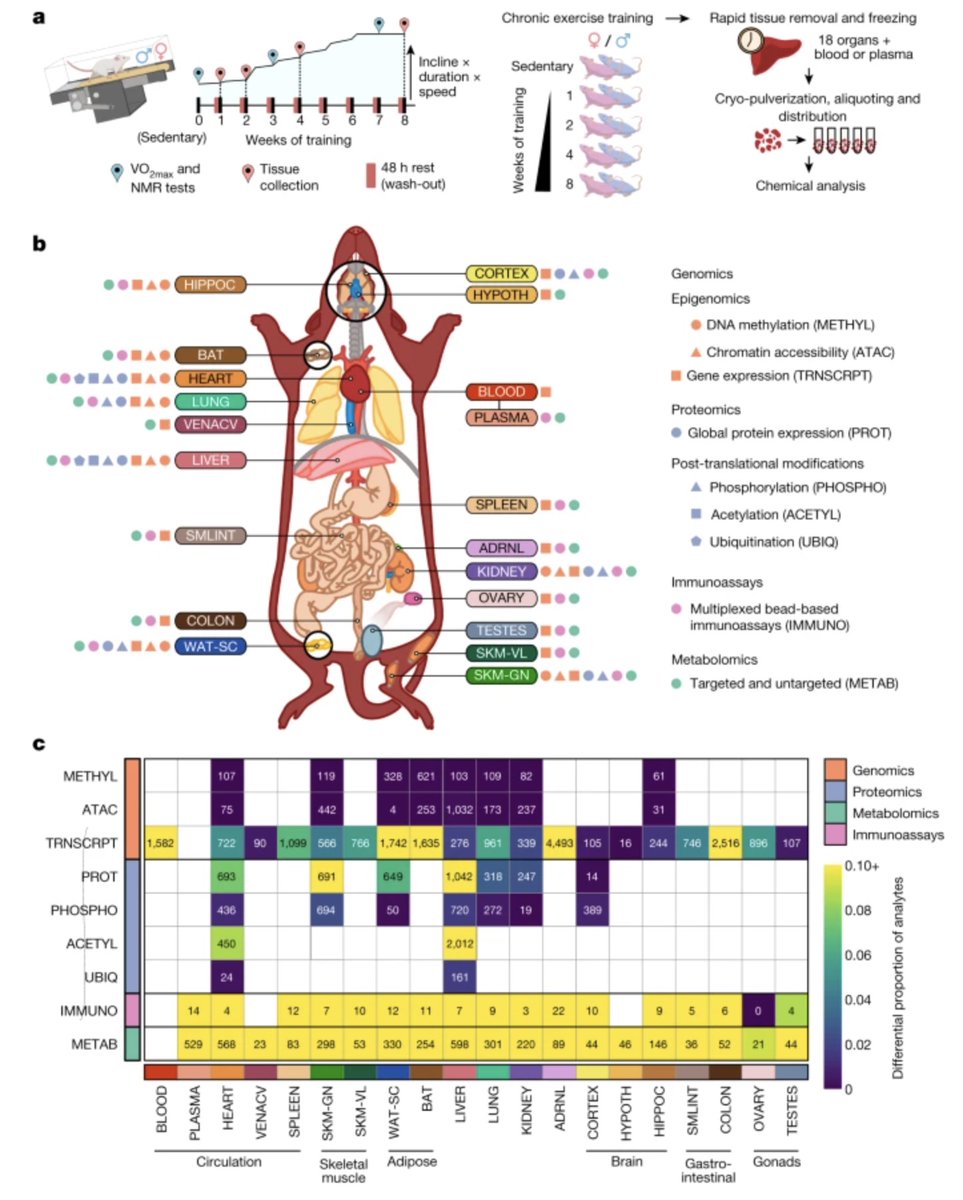
Exercise may be the single most potent medical intervention ever known. Its benefits in prevention outstrip any known drugs: 50% reduction in the risk of cardiovascular disease, 50% reduction in the risk of many cancers, positive effects on mental health, pulmonary health, GI health, bone health, muscle function. You name it. Exercise helps. In fact, the ability to exercise over long distances was likely key to our evolution as a species because the availability of densely caloric foods due to persistence hunting allowed our energy-avid brains to enlarge. And yet, we have had very little insight into the molecular basis of these magical effects...until now!
Published in yesterday's Nature and featured on the cover was work from our consortium that represents the culmination of a couple of decades of pitching ideas to the NIH, forming a consortium, planning experiments, executing those experiments, and analyzing data at unprecedented scale, all aimed at enhancing our understanding of the molecular transducers of exercise.
It was a major effort from so many in our consortium (playfully named MoTrPAC) and is the first landmark paper of many more to come. This first paper focused on the multi-tissue, multi-omics of treadmill exercise in rats. Specifically, we report the effects of eight weeks of treadmill running on the transcriptome, the epigenome, the proteome, the metabolome, the lipidome and the immunome of a broad range of tissues (in fact, 9,466 assays across 19 tissues, 25 molecular platforms, and 4 training time points).
The result is the most comprehensive molecular map of exercise ever created. At Stanford, my colleague @MWheelerMD and I co-lead the bioinformatics center and it was our team's duty and privilege to ingest the data, QC the data, help analyze the data, and make the data available to the world. Various tools available at our data hub allow you to explore the data, visualize it, and download it for your own use.
Have fun! And stay tuned for human data that will be coming.
So many people to thank who made this possible (see the paper for details). Special shout out to the primary analysts and authors: David Amar, Nicole Gay, & Pierre Jean Baltran.
Paper: https://t.co/0nhXdfhxx0
Data hub: https://t.co/NxTHsVdfRp
I’m happy to share that I’m starting a new position as Chair of Endocrinology at Mayo Clinic Health System! Grateful for this opportunity to lead and shape a healthier future for our communities.
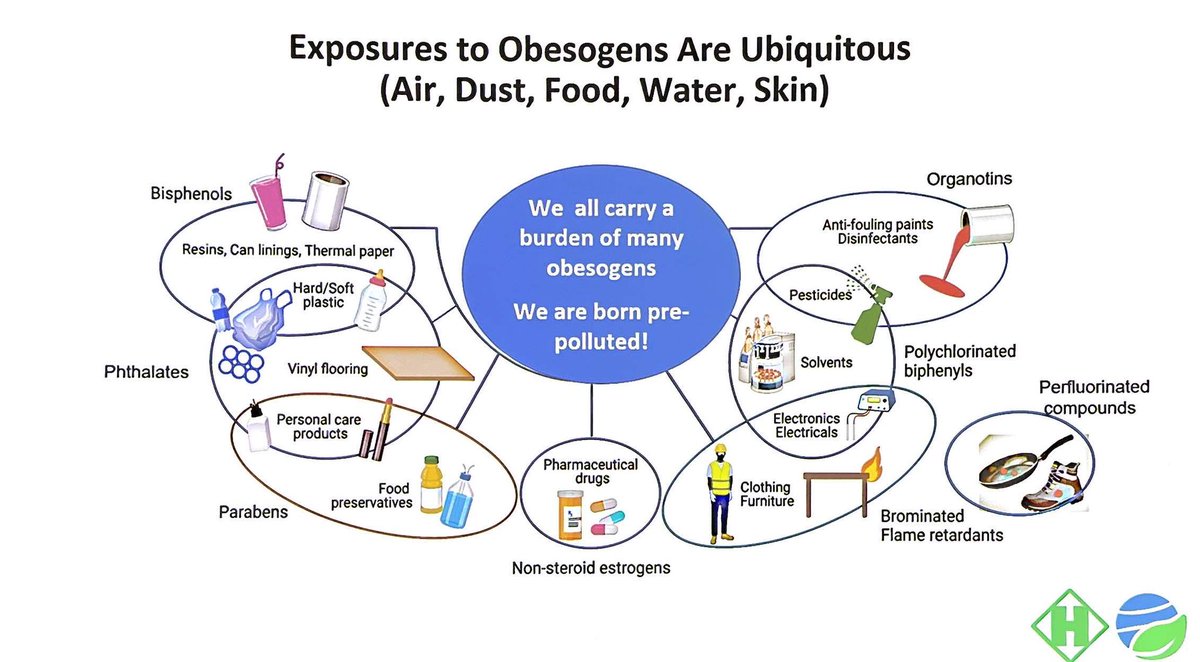
@AskDrShashank@neetadiabesity There are so many chemicals whose far-reaching consequences beyond direct ingestion or exposure weren’t recognized until they had been in widespread use for decades! EDCs and obesogenic substances are ubiquitous! (Slide courtesy: Jerry Heindel)
Obesogenic substances are EVERYWHERE!
We consider the western diet obesogenic because of its high fat, high sugar.
But what about the the plastics that hold that food?
Bisphenol and phthalates in plastics leach into our food/drinks that also cause weight gain #ENDO2023
How do you know if or when it's OK to use a medication #OffLabel? @SumitBhagraMD explains possible benefits, risks and unintended consequences when an on-label use causes a spike in demand. https://t.co/d5n5bqyMLt
Mayo Clinic has been ranked once again No.1 in #Diabetes & #Endocrinology by @usnews for 2022-2023.
#MayoEndo ranked #1 for 26 consecutive years!
A testament to the dedication of all our team & a renewed commitment to advancing clinical care and research in endocrinology.
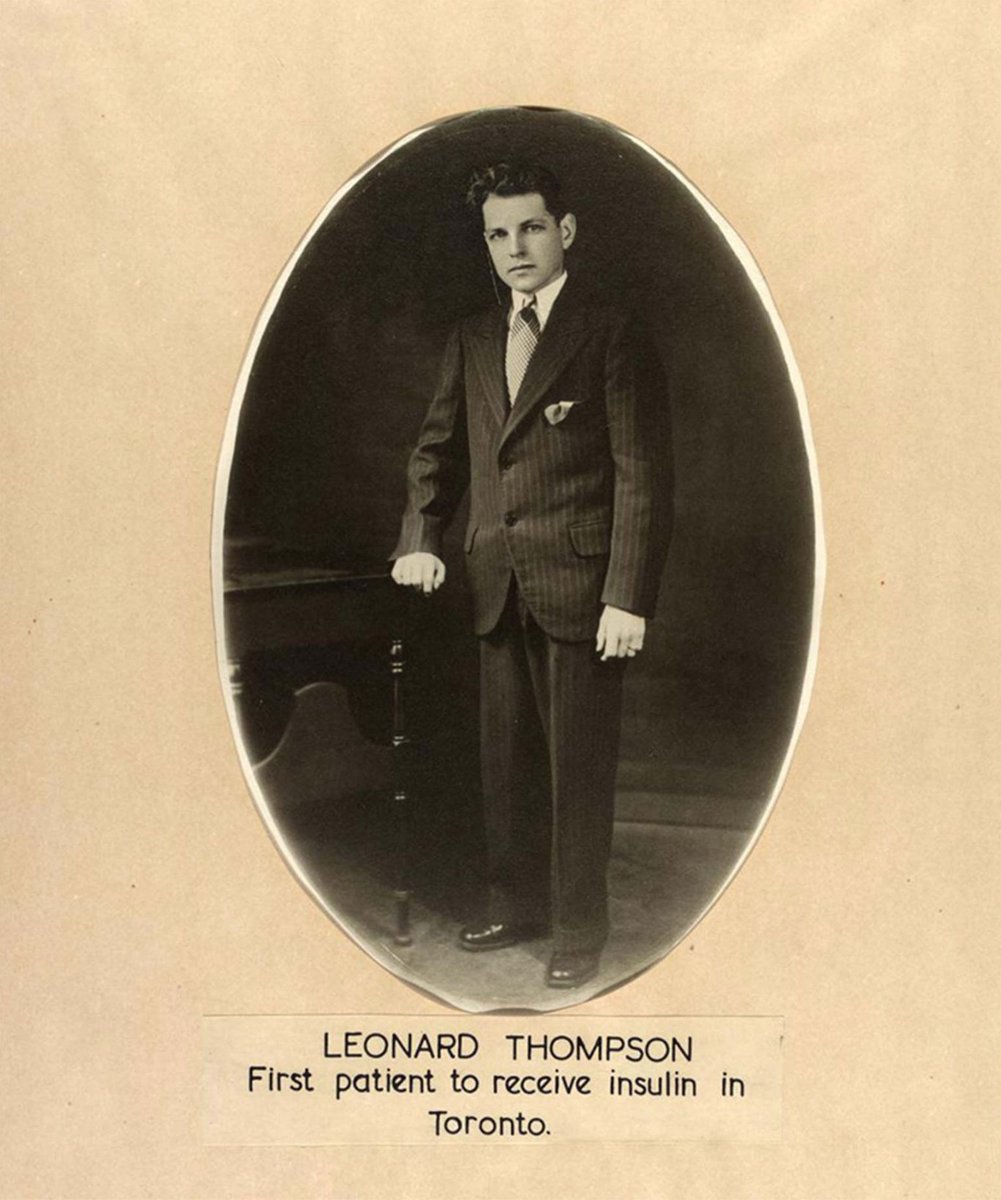
💉 Today marks exactly 100 years since Leonard Thompson, a 14-year-old boy dying from type 1 diabetes, became the first person to receive an injection of insulin on 11 January 1922.
A thread 👇 (1/6)
Prof. Jens Juul Holst receives the WIDF Global Award 2022 for his groundbreaking research on GLP-1. An inspiring story of bench to the bedside improving lives for people living with diabetes #WIDF
Being too busy can make us unhappy, but so can being too idle.
New data: life satisfaction in the U.S. peaks at ~2-5hrs of free time per day.
Time poverty fuels stress and burnout. Time abundance undermines purpose and progress.
The sweet spot is time affluence: having enough.
Leadership isn't a race to make the fastest decisions. It's a responsibility to make the wisest decisions.
Time pressure leads to shallow processing. Many of our regrets are choices made in haste.
Being quick and decisive is overrated. Being patient and flexible is underrated.