Food inflation is rising fast.
People like us on Twitter know it is due to El Nino, a steep increase in the price of imported fertilisers and farm inputs, huge supply chain disruption, high shipping costs, an increase in the price of energy and power, and so on.
A common man would only blame the government for food inflation.
Food and related items already accounts for close to 50% of the monthly expenses of average Indian households.
Add to that rent, electricity, transport, education, healthcare and other expenses, and day to day living is becoming more and more difficult.
In good times, people credit the government, and in bad times they blame it. This is how it has always been.
I don’t know how many of you remember.
The increase in onion prices became such a challenge for former Prime Minister Atal Bihari Vajpayee’s government.
I don’t know whether it is instigated or organic.
A lot of protests across Europe cite increasing prices and the unaffordability of even basics as the reason for unrest.
80% of our population has no money. The government needs to plan and be ready not only to procure sufficient supply but also to hugely subsidise the following:
LPG
Electricity
Petrol
Diesel
Rice
Wheat
Dal
Milk
Onions
Tomatoes
Potatoes
And any other essentials for day to day living that got missed out above.
This would not only ensure the basic survival of all but also prevent any kind of unrest, whether instigated or organic.
"You will be civilized on the day you can spend a long period doing nothing, learning nothing, and improving nothing, without feeling the slightest amount of guilt." - Nassim Nicholas Taleb
The problem isn’t that AI is intelligent. It isn’t. The problem is that too many adults (but not all) are at once mechanistic, imitative, unimaginative, stupid, formulaic, influenceable, & gullible, arrogant beyond their skill set, & too expensive to maintain.
MATTER OF GREAT PRIDE FOR INDIAN SCIENCE!
Ashoke Sen becomes the first Indian to win the prestigious Oskar Klein Medal (2026), jointly awarded by Stockholm University and the Nobel Committee for Physics of the Royal Swedish Academy of Sciences for his pioneering work in String theory.
https://t.co/dCJ1D9DVDs
String theory gives a unified description of all matter and the forces between them based on the postulate that the elementary constituents of matter are tiny one dimensional (string-like) objects instead of point particles. Sen’s breakthrough work has shown that multiple string theories are all different versions of a single underlying theory.
Incidentally, I met Ashok Sen for the first time, when both of us were elected as FRS (Fellows of Royal Society) in 1998. Ashoke ( nominated by Stephen Hawking himself) was young 42 yrs and
I was an oldie - 55 yrs though!
What struck me was Ashoke’s incredible simplicity. His wife Sumathi Rao has reportedly said that Ashoke bought his first suit and needed some assistance to wear his first tie for that prestigious 1998 FRS ceremony in London, when one signs in the same book that Sir Isaac Newton has signed.
A film made on the life and work of Ashoke Sen, when we at the
H K Firodia Award in Science & Technology honoured him in 2005 in Pune, will inspire all our budding scientists - showing how science & simplicity goes together.
https://t.co/XeCl4s35d6
We all feel so so proud Ashoke!
@PMOIndia@NITIAayog@PrinSciAdvOff@IndiaDST@CSIR_IND@ictstifr@PuneIntCentre@kvijayraghavan
Just to set the records straight…
For all non-Bengalis who confuse Durga Puja (of Bengal) with Navaratri (outside Bengal), there's a simple big difference in the way it's celebrated. While Navaratri could be religious (as people claim it to be), Durga Puja is a cultural festival. There's a remarkable difference between religion and culture.
Why is Durga Puja not religious, but cultural? Here's a Bongs take!
1. For most Bengalis, they have nothing to do with devotion, and everything to do with celebration. Religion (as it has become) is an organized way to deal with devotees, and the Bengalis are far far away from any sort of blind beliefs.
2. God/Goddess is an image that's alienated from family of our own lives and seen as an authority. To Bengalis, Durga is just a part of our family. She could be termed as the Goddess, but never seen with a God-like image. There's way more love than devotion. It's a very human connection. She's the daughter of the house who's come for Autumn break to her parents house with kids and friends
3. While people outside Bengal may fast as much as they like, Bengalis will continue to feast on Mutton Biriyanis and all sorts of delicious non-veg food (even at Puja premises where organizers often arrange for meals). Had there been any religious angle, things might not have been so simple.
4. Durga Puja as a festival is deeply connected to arts, crafts, music, theater, films ... everything! It's an all-round celebration. Only a very tiny percentage of people would bother to offer prayers. For the rest of us, Durga and the spirit of Durga puja is all in our heart. Even if we offer 'Anjali' (a prayer), our eyeballs hover all over the surrounding beauties in laal-paar-sada-sarees (a beautiful dress that ladies prefer to wear).
5. Durga puja is all-inclusive. Many Muslims in Bengal celebrate it too. Even there are religious Muslims who are the Presidents and Secretaries of Puja committees. No 'religious' festival could ever break these barriers!
6. There are hundreds of government and private awards given for 'Best Puja'. Not a single parameter in judgement relates to the devotion aspect of it. The Best Puja judgement takes into consideration the artistic finesse of the idol-making, the decorations around it, the lights, the sound, the safety measures, the theme, the concept, the social relevance of the theme, etc. It never considers how devotedly people offer prayers. So, devotion doesn't even come in our way of celebrating Durga Puja.
For those who have never witnessed Durga puja in Kolkata but have a lot to comment on it, please do make a visit. Your idea of a festival will change. Our country had no religion, but we thrived on our culture. It's time we pack religions into the sacks and throw them back to the western world (from where it has come) and fall back on our all-inclusive cultural ways of celebrating life once again.
Originally penned by Niilanjanaa Daschakraaborty
"The curse of modernity is that we are increasingly populated by a class of people who are better at explaining than understanding, or better at explaining than doing." - Nassim Nicholas Taleb in Skin in the Game
The modern man, particularly the modern western man, worships the intellect. I used to be in this category so I know whereof I speak.
Pure mathematics, the highest intellectual activity known to man, is falling to AI. It is a deeply humbling moment.
At this point, I would assume that most "intellectual jobs" are at risk. That includes much of software.
What will people do? Living in a village (I just came from Lalita Sahasranama pooja for Navaratri), I am not worried about "What will humans do" question.
Humans have infinitely many things to do and I categorise those human activities as nature, nurture, culture and scripture: restoring soil and water, raising children and caring for elders, making music, sustaining festivals, sports and entertainment, studying and practising spiritual traditions.
Those activities can pay well in the sense of being able to afford the goods and services produced with near zero human labor. The task of the political economy is to ensure this income distributional outcome and I reject UBI as an unimaginative and dystopian vision of the intellect-worshipping modern man. The UBI future implicitly assumes monopolization of the means of production and sovereign states already have the power to disallow monopolies.
Hindu philosophy, in all its depth and grandeur, never worshipped the pure intellect. Finally I understand why.
Om Shri Lalitambikayai Namah 🙏
The business outlook for software is uncertain and AI has raised costs dramatically with a) massive 4-fold increase in server prices which we need for data centers b) AI usage increasing rapidly, leading to much higher expenses, which we are trying to control.
On top of that is the challenging geopolitical backdrop.
We have cut down on our marketing budget. We have also told our employees that we cannot have our usual pay increase this year. I have apolgized for not being able to avoid this.
We will work hard to avoid mass layoffs but the outlook for software jobs in general is grim. We have not been growing our employee count for 18 months now.
Most of our employees understand the situation. I am thankful to them.
We are in the middle of reinventing ourselves. The next 3-5 years will decide how our reinvention has worked. Please pray for us 🙏
Thinking about problems that are difficult to solve may make you anxious, but not thinking about them (and hence not dealing with them) should make you more anxious still. When a problem stems from your own lack of talent or skill, most people feel shame.
Get over it. I cannot emphasize this enough: Acknowledging your weaknesses is not the same as surrendering to them. #principleoftheday
"When an individual adopts a political, economic, or social ideology as a core component of their identity, their cognitive machinery gets locked into defending the tribe.
Any piece of evidence that contradicts the group narrative is treated not as a data point to be analyzed, but as an existential attack on their self worth.
If you want to maintain a high level of mental clarity, you must actively refuse to let your political or social opinions become your identity."
- Charlie Munger
The global economy is running out of shock absorbers. 🌐
We are one sentiment shift away from a major financial shock. ⏬️
That is the stark warning from Nobel laureate Michael Spence.
Yet in the same breath, he identifies one clear structural exception: India. 🇮🇳
While stretched Western markets sit on elevated valuations with almost no margin for error, and China’s export model collides with rising tariff walls, Spence sees India as the rare growth outlier, operating near high structural potential with an engine built on domestic depth rather than external dependence.
Here is the executive briefing on the shifting macro plates: and why India’s model is different:
1. Fragility at the Global Core:
• Major Western indices are priced for perfection. Any abrupt reversal in sentiment (sticky inflation, conflict, or sovereign stress) risks sharp contagion and a US recession.
• Policy space is largely exhausted. Record G7 debt-to-GDP leaves little room for another massive fiscal or monetary rescue.
2. China’s Structural Bind:
• Heavy reliance on investment and foreign demand while household consumption remains suppressed (~40% of GDP).
• The old export sponge is gone. Aggressive US and EU tariffs now block the surplus absorption that powered the 2000s model. Overcapacity risks exporting deflation instead of growth.
3. India’s Distinct Architecture:
Spence highlights why India stands apart:
• Domestic demand as the primary engine (~60–65% of GDP), anchored in 1.4 billion consumers, a built-in buffer against external shocks.
• Digital Public Infrastructure (India Stack, UPI, identity systems) delivering financial inclusion and lower transaction costs at a speed physical infrastructure alone cannot match.
• Capex focused on deepening domestic supply chains and critical infrastructure, creating internal momentum rather than pure export dependence.
Strategic Takeaway:
The era of frictionless globalisation is over.
The next cycle will favour economies with deep domestic demand, resilient digital systems, and the ability to grow without relying on open external markets.
India is not merely weathering the transition.
It is running a different playbook.
@FinMinIndia@RBI@NITIAayog@wef
By @sruthijith
#GlobalEconomy #MacroEconomics #Geopolitics #MichaelSpence #IndiaGrowth
Singapore is paying its people to take up reading
National Library Board chief says ‘we want to see a nation of readers who are curious, thoughtful, discerning and equipped to navigate an increasingly complex world’
Singapore is encouraging its citizens to pick up a book for 15 minutes a day under a new five-year national programme to fight brain rot and strengthen the country’s reading
https://t.co/IkJn61LOiu
@readingkafka you’re right on target. More power to you ⚡️📚
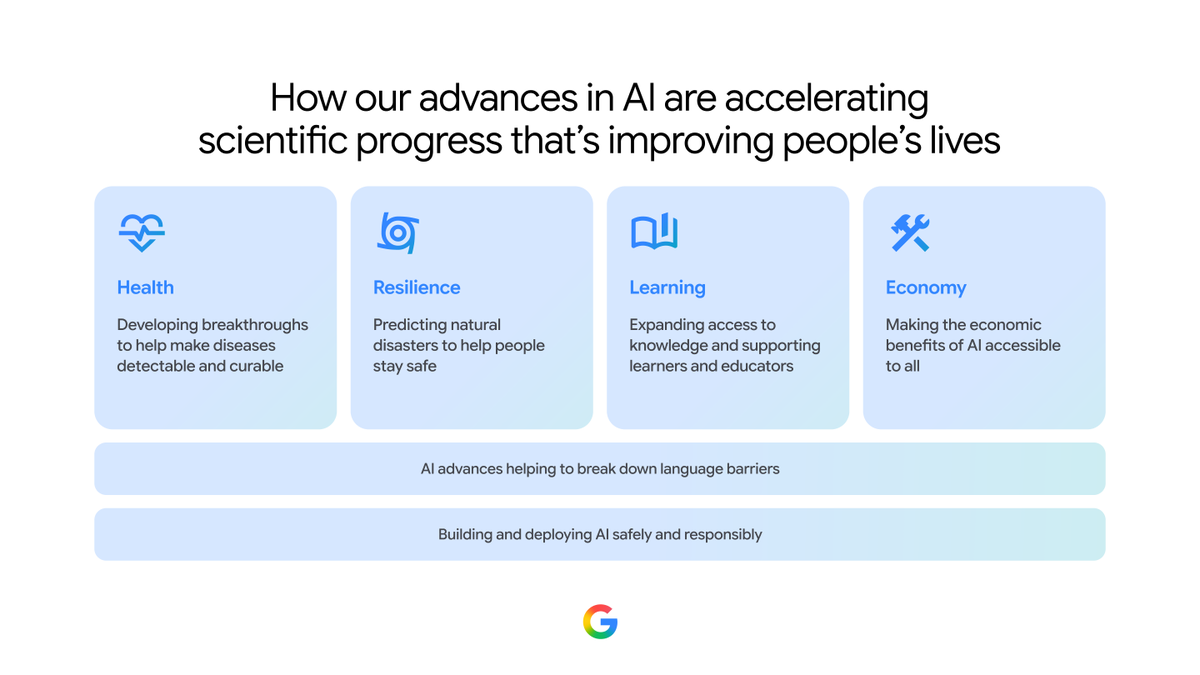
Today we have set out how we’re building AI to accelerate science and improve people’s lives. Just some examples in the last week or so:
- Mapped all 9B possible single letter genetic changes across the human genome with AlphaGenome Atlas and made it openly available to researchers.
- Billions of decisions depend on weather predictions so we introduced WeatherNext 3, our most accurate and capable global weather AI model to date.
- We published AI & Economy ATLAS, a comprehensive open-access look at how people are using AI globally.
- AI has enabled extraordinary advances in language translation. Today our services are available in nearly 300 languages, spoken by 7B people
We’re focusing our efforts on four key areas: health, natural disaster and weather resilience, learning, and economic opportunity. https://t.co/DDKcUTYj54
This is the kind of education India actually needs.
290 students from 60 colleges across the country spent 22 hours at Anna University, Chennai solving real industrial problems.
Detecting leaks in underwater pipelines. Designing a passive cooling laptop stand. Building a multi mission UAV platform. Not another mock exam.
They worked with CAD, simulations and system architecture under time pressure. No fancy prototypes. Just thinking, designing and solving.
That is the gap. Our industries need engineers who can take a messy problem and ship a workable idea.
Brain Bolt by the American Society of Mechanical Engineers (ASME) India at Anna University Chennai puts industry grade challenges directly in students hands and asks them to think across disciplines.
Winners get announced at the International Mechanical Engineering Congress later this week.
The real win is already happening in those halls.