Harness Engineering, visualized.
Most agent failures aren't model problems. They're environment problems.
The 7 jobs of a production harness:
1. Contract
2. Map, not manual
3. Tools
4. Durable memory
5. Sensors
6. Permissions
7. Traces
https://t.co/n2L3YJUYnE
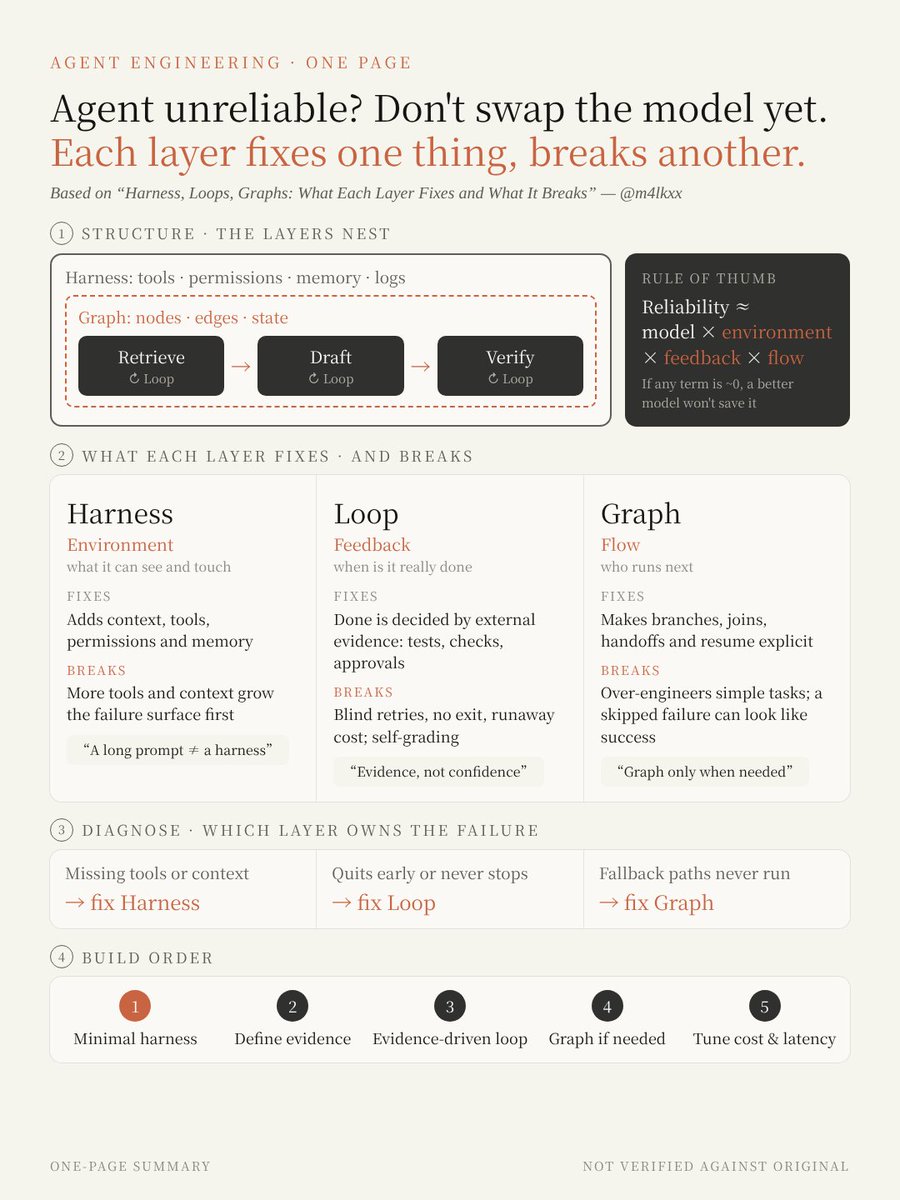
Agent unreliable? Don’t swap the model yet.
Three layers, each fixing one thing and breaking another:
Harness → what it can see & touch
Loop → when it’s actually done
Graph → who runs next
Reliability ≈ model × environment × feedback × flow
One-page breakdown of @m4lkxx’s “Harness, Loops, Graphs”
Your agent is not autonomous
You are its loop
You check every step because nothing else in the system can
I broke down the 7 levels from babysitting agents to running a fleet ↓ https://t.co/4RacdXA4nE
both OpenAI and Anthropic's next flagships “leaked.”
First, this is not an announcement.
Confirmed: the names showed up.
GPT-6.2 Astra appeared in Codex, Claude Mythos 5.5 appeared in Anthropic's source code.
Unconfirmed: performance, release dates, and whether these are actually the next generation. No official word on any of it.
Debunked: the circulating Fable 5.5 specs are copied from 5.1, and the 14T weight-library claim has been debunked. Stop reposting those.
What the leak is really worth watching isn't the names. It's the timing.
Both surfacing on the same night means the next generation is close enough that it can't be hidden anymore.
But a name showing up is not a product launch.
Are you waiting for the official announcement, or already believing the leak?
The real story isn't HackerTube itself. It's that it took about 2 hours.A project that used to take weeks or months now needs only three manual steps: create an API key, spin up a VPS, buy a domain. The rest — updating, hardening, deploying, optimizing — all went to Claude.
You asked what else we haven't thought of. Maybe the answer is this: the bottleneck is no longer how fast we can write code, but whether we dare to hand over a whole pipeline at once.
DeepSeek just said it plainly: with one task, the model is the bottleneck. With many, you are.
The idea in one picture
2/ Why you? Because a person can only watch about 3–5 chat windows at once.
After that you become a human scheduler: where is each task, should that one continue, copy the context over again...
3/ Their fix works like a restaurant.
The front desk (Router) only talks to you and hands out orders. The kitchen (Workers) gives each order its own stove, all cooking at once.
The kitchen never talks to you. Everything goes out through the front desk.
4/ A few small touches:
· Messages are filtered first, so trivia never bothers the front desk · Follow-ups on a job go straight to its stove · A "watchdog" keeps an eye out and nudges anything that's stuck
5/ Results (simulated test):
95% of tasks finish within 15.7 min, down from 29.5. Nearly twice as fast.
The price: a lot more tokens (~23M vs ~6M).
6/ My favorite line:
Human attention is the real budget.
Every ping should earn its place. When there's nothing to say, stay quiet.
7/ Fair warning: this is a research prototype, not a finished product.
Prompt injection is still an open risk, and the test was simulated, so it doesn't prove better coding. Use it in small, trusted setups.
Prompting is not the job anymore.
This explainer walks the real progression:
Prompts → Agents → Loops → Graphs.
Prompts tell a model what to do.
Agents use tools, context, and reasoning to finish tasks.
Loops repeat execution, feedback, evaluation, and improvement.
Graphs connect agents, tools, decisions, and shared state into a structured workflow.
The question is no longer how to write a better prompt.
It's how to build a system that can coordinate complex work reliably.
Start with the loop, then earn the graph.
someone just reverse-engineered Lovable's growth for $0.58.
not a consultant. a Claude Code skill by @jasonzhou1993.
it lined up 2+ years of launches, ads and hires against traffic.
one of its biggest wins wasn't a launch. it was an affiliate badge.
here's how it works 👇 https://t.co/v44dj3EyTM
Introducing /REA-growth skill
Reverse-engineer any company's growth
- Name any company, get its growth blueprint
- Every move on its timeline: SEO, AEO, ads, social
- $0.58 for a full Lovable teardown
- Fully OpenSource
Try it at https://t.co/m9kFVsgRCV
Partnered with @sharenow_today
Repo link below 👇
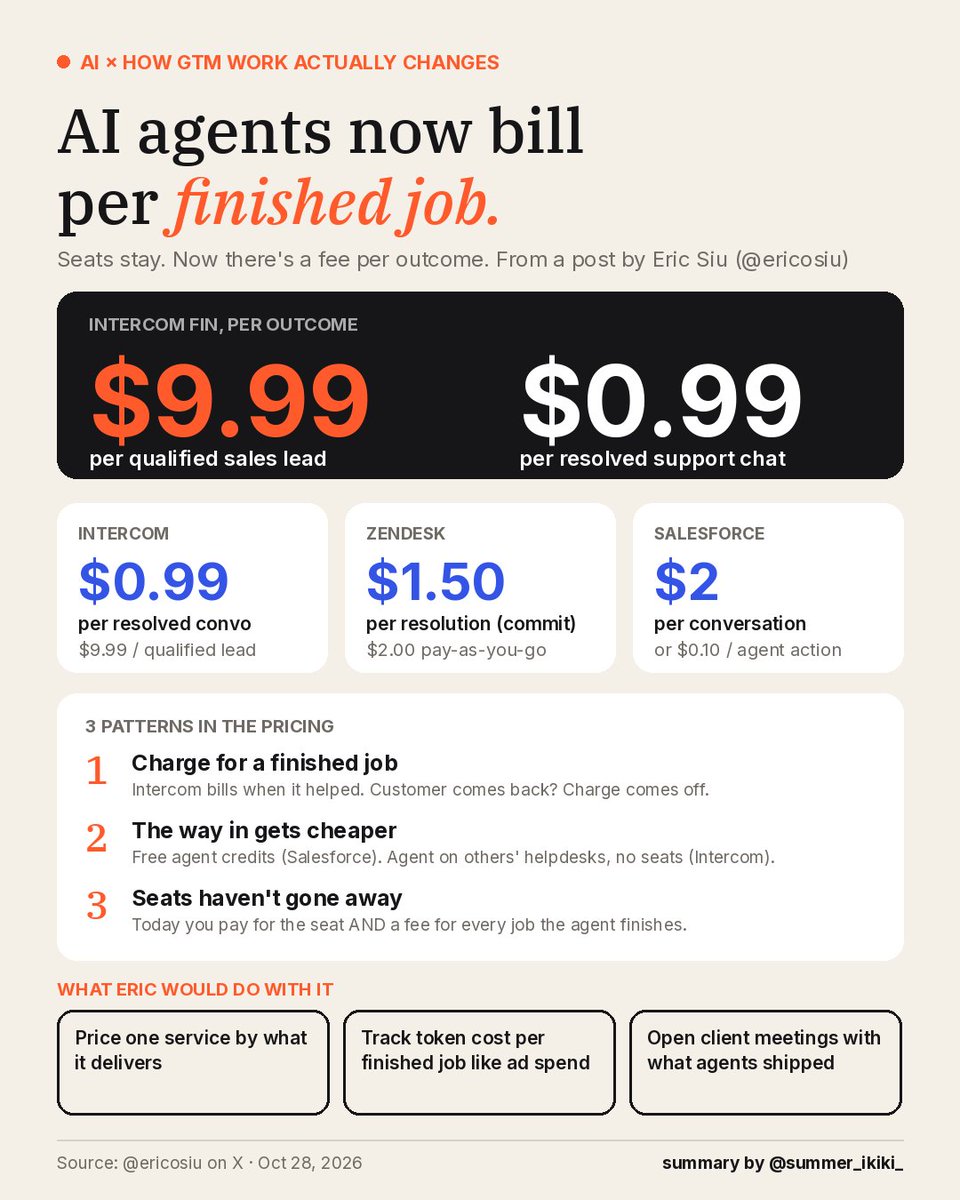
intercom now charges $9.99 when its AI agent qualifies a sales lead. $0.99 when it resolves a support chat.
people think AI kills the seat. per @ericosiu's breakdown, it doesn't: you pay the seat AND a fee per finished job.
cost per lead is a line item on your software invoice.
https://t.co/9ksX6dcQrd
Intercom now charges $9.99 every time its AI agent qualifies a sales lead, and $0.99 every time it resolves a support chat.
3 of the biggest support platforms already bill for it (breakdown):
> Intercom: $0.99 per resolved conversation, $9.99 per qualified lead
> Zendesk: $1.50 per resolution on a commitment, $2.00 pay as you go
> Salesforce: $2 per conversation, or $0.10 per agent action
1. They charge for a finished job
> Intercom bills when the customer says the answer helped or leaves without asking for more
> If that customer comes back to the same conversation, the charge comes off
2. The way in gets cheaper
> Salesforce gives Enterprise customers a pile of free agent credits to start
> Intercom sells its agent on top of Zendesk or Salesforce with no seat fees
3. Seats haven't gone away
> Intercom's help desk is still priced per seat, and so are Zendesk's plans
> For now you pay for the seat and then a fee for every job the agent finishes
I said in July that more agency services would move from hourly billing to pricing on what ships. Software is getting there first.
What I'd do with it:
> Price one service by what it delivers, since clients care what shipped and what changed
> Track token cost per finished job the way you track ad spend
> Start client meetings with what your agents shipped that week
AI search is now losing on both sides.
Google just admitted it: AI Mode earns less per query than traditional search.
Reddit just said it out loud too: its CEO told the Q3 call that Google's AI-driven search brings the platform no traffic — search referrals fell by more than 1 million visits per week on average in October.
The search company earns less. The publishers get no traffic at all.
If the answer is given directly, where do traffic and ads go? Who pays for content?
If progress is vertical, “catching up” is the wrong goal. You don't catch a vertical curve.
You build a system that re-evaluates itself monthly. Otherwise your standardized workflow is just standardized lag.
It’s almost incomprehensible how wide the distance is between someone who’s working at the frontier with AI and basically everyone else right now.
The crazy thing is these lines are not converging, but only growing farther apart. If the curve of AI progress had leveled off, it would certainly have given most people and companies time to catch up or implement their workflows in a standardized way. The technology would have neutralized competitive advantage because everyone would be using it the same way.
But what’s happened is the opposite. The curve of AI progress is basically going vertical right now, which means if you had codified your processes 3-6 months ago you’re likely already behind again. Now imagine most companies that kicked into gear a year ago and thought that they were done. Even further behind now.
I’ve never seen a technology in my life and career that improves at this rate, which consequently means you need to upgrade your expectations at a similar rate. Our brains weren’t wired for this, and our organizational change management processes certainly weren’t either.
With any form of recursive self improvement, things just get wilder. It’s a time when you will need to be constantly reevaluating the things that didn’t work just a couple months ago to see if they now can be solved. AI native companies certainly have a strong advantage due to this right now, so now it comes down to can the bigger companies keep up. Wild times.
@alliekmiller honestly the boardroom one is the real gap. right now every team has its own ai and none of them talk, so it's just org silos with better autocomplete
my whole career has been guessing what people like from clicks and surveys nobody finishes. this just skips straight to the brain. a/b testing got a very creepy little sibling https://t.co/cfEfgrLNzZ
Introducing RL with Neural Feedback (RLNF). We have found reliable ways to train AI models to respond to human preferences purely from brain signals.
The example below is a picture of a face that self-transforms into a more attractive version for the subject as they are looking at it.
@b4dgerr building a marketing tool and struggling with distribution is the most honest irony in saas. you're your own first case study, so post the struggle, that's the content
@HarryStebbings the part nobody says out loud: a lot of those roles were built for work the company now wants agents to do. that's a strategy change, not a verdict on the people
@rdominguezibar an ai that lives in your texts is such a sneaky good wedge. no new app to download, no habit to build, it just shows up where you already are