@bsindia "Legal experts have asserted that the EC’s claim that the Supreme Court had approved this parent-mapping declaration in the online form, which was included in July this year, is incorrect; there is no specific adjudication on this point." But your editorial is too late
#Opinion | Corporate India is not always the saviour
Small and regional businesses are already serving #India’s emerging mass market, but access to capital remains their biggest impediment. Policy needs to recognise India’s multi-tiered base of consumers, suppliers and employers, writes Rama Bijapurkar
https://t.co/qNFUqGTyO1
@bsindia Can't agree more: "A segment of small businesses sits at the confluence of consumption, mass markets and employment. Yet the notion exists of big “industry” being the propeller of all forward movement, while those already there are not offered the same facilitation."
@bsindia MNCs ..consistently followed a strategy of “let’s serve the top of the income pyramid & wait for the rest to attain income levels worthy of being served” & found that, far from being eagerly embraced when consumer incomes grew, they had to fight to get into the consideration set
@bsindia "In the last 20 years, and with the advent of the digital age, ......the small unorganised sector, now goods and services tax-purified, evolved and, in many cases, started offering superior consumer-perceived value (benefit minus cost) compared to larger corporations."
#Take2WithBS | #India’s power shortages are back, and the warning signs are hard to miss.
Between April 1 and September 20, evening power shortfalls were more than four times last year’s level, while the grid spent 30% of evening hours below 49.90Hz.
✍️ @abhishekecon, Praveen Ravi, Navneeraj Sharma and @arvindsubraman
https://t.co/abZkMWv3Ux
@bsindia@abhishekecon "The success of renewables has obscured these fundamentals. And while there are some good apples, most state governments are culpable, with many richer states’ electricity systems probably faring worse than others"
@bsindia@abhishekecon 🎯"India’s electricity distribution system has been in trouble for some time and is approaching crisis levels because of years of under-investment, poor management, perverse incentives, and disastrously inefficient and costly populism."
🚨#Important: Several petitions are now being filed in the High Courts and the Supreme Court “against” the actions of Chief Election Commissioner Gyanesh Kumar.
But we must not forget what happened the last time citizens knocked on the doors of the judiciary. The Supreme Court ENSURED that the SIR happened in Bengal in whatever manner barely months before the election. When the consequences of mass voters deletions became impossible to ignore, Justice Joymalya Bagchi in that bench made an extraordinary observation that those unable to vote “this time” could vote “next time”.
Who is to tell him that there is no “next time” for a possibly stolen election?
So because the courts are constitutional institutions, let them hear these new petitions against Gyanesh as many times as they want. Let them pass whatever orders they want to. But our democratic demand for Gyanesh Kumar’s accountability will NOT BE outsourced to the courtrooms.
The people will decide.
Because ultimately, neither an Election Commissioner nor a judge owns Indian democracy. We, the People, do.
@Cockroachisback@abhijeet_dipke@AshutoshRanka
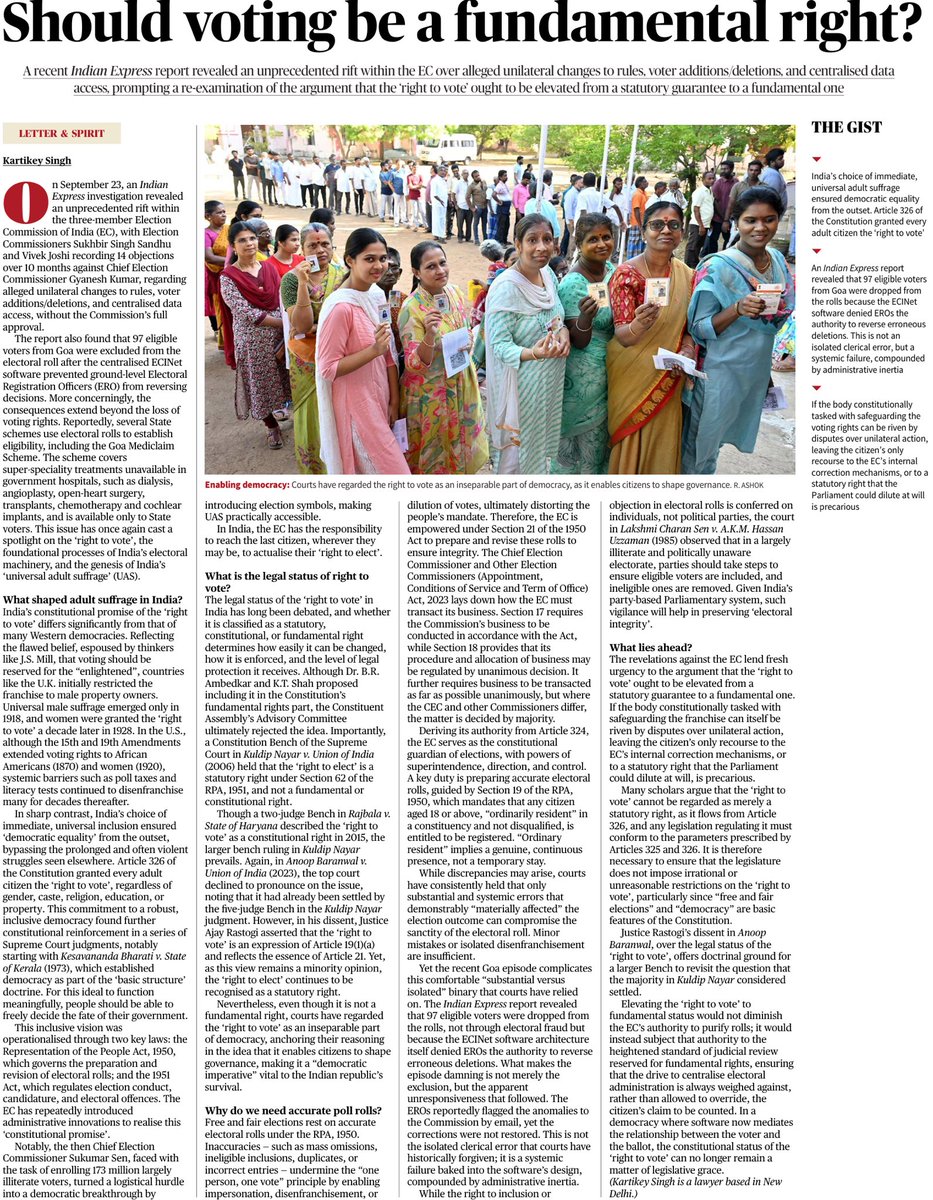
@nramind “In a democracy where software now mediates the relationship between the voter and the ballot, the constitutional status of the
'right to vote' can no longer remain a matter of legislative grace” 🎯
Should the right of an Indian citizen to vote be elevated to the status of a fundamental right? Yes, contends lawyer Kartikey Singh in this incisive, well-substantiated article published in The Hindu (September 28, 2026):
“Elevating the 'right to vote' to
fundamental status would not diminish the EC's authority to purify rolls; it would instead subject that authority to the heightened standard of judicial review reserved for fundamental rights, ensuring that the drive to centralise electoral administration is always weighed against, rather than allowed to override, the citizen's claim to be counted. In a democracy where software now mediates the relationship between the voter and the ballot, the constitutional status of the
'right to vote' can no longer remain a matter of legislative grace.”
@bsindia@HaseebDrabu "Delhi begins life as an advance estimate, graduates to an estimate, becomes pre-final, is then revised, becomes actual & is revised again when a new series arrives. Delhi’s data is produced by people who can always issue a corrigendum. Mumbai’s by people who live by the close"👋
Read “Deep rot,” today’s lead editorial in The Hindu: https://t.co/Jj0HMlMxJr
Electoral fraud is not uncommon in electoral democracies. But the SIR (Special Intensive Revision) conducted by the Election Commission of India under the authoritarian and arrogant reign of Gyanesh Kumar belongs to a special species. It is now beyond dispute that the SIR done in several States, and worst of all in West Bengal, has inflicted a grievous and seemingly irreparable wound on India’s electoral democracy. The revelation that Chief Election Commissioner Kumar pushed through decisions related to the SIR without the knowledge, let alone consent, of the two other Election Commissioners shows arbitrariness and lawlessness of the worst kind. The Indian Express must be commended for its investigation, which has exposed how deep and how high the rot has gone into the electoral system. Unfortunately, when the scandal of the ongoing SIR was taken to the Supreme Court of India in the expectation that it would act to uphold the constitutional guarantee of universal adult franchise, the highest court in the land failed the big test. Gyanesh Kumar must resign. An impeachment motion to remove the CEC is unlikely to make headway, given the numbers in the Lok Sabha. If Gyanesh Kumar, with the backing of the Union government, decides to brazen it out, mass democratic protest will be the only way to force him out.
The brilliant investigation by @RitikaChopra__ shows the SIR farce that is deleting nearly 13 crore voters in the country is-
-a centrally controlled secret system to decide who should be on the voter list
- being controlled single-handedly by the Chief election commissioner, Gyanesh Kumar, with the help of DG (IT) Seema Khanna, in violation of the statutory framework.
The election commission, which consists of 3 commissioners, has to take decisions either unanimously or by majority. The Investigation shows that 2 out of the 3 commissioners in the ECI were kept in the dark and their serious objections about the SIR were not taken on board.
When the SIR had started in the country I had filed an RTI application asking for a copy of the files vide which decision was taken to undertake the SIR. The Principal Secretary of ECI said on record- “Commission has so far not taken any decision on initiating a Special Intensive Revision (SIR) across the country in 2025!”
So the question today is: Who is really calling the shots and taking decisions about the SIR, if it isn’t the ECI? Is it the MHA? Or the PMO?
From Changes in Form 6 to SIR Voter Deletion Appeals, 2 Out of 3 Election Commissioners Objected 14 Times in 10 Months: Report https://t.co/5dW6ioz9lM via @thewire_In
Specific question to ECI:
Did the two Election Commissioners object to the proposed changes to Form 6 (new voter form). If so, how did the ECI make changes to Form 6 ? Clearly it wasn’t a majority decision.
While deliberations and discussions are expected in any decision-making process and deserve appreciation, but if the Election Commissioners as reported by @IndianExpress had contended that only the government holds authority to amend Form 6, not the ECI, how was this disagreement resolved because it was Commission that made changes to Form 6 and not the Govt.