Companies are spending billions on AI subscriptions every month. But how much value are these tools really providing in return?
John Burn-Murdoch examines the data behind a new study about the technology's impact on productivity. https://t.co/WMRWATE849
GOLD FALLS 1% AS FED, MIDDLE EAST PRESSURE MOUNTS
Gold posted a second straight loss as renewed Middle East military action and hawkish Fed expectations pressured prices.
Front-month gold settled 1% lower at $4,431.10/oz, but still gained 9.4% in August.
Silver fell 1.2% to $66.221/oz, while posting a 15% monthly gain.
Markets now turn to upcoming U.S. inflation and labor data for direction.
UBS SEES S&P 500 BULL RUN EXTENDING
UBS raised its S&P 500 targets to 8,100 for December 2026 and 8,400 for June 2027, citing stronger earnings and resilient growth.
The bank now expects EPS of $350 in 2026 and $400 in 2027, driven by strength in technology, semiconductors and energy.
UBS remains bullish on resilient economic growth, a patient Fed and accelerating AI adoption.
Key risks include higher oil prices, renewed inflation and disappointing AI returns.
$TLT
Chair Kevin Warsh's proposal to give markets less insight into the Fed's reaction function would not improve policymaker feedback, but could instead delay monetary policy transmission and create unnecessary volatility in financial markets.
While everyone's distracted by the Leopold fund collapse, Japan could crash the world economy.
Here's what nobody connected this week.
The Bank of Japan held its rates. No hike.
Then it did something it almost never does. It stepped into the market and bought its own currency.
Then the part that should be front page everywhere.
The US Treasury bought Japanese yen. First time in decades.
America is now defending Japan's currency.
Why?
Because the yen is what paid for America's party.
Japan is the largest foreign holder of US treasuries. For decades, investors borrowed yen at nearly 0% and pumped it into US markets. Stocks, tech, AI. It's called the yen carry trade, and it's been quietly funding America's debt for thirty years.
Until now.
Japan already spent $74 billion trying to stop the slide this year. It failed. The yen hit its weakest level since 1986.
So this week, both governments went in together. The yen ripped 4% in two days.
Currencies aren't supposed to move like that. When they do, someone is being forced out.
The same borrowed yen that pumped the AI trade is the money now leaving it. Leopold's fund wasn't a one-off. It was the first exit in a crowded theater.
Wall Street knows. They've been piling into the carry trade harder than they have in decades. [SHOW: 'Carry Trade Returns Soar Most in Decades' 7/21]
Not because they know something you don't. Because the returns were too good to leave.
And crowded exits are how small moves turn into crashes.
In 1987, Germany raised rates against a weak dollar. Two months later, the S&P fell over 20% in one day. Black Monday.
In 2026, it's Japan.
Except this time, the US government is already in the market - buying yen with its own reserves, trying to control the exit.
Governments don't do that unless the alternative is worse.
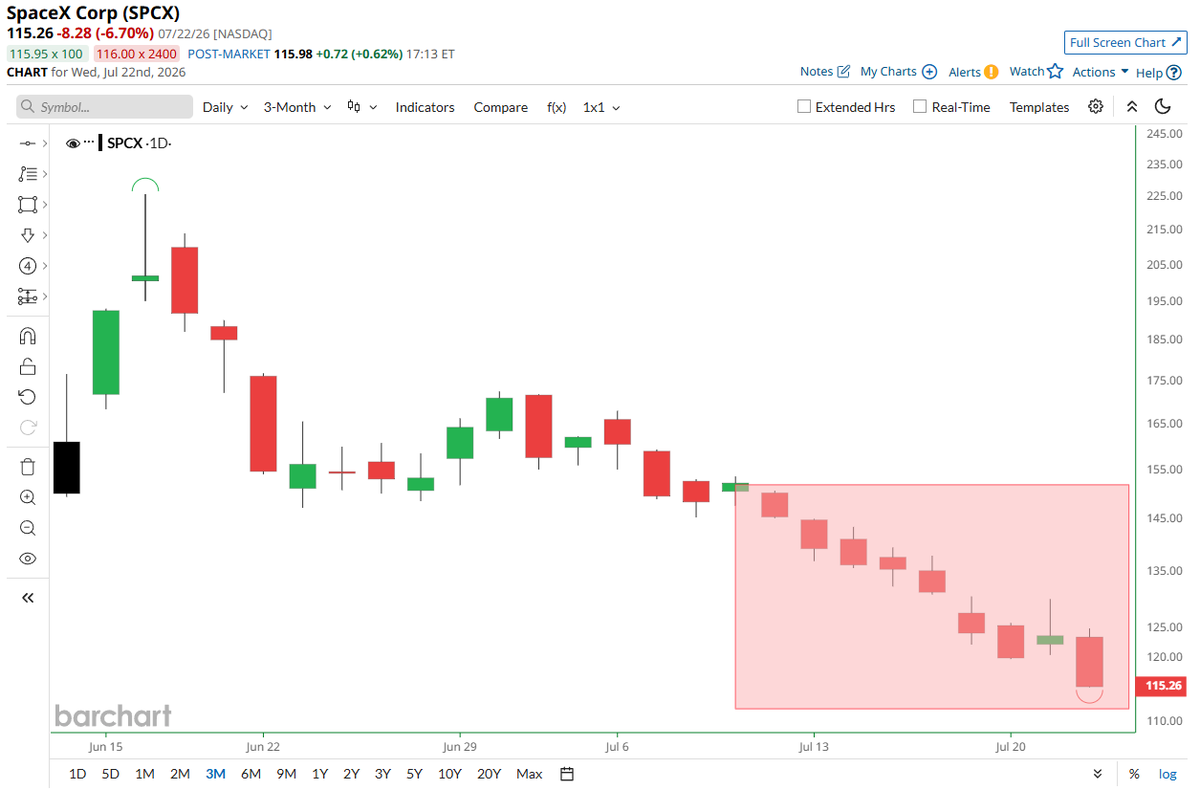
$SPCX closed just above $115, nearly 20% below its IPO price and almost 50% below its high. This could be a harbinger of things to come for other overhyped stocks and cryptos. Look out below!
BREAKING 🚨: SpaceX
$SPCX falls to its lowest price in history and has now plunged 49% from June's all-time high, a total market cap loss of almost $1.5 Trillion 📉 📉
$SPCX
People constantly ask me if I would buy SPACEX
I would, it needs to get pass the lockup and have more chart history
I would also prob nibble around $100 bucks









![casper_smc's tweet photo. While everyone's distracted by the Leopold fund collapse, Japan could crash the world economy.
Here's what nobody connected this week.
The Bank of Japan held its rates. No hike.
Then it did something it almost never does. It stepped into the market and bought its own currency.
Then the part that should be front page everywhere.
The US Treasury bought Japanese yen. First time in decades.
America is now defending Japan's currency.
Why?
Because the yen is what paid for America's party.
Japan is the largest foreign holder of US treasuries. For decades, investors borrowed yen at nearly 0% and pumped it into US markets. Stocks, tech, AI. It's called the yen carry trade, and it's been quietly funding America's debt for thirty years.
Until now.
Japan already spent $74 billion trying to stop the slide this year. It failed. The yen hit its weakest level since 1986.
So this week, both governments went in together. The yen ripped 4% in two days.
Currencies aren't supposed to move like that. When they do, someone is being forced out.
The same borrowed yen that pumped the AI trade is the money now leaving it. Leopold's fund wasn't a one-off. It was the first exit in a crowded theater.
Wall Street knows. They've been piling into the carry trade harder than they have in decades. [SHOW: 'Carry Trade Returns Soar Most in Decades' 7/21]
Not because they know something you don't. Because the returns were too good to leave.
And crowded exits are how small moves turn into crashes.
In 1987, Germany raised rates against a weak dollar. Two months later, the S&P fell over 20% in one day. Black Monday.
In 2026, it's Japan.
Except this time, the US government is already in the market - buying yen with its own reserves, trying to control the exit.
Governments don't do that unless the alternative is worse.](https://pbs.twimg.com/media/HOm6tJYXMAAyHBV.jpg)