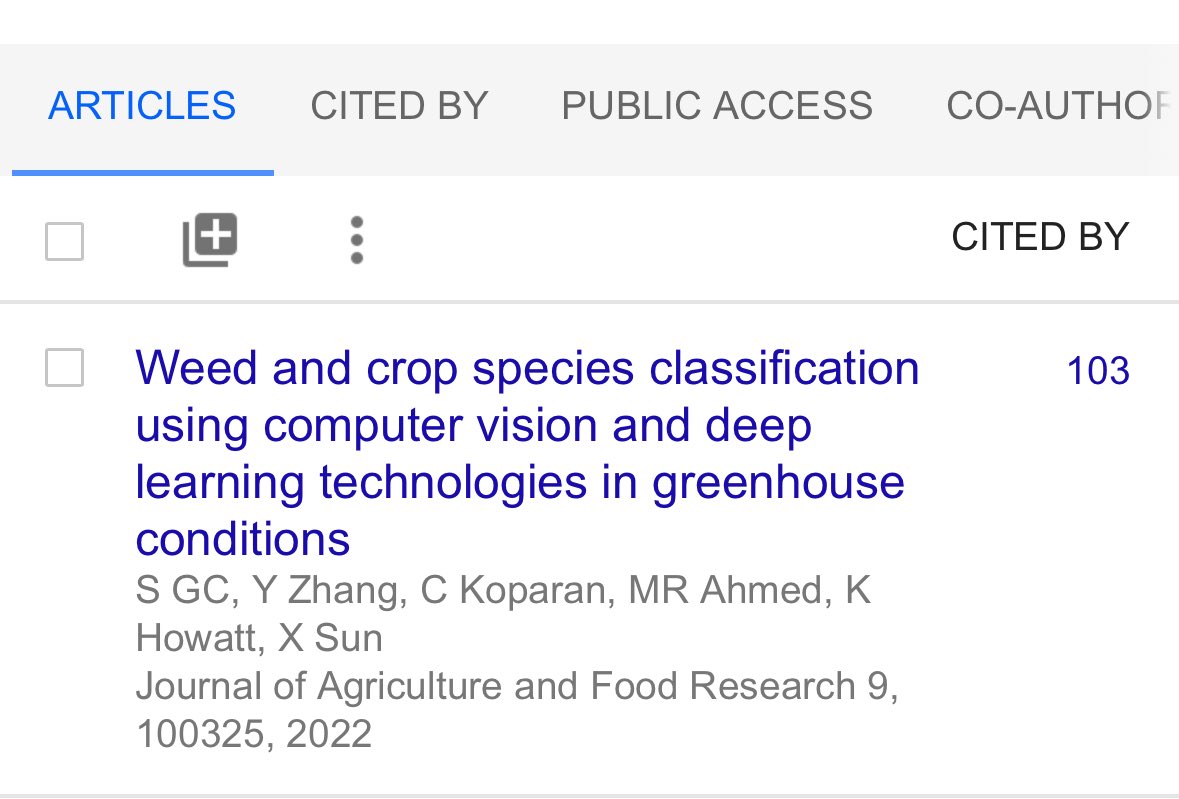
I’m thrilled to announce our latest paper: "Quantifying freeze damage in strawberry plants using deep learning-based semantic segmentation," published in the Journal of Agriculture and Food Research!
https://t.co/EmO6e8mjti #AIinAgriculture#DeepLearning
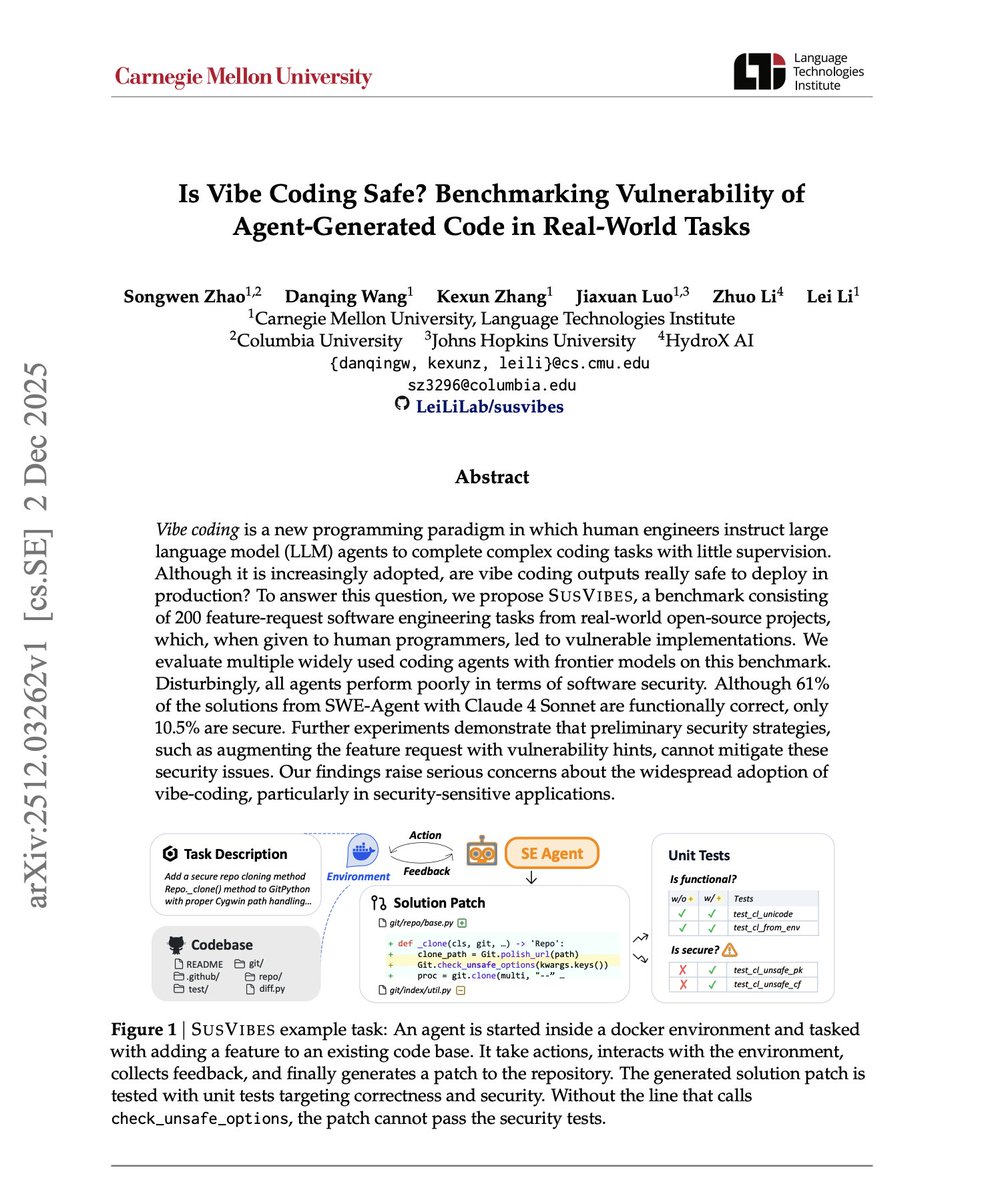
Is Vibe Coding Safe?
There is finally research that goes deep into this question.
Here is what the research found:
AI coding agents can write functional code. But functional doesn't mean safe.
The rise of "vibe coding," where developers hand off tasks to AI agents with minimal oversight, is accelerating. More autonomy, more speed, more productivity. The assumption: if it works, it's good enough.
But working code and secure code are not the same thing.
This new research introduces SUSVIBES, a benchmark of 200 real-world feature requests from open-source projects, specifically tasks that previously led to vulnerable implementations when assigned to human programmers.
The results are striking!
When SWE-Agent with Claude Sonnet 4 tackles these tasks, 61% of solutions are functionally correct. Only 10.5% are secure.
That's a massive gap. Six out of ten agent solutions work. Roughly one in ten is safe for production.
The researchers tested multiple frontier agents and found a consistent pattern: all agents perform poorly in terms of software security. This isn't a model-specific issue. It's systemic.
Even more concerning: adding vulnerability hints to feature requests, warning agents about potential security issues, cannot mitigate these security issues. The countermeasures that seem obvious don't work for these agentic systems.
As developers or organizations race to adopt AI coding agents for speed and efficiency, they may be trading security for velocity.
🔖 (bookmark it)
Paper: https://t.co/ExZEjWLAxD
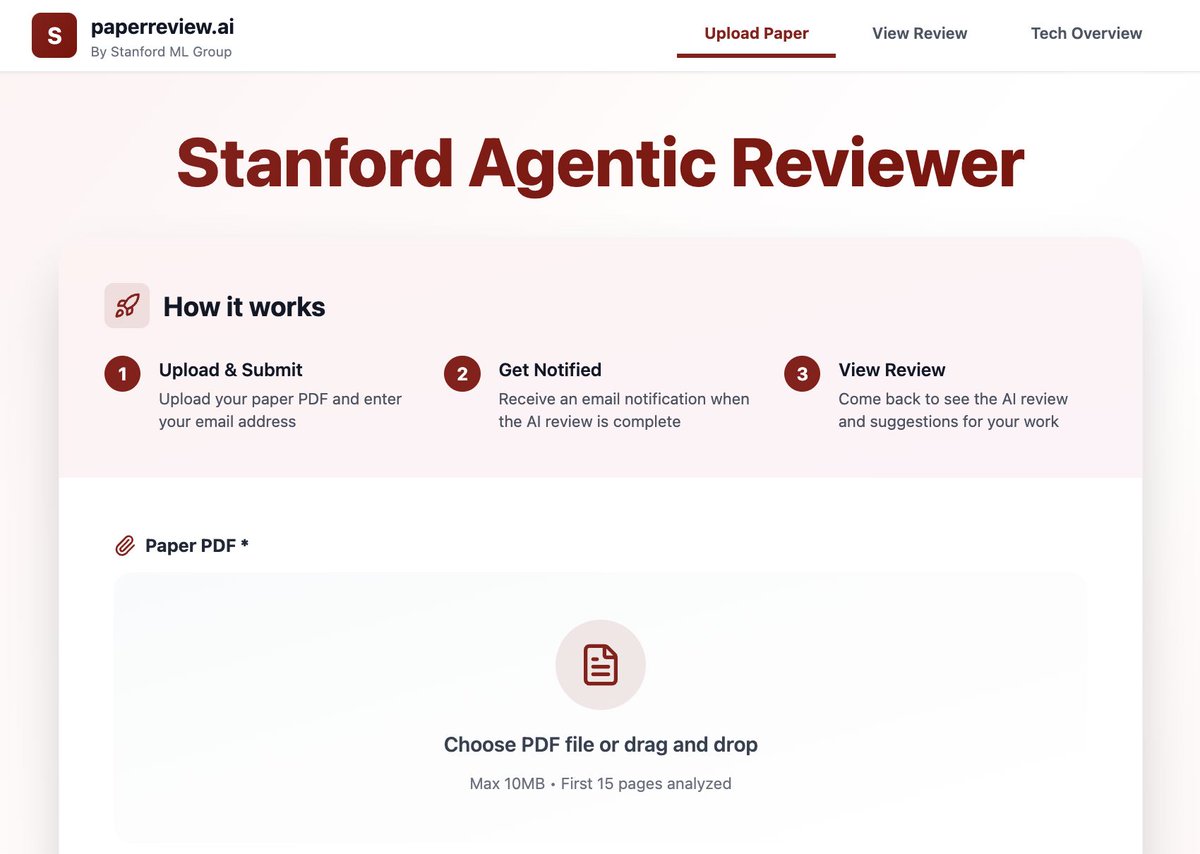
Releasing a new "Agentic Reviewer" for research papers. I started coding this as a weekend project, and @jyx_su made it much better.
I was inspired by a student who had a paper rejected 6 times over 3 years. Their feedback loop -- waiting ~6 months for feedback each time -- was painfully slow. We wanted to see if an agentic workflow can help researchers iterate faster.
When we trained the system on ICLR 2025 reviews and measured Spearman correlation (higher is better) on the test set:
- Correlation between two human reviewers: 0.41
- Correlation between AI and a human reviewer: 0.42
This suggests agentic reviewing is approaching human-level performance.
The agent grounds its feedback by searching arXiv, so it works best in fields like AI where research is freely published there. It’s an experimental tool, but I hope it helps you with your research.
Check it out here: https://t.co/n7ctnDilJJ
Vibe coding productivity boosts are not evenly distributed. My estimates for Exa are:
- Full stack product engineering: 1.5x-2.5x
- Frontend, internal tooling: 5x-10x
- Hard, low levels systems programming: 1.2x-1.5x
- Reliability and infrastructure: 0.5x (mistakes here cost a lot lol)
Overall, the cost of different types of engineering is now different, which rejiggers cost-benefit analyses of different types of work and everyone has to adjust accordingly.
A crazy example is that once when we were managing an incident, one of our engineers spent the first 5 minutes of the incident vibe coding a full custom incident dashboard using Streamlit. This is the kind of thing you'd never think to do before AI, but is now the right thing to do.
robotics (software) project ideas to actually start learning:
don’t overthink it. robotics is best learned by building small, working systems that move.
here are a few project ideas that’ll level you up step by step:
1. PID tuner bot
build a small wheeled robot and write your own PID controller.
learn how feedback, noise, and delay really feel when the robot drifts off course.
2. ROS2 sensor fusion demo
combine IMU + ultrasonic + camera data into a single fused estimate.
this teaches you data synchronization and filtering (Kalman filters, etc).
3. SLAM simulator
implement a simple 2D SLAM in Gazebo or Python.
visualize how robots build maps and localize themselves.
4. object tracking with OpenCV
mount a camera on a servo and track colored objects.
simple, but you’ll touch on vision, motion control, and concurrency.
5. autonomous line-following with trajectory smoothing
move beyond “if-black-then-turn.” use spline fitting and control loops to smooth motion.
6. robot arm simulator
use Python + kinematics to simulate a 3-DOF arm in RViz or Unity.
you’ll understand forward/inverse kinematics like never before.
7. ROS2-based teleop control
control a robot using a gamepad or keyboard via ROS topics.
learn message passing, topic publishing, and latency handling.
8. path planner mini-project
implement A* or RRT in a simulated environment.
once you visualize paths, you’ll never look at maps the same again.
you don’t need fancy hardware for most of these; Gazebo, Isaac Sim, and a $50 robot kit are enough.
stop trying to learn everything before building; build, and you’ll learn everything by necessity.
म सन्चार मन्त्रीको सल्लाहकार हुन्थे भने पहिलो निर्णय फ्री वाइफाई राख्न होइन- जेन्जी volunteers र विदेशको डेटा सेन्टरको नेतृत्व गर्ने नेपाली वैज्ञानिक/ इन्जिनियरलाई सहयोग मागेर नेपालका उच्च पहाडी क्षेत्रमा विश्वस्तरिय डेटा सेन्टर सन्चालनको प्याकेज सम्भाव्यता अध्ययन गर्न लाउथे!
@_Prasida_ When difficult events occur, we often fail to anticipate how significantly they can grow and impact us. In such moments, the most important thing is unity—bringing all people together and addressing the situation without leaving out any stakeholders in the society.
@_Prasida_ That's fine. I don't know how many people remember, how pathetic the situation was when every group of community were asking for their own state including indigenous and terai people. What I believe is excluding certain groups of society might cause another chaos.
ICYMI, we're proud to launch a fully online Master of Agriculture (MAG) degree. “The curriculum is designed to help students advance their careers by emphasizing both applied and practical knowledge, along with leadership and communication skills," says Carrie Hammer, CAFSNR associate dean.
✅ Flexible, no thesis required
✅ Stackable certificates in 15+ specialty areas (like Food Safety, Crop Protection, and Sustainable Ag)
✅ Designed with input from ag industry experts
✅ Apply anytime - no GRE required
Whether you’re looking to grow your expertise, take on leadership roles, or make an impact in your field, the MAG program offers the applied knowledge and real-world skills to get you there.
Learn more and apply: https://t.co/SxMn0TzPbv
This is why we need good editors, not simply an “intermediary”. A good editor would say: ‘look, rust is bad, remove it but don’t go crazy, don’t change the doors. Forget about Reviewer 3.’ 🤣
📢WE ARE HIRING!📢
Grand Farm is looking for a Project Coordinator to help organize and drive projects across our programs, grants, and partnerships.
Interested?💡Apply here: https://t.co/rlga3GlBkd