Chapter 1 of my audio deep learning series is live.
Here's why it opens with physics instead of PyTorch.
Most audio ML tutorials start at "load your spectrogram, feed it to a CNN." That works right up until it doesn't — and then you're debugging a model when the real problem was your sample rate, your filter, or the fact that the information you needed was never in the signal to begin with.
So Chapter 1 is the foundation everyone skips:
• Why sound needs a medium (and moves 35× faster in diamond than in air)
• The full spectrum — infrasound, audible range, ultrasound
• Sampling and the Nyquist theorem
• Quantization and bit depth
• WAV vs MP3 vs FLAC, and what each one costs you
Plus interactive visualizers — drag the sample rate down and watch reconstruction fall apart in real time. That did more for me than any equation.
This is a long series, not a one-off post. Chapter 2 covers signal processing: Fourier transforms, spectrograms, feature extraction. After that, we start building.
Chapter 1: https://t.co/uzYQqUc18R
Writing it in public, one chapter at a time. Tell me what you want covered.
#DeepLearning #AudioML #SignalProcessing #LearnInPublic
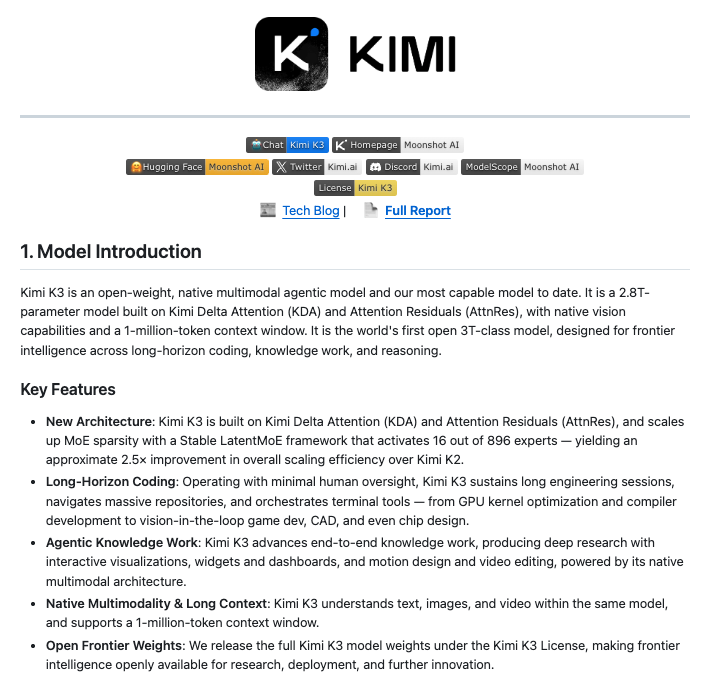
Kimi K3 is a massive leap forward for open-source AI.
Moonshot AI just released the full model weights and technical report:
• 2.8T total parameters
• 16 of 896 experts active per token
• 1M-token context window
• Native text, image, and video reasoning
• ~2.5× better scaling efficiency than Kimi K2
The standout: multimodality is built into the core model—not bolted on through separate encoders.
Moonshot also open-sourced the vLLM KDA prefill cache implementation and was refreshingly honest about K3’s limitations.
Open models are closing the gap fast.
https://t.co/lRvvLzOZUa
#AI #OpenSourceAI #LLM #MultimodalAI
Loop engineering is dead. Graph engineering is what comes next.
Most multi-agent systems are not really multi-agent systems.
They are queues:
Step 1 → Step 2 → Step 3 → Step 4
Every task waits, even when half the work is independent.
One agent carries the entire context until it becomes slow, expensive, and confused.
Graph engineering changes the shape of the work.
• Nodes perform bounded jobs
• Edges carry structured data
• Independent nodes run in parallel
• Routers choose paths dynamically
• Verifiers kill weak findings
• Barriers merge results only when necessary
• Cheaper models handle routine work
• Stronger models handle judgment
Prompters ask agents to work harder.
Architects design systems that work wider.
https://t.co/NcCMG1zWRW
Is China about to win the AI race?
Moonshot’s Kimi K3 suggests the winner may not be the country with the most compute—but the one that uses it best.
Kimi K3 is a 2.8-trillion-parameter open model reportedly reaching benchmark performance close to Fable 5 and GPT-5.6.
The real breakthrough is not just scale. It is the architecture:
• Kimi Delta Attention
• Stable LatentMoE
• Attention Residual
China may not be following the US AI playbook.
It may be rewriting it.
https://t.co/tuIUqMNqPF