Amazing news. This is why I am so optimistic about India. We have the brain power to solve our problems - and lead the world in solving the world's problems.
Pessimists who do not believe should watch from the sidelines as the optimists get it done!
I promise this will be the best 20 min you spend today! Robotics: Endgame, the sequel to my last year's Sequoia AI Ascent talk, "Physical Turing Test". I laid out the roadmap for solving Physical AGI as a simple parallel to the LLM success story. Be a good scientist, copy homework ;)
And stay till the end, more easter eggs and predictions for your polymarket!
00:30 DGX-1 origin story at OpenAI, I was there in 2016 signing with Jensen and Elon. Heading to the Computer History Museum!
01:42 The Great Parallel
03:31 Robotics, the Endgame
03:39 Why VLAs fall short
04:32 Video world models as the 2nd pretraining paradigm
06:09 World Action Models (WAM)
07:46 Strategies for robot data collection and the FSD equivalent to physical data flywheel for robot manipulation
11:06 EgoScale and the Dexterity Scaling Law we discovered recently
14:00 Physical RL: bridging the last mile
15:39 DreamDojo: an end-to-end neural physics engine for scaling RL in silico
17:00 Civilizational Technology Tree and my predictions for the near future. Spoiler: it's closer than you think.
Thanks to my friends at Sequoia for inviting me back to AI Ascent this year! I had a blast! Last year's talk is attached in the thread if you missed it.
@xwang_lk Spiritual life is not a theory
Make everything a win-win. Celebrate those who achieved and those attempted to achieve.
Our job is to push the rock... moving it well that's out of our control.
Great job. You got this @xwang_lk
Times Making AI Work Awards 2025!
From revolutionizing healthcare to redefining education and powering the future of energy, these visionaries are setting new benchmarks in AI-driven transformation:
Know More: https://t.co/EtsY2V7O4h
#ETMakingAIWorkAwards#ETMakingAIWork
Human generated data has fueled incredible AI progress, but what comes next? 📈
On the latest episode of our podcast, @FryRsquared and David Silver, VP of Reinforcement Learning, talk about how we could move from the era of relying on human data to one where AI could learn for itself.
Watch now →
00:00 Introduction
01:50 Era of experience
03:45 AlphaZero
10:19 Move 37
15:20 Reinforcement learning and human feedback
24:30 AlphaProof
29:50 Math Olympiads
35:00 Experience based methods
42:56 Hannah's reflections
44:00 Fan Hui joins
Thrilled to share new AI research advances from the FAIR team at Meta. These releases highlight our continued commitment towards open research.
Read our blog post for details. https://t.co/ZULFtSmePb
AI researchers seek to understand intelligence well enough to create beings of greater intelligence than current humans.
Reaching this profound intellectual milestone will enrich our economies and challenge our societal institutions. It will be unprecedented and transformational, but also a continuation of trends that are thousands of years old.
People have always created tools and been changed by them; this is what humans do.
The next big step is to understand ourselves.
This is a quest grand and glorious, and quintessentially human.
My mother is ~65 years old. She defended her PhD thesis two weeks ago. She got retired a few years ago, entered university again and started working on her thesis for 5-6 years. I hope my kids (and yours) follow her path of resistance.
The things I didn't know as a high school runner:
* sleep is essential to recovery
* progress depends on steady training and remaining injury free
* remaining injury free depends on diet, cross-training, posture, relaxation
* winning is wonderful but running hard is spiritual
Very excited about this paper and its implications. Turing-completeness of transformers implies they can simulate other models inside them. But it's nontrivial a net can do gradient updates on another net insided them which is 1/8th the size. Great work by the student team!
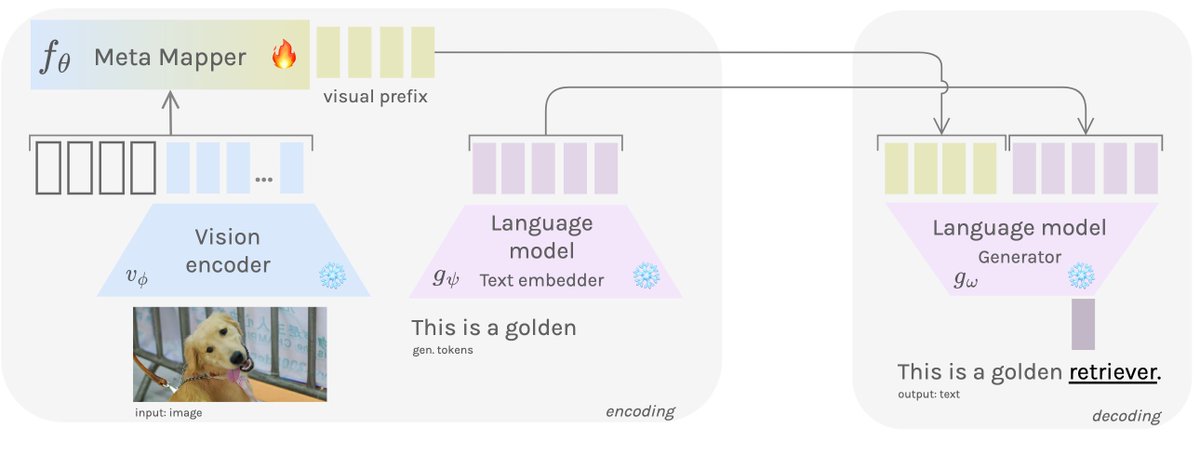
Interested in models that can learn quickly by observing only a few examples in a multimodal space? In our #ICLR2023 paper on multimodal few-shot learning, we leverage existing large-scale VL models to learn shared meta-knowledge and adapt rapidly to new samples! 🥳🧵⏭️ 1/n
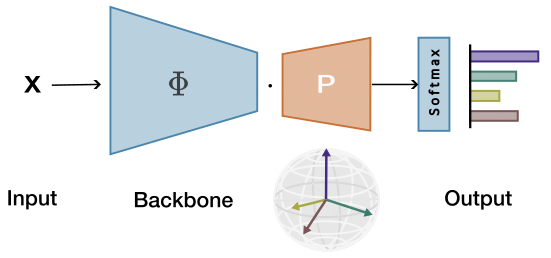
We show that maximum separation is not an optimization problem, but can be solved in closed-form prior to learning. The solution takes the form of a single matrix where all class vectors are equally separated. All we need to do is add this matrix before the softmax loss.
Bring Your Own Data! Self-Supervised Evaluation for Large Language Models
paper page: https://t.co/cXVomErRBV
With the rise of Large Language Models (LLMs) and their ubiquitous deployment in diverse domains, measuring language model behavior on realistic data is imperative. For example, a company deploying a client-facing chatbot must ensure that the model will not respond to client requests with profanity. Current evaluations approach this problem using small, domain-specific datasets with human-curated labels. These evaluation sets are often sampled from a narrow and simplified distribution, and data sources can unknowingly be leaked into the training set which can lead to misleading evaluations. To bypass these drawbacks, we propose a framework for self-supervised evaluation of LLMs by analyzing their sensitivity or invariance to transformations on the input text. Self-supervised evaluation can directly monitor LLM behavior on datasets collected in the wild or streamed during live model deployment. We demonstrate self-supervised evaluation strategies for measuring closed-book knowledge, toxicity, and long-range context dependence, in addition to sensitivity to grammatical structure and tokenization errors. When comparisons to similar human-labeled benchmarks are available, we find strong correlations between self-supervised and human-supervised evaluations. The self-supervised paradigm complements current evaluation strategies that rely on labeled data.