Welcome to the second half of the year.
The actions of hyperscalers in terms of their capital commitments will be key as the year proceeds, expect an uptick across the board, the demand is real.
The flip side - the funding sources will need to be from the capital markets. The largest companies will flip to negative cash flow except for one or two.
Hyperscalers have balance sheet capacity to do so (for 1-3 years), however new Frontier labs will need to go public, not sure there's more private market capital available to support their Capex needs. Of course, there's the chip guys, NVIDIA is at the party, will MU join the investment party to keep spending going?
We still need visibility for when AI revenues will start to fund much of this cash need.
Expect more advertising plays from LLMs, Token prices have to decline to drive Enterprise adoption. Expect LLMs to chase more vertical profit pools, legal, life science, expecting physical AI companies. Pure models will continue to see arbitrage with open source touching 30% usage, depth will create a better moat, breadth will commoditize. It's not a demand problem - "it's a monetization problem". Silicon valley has always built product with intensity and the market has funded adoption years.
This time it might just be too big and the market may not have capacity to fund everyone. "Darwinian moment for AI providers?"
If you are a founder, or a CEO - don't be distracted, focus on your product, how it gets better with AI. Eventually product and customer adoption will bring us to the other side, but expect a bit of a wild ride. We are still early in many PMF categories. Speed could create waste, but waiting and watching could leave us behind.
I want people to really process what Taylor Swift is doing here. She has the means to get married anywhere in the world but chooses something that inconveniences millions because she doesn’t see us as real people.
Her music has never been good enough for your worship, either.
Taylor Swift emits 8,300 tons of CO₂ emissions every year.
The average American emits just 16.
Zohran Mamdani wants New Yorkers to set their AC thermostats to 78 degrees.
Meanwhile, the AC will be blasting at Taylor Swift's wedding celebration at Madison Square Garden.
HYPOCRISY 🚨 Taylor Swift has a net worth of $2 billion dollars.
Swift is shutting down numerous streets in New York & costing NYC tax payers over $160,000 to "protect" her wedding at Madison Square Garden.
Where are the "anti billionaire" leftists protesting her wealth? Protesting her stupid wedding? Protesting her oligarchy?
Rules for thee but not for me. If this was a Republican there would be numerous headlines, leftists "protesting" it would be called a Nazi wedding.
🚨#BREAKING: THERE IS A MASSIVE ACTIVE SHOOTER SITUATION TAKING PLACE IN FAIRLANE MALL IN DEARBORN MICHIGAN.
PEOPLE ARE HIDING IN STOCK ROOMS AND RUNNING FOR THEIR LIVES.
PLEASE PRAY!!!!
WE DO NOT HAVE TO LIVE LIKE THIS!!!!!
My OG post now has a completely false community note that claims I did not design this plane, so I would like to clear some things up.
This plane is my design. The body shape is similar (not identical) because that’s what’s optimal for these design constraints. Rockets are all tall and pointy.
I’m sure Niels is an incredible engineer, and his plane is amazing. But this is my plane, designed by me from scratch (you can see a full 5-month building in public series on my LinkedIn, posted in realtime) and I’ve been building RC planes continuously since I was 10 (https://t.co/pajDW5lAtv). Took a closer look at Niels' video now, and here’s just a couple of the most obvious engineering differences I can reveal:
> Niels’ plane design is literally not available online. There were no build plans to copy from, but from photos it looks like he used foam+fiberglass overwrap. My plane is fully custom carbon fiber (internal structure CNC cut + skin, which I designed molds for and laid up myself).
> My fusion file has 1480 operations. I pulled dozens of all nighters (in my dorm!) to make it fully myself, from scratch.
> Fully custom inlet design with a bled boundary layer (not pictured in the OG post CAD, I iterated on it later. Pictured here)
> Fully custom DMLS 3D printed titanium nozzle (looks like Niels uses a stock nozzle? either way looks nothing like mine, feel free to look at photos of my nozzle + dev process on my LinkedIn)
> FPV (mine) vs line of sight (Niels)
> Launch method: I use a completely different custom 30ft aluminum extrusion catapult
There’s several more innovations that I can’t reveal right now to protect IP.
The design is mine, and I’ve had no problem proving that to any VC who has asked. You don’t have to take my word for it: more to come, stay tuned.
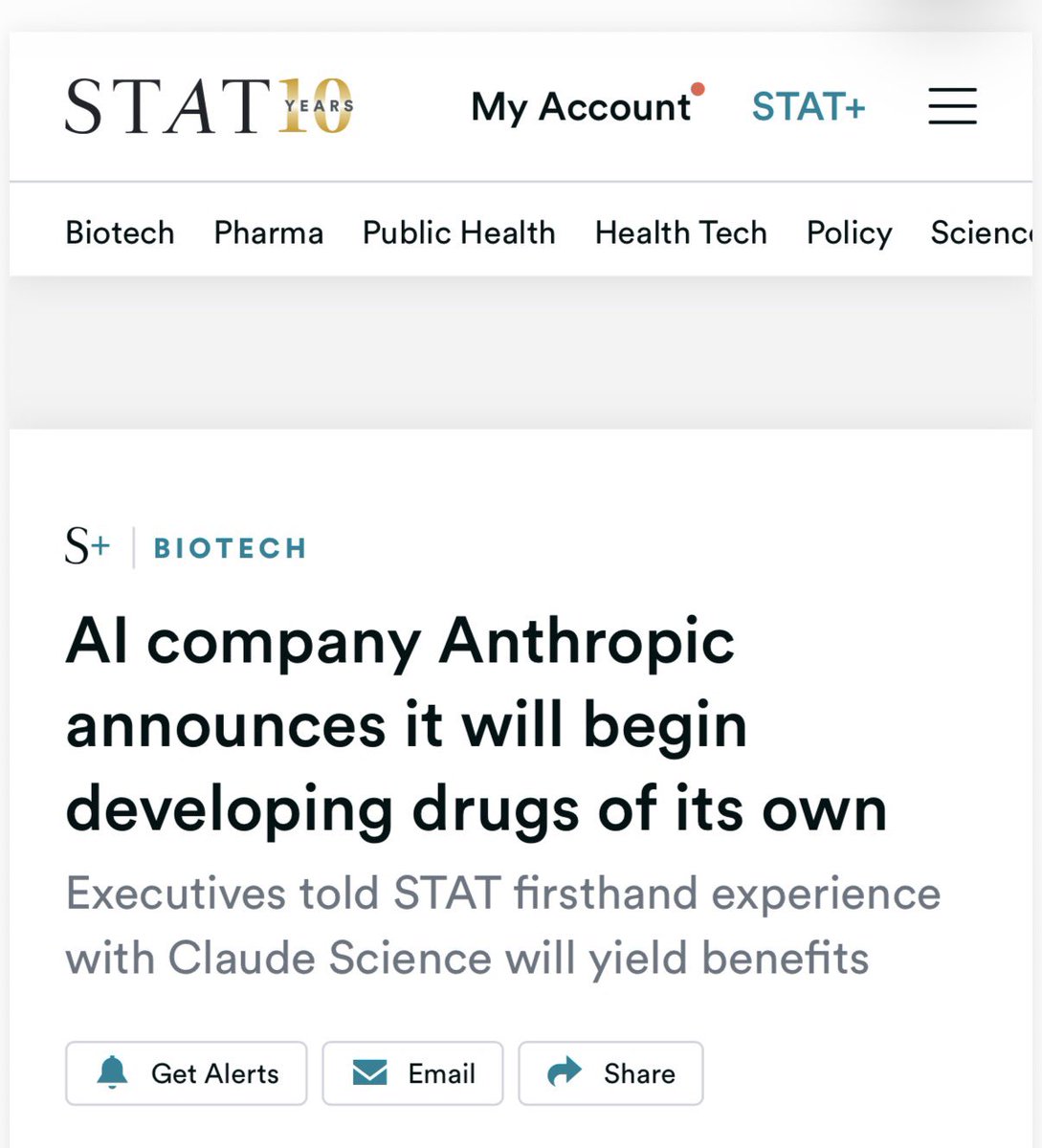
It’s well within Anthropic’s rights to compete in any market they choose.
What’s funny, in this instance, are the number of Pharma companies, who through their unchecked use of Anthropic, are driving revenues into what they think is a model provider but is in fact a competitor lurking in the shadows thereby accelerating their own demise.
I suspect any end market with reasonable ROCE that could be AI accelerated is on the table.
If I were them, I’d probably do the same.
.@RoKhanna is a rich radical who is seeking power by any means necessary. He does not even have a basic understanding of economics and he is a dissembler who greatly misled me and others to raise funds for his campaigns.
He is not to be trusted.
Since February, I've designed and built the world's fastest RC airplane in my college dorm, and that’s not clickbait. Reaper has a 5kg carbon-fiber frame, 250N turbojet, and flies at 500mph. New to X and will be going through the whole build here in the coming days.
#aerospace
Legacy Media types are calling this Alex Karp interview a “crash-out” so that’s your first clue that he is actually saying something extremely insightful. He is articulating what real “AI safety” looks like in the enterprise.
Not abstract alignment research or certification by a government-run DMV for AI. Real AI safety for businesses is the ability to control their own data, model weights, and compute — so a frontier lab can’t hoover up their proprietary knowledge and turn it into their next product.
As Karp explains, technical customers want “control over their compute, their models, their data stack, and their alpha. They want to know they own the means of production, and it’s not being transferred to someone else.”
Don’t think that can happen? Just look at Figma. According to The Information, Anthropic “blindsided” its then-business partner with the launch of Claude Design. Figma’s founder said Anthropic had not been “consistently honest” with them. Anthropic’s chief product officer had even served on Figma’s board until three days before the launch of Claude Design. Figma’s stock has fallen sharply this year while Anthropic’s valuation has surged.
This isn’t an isolated example. Anthropic has launched Claude Science, Claude Security, Claude Legal, and of course Claude Code — each expanding into categories previously served by companies building on top of their models. The pattern is consistent: watch where value is being created, then move in directly. Dominate the model layer, then use that position to capture the most lucrative verticals.
Dario has argued that open source models powerful enough to compete with Anthropic are “dangerous.” But dangerous to whom? Not to enterprises that want to retain control over their data and workflows. Dangerous to a business model that benefits from customers having few real alternatives at the model layer.
As Karp exposes, true enterprise safety isn’t trusting that a lab’s future roadmap won’t include your business. It’s retaining the ability to choose — at the model layer — who gets to see and use your alpha.
Our thoughts on the importance of AI sovereignty.
1. Your AI sovereignty dictates your institution’s future. Sovereignty is the precondition for choice. Relinquishing sovereignty transfers the future choices of your institution to others, who are likely to exploit it for their gain and your loss.
2. Data retention is your treasure. Transfer it at your own peril. Your ability to win is dictated by your ability to recognize and use your unique edges, and you keep winning by compounding the underlying data to generate new insights. Transferring that data hands over access to your pre-existing winning plays and yields the means of production for new ones.
3. Tokenmaxxing hijacks your value orientation and decreases your institutional fortitude and intelligence. The pursuit of high token usage incentivizes disposable scripts over robust software — with the addictive feeling of false progress. There is a reason why those selling tokens refuse to charge based on value.
4. Controlling your weights is controlling your fate. Weights are the distilled form of hard-won, accumulated institutional knowledge. If you let others control your weights, you are allowing them to migrate the alpha of your business to theirs.
5. There is no contradiction between sovereignty and alpha. The architecture that maximally preserves sovereignty is one that enables institutions to own their tribal knowledge, and to compound it as alpha.
6. Politicizing the technical issues involving sovereignty is what your adversary wants. Techno-politicization is the wellspring of false sovereignty. Techno-politicization drives decisions that seem to reduce dependency, but ultimately limit agency — especially on the battlefield in the West.
7. Real expertise is existential. Allowing politics or favoritism to determine your technical decisions rewards whoever is best at politics, not whoever is right. Listen to those closest to the problems, not those speaking most compellingly about them.
8. Learn from institutions that are winning or that have consistently delivered. Institutions facing existential threats do not have the luxury of making technical decisions based on political preferences.
9. Only listen to institutions, countries, and people who have a proven record of being right. A track record of correctness is the best and only signal for future correctness. Judging something as right or wrong based on who you like is exceedingly misguided.
Ro Khanna reported his children's ownership in three private golf clubs & the income they received from them on page 126 of his 2024 financial disclosure.
Good luck finding this on your own. The document isn't text-searchable and these tables are designed to be unreadable
Speaking of hoarding wealth, Khanna’s two young children are the proud owners of THREE private golf courses in Ohio, where member initiation fees run upwards of $45k
Khanna’s children — still in elementary school — earned up to $2 million from their golf courses in 2024.
NEW: @FreeBeacon has the receipts on Ro Khanna’s obscene, oligarchic wealth:
—his 2 kids (under 10yrs old) own 3 private golf courses in Ohio (not kidding)
—his wife drives a $190,000 luxury Range Rover
—his house has a 4-story indoor elevator
And more:https://t.co/Bk6nS7WRwT