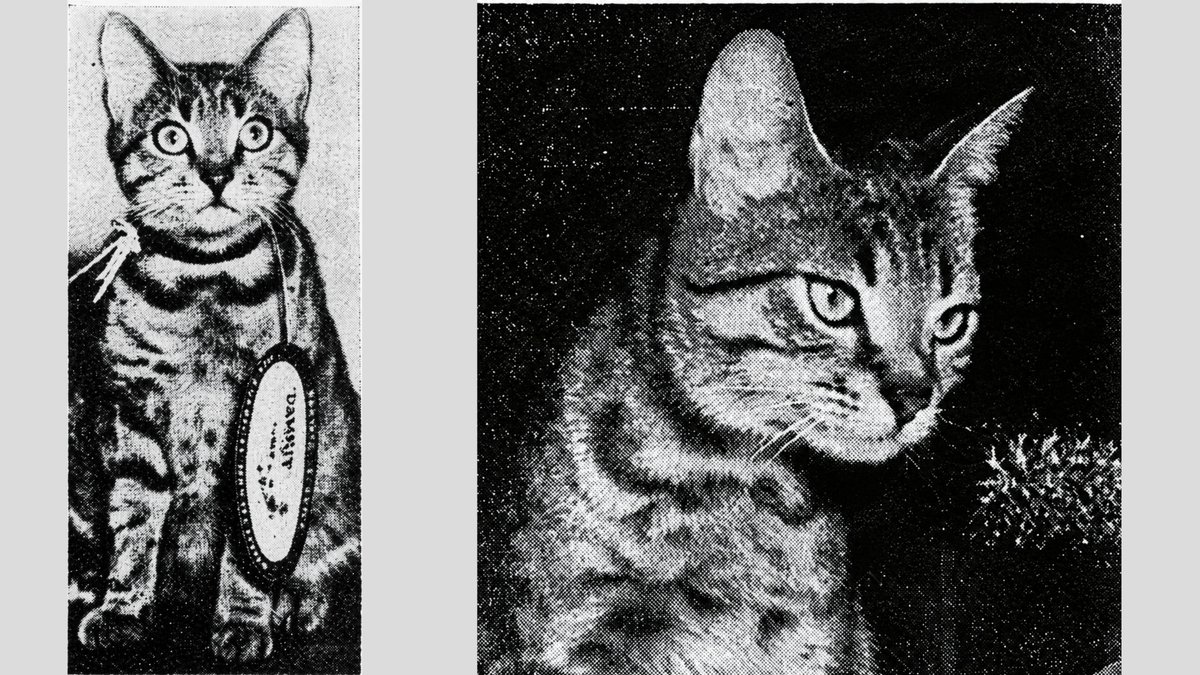
Dammit was the mascot of a U.S. Marine dive bomber squadron and the only female to see combat during the Battle of Guadalcanal in 1942. She served as an early warning system because her acute hearing allowed her to detect approaching aircraft. When Marines saw her dart into a foxhole, they knew to prepare for an air raid. Dammit also produced kittens named Helldiver, Hellcat, Hellion, and Hellbent that became mascots for other squadrons. Her smallest kitten was deemed unfit for military service and simply named Hello.
#cat #cats #catlovers
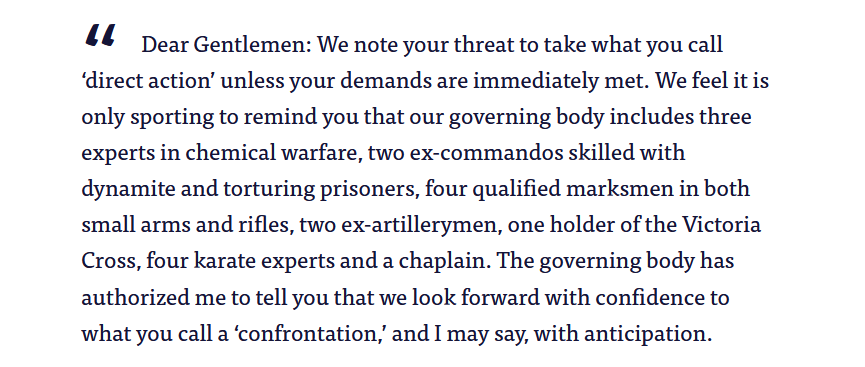
@DomAdlerUK Penned by Sir Maurice Bowra. He was one of the “ex artillerymen”. Bowra saw action at Passchendaele & Cambrai. He had a hatred of war: “Whatever you hear about the war, remember it was far worse: inconceivably bloody – nobody who wasn't there can imagine what it was like.”
An oldie but a goodie. In 1968 a bunch of entitled hippy bastards sent a letter detailing their specious demands to the Warden and Fellows of Wadham College, Oxford. This was their letter of reply, which speaks to how far the academy has since fallen.
Beautiful Georgian buildings of the former Royal Dockyard in Pembroke.
These Classical buildings have stood the test of time - both physically and aesthetically, and due to an ever adaptable plan for changes of use.
Happy to announce I built a Greek/English reader site with all the surviving plays of Aeschylus, Sophocles, Euripides, & Aristophanes.
Multiple translations for each play; click to parse & define for any Greek word; full Greek & English search.
https://t.co/8RevjZwyLl
The impacts of #StormBoelo are becoming clearer this morning.
Significant flooding in Largs, Scotland. Looks like homes and businesses have been flooded.
HMRC writing off £13bn in unpaid business taxes due to businesses going into liquidation. Unpaid council tax bills a £7.4 billion. Stamp duty down £500m due to higher rates. North Sea windfall taxes achieving only 25% of forecast. The Laffer curve is everywhere. The country is on its knees.
"You cannot talk seriously about national resilience and food security while watching the infrastructure that produces British food shrink year after year. The contradiction is obvious." 😡
The UK government has spent years heaping costs, regulation and tax uncertainty onto British food producers, Farmers, and Small businesses - then turns around and tells the public to stockpile three days of tinned food and bottled water because "unexpected events seem to be becoming more common."
Official figures show a net loss of more than 3,000 agriculture, forestry and fishing businesses in 2025 alone, the highest on record, with thousands more closures in the years before that. Inheritance tax changes on family farms (even after partial U-turns), soaring energy and inspection costs, labour shortages, post-Brexit trade deals that opened the door to cheaper imports, and chaotic subsidy schemes that left most applicants empty-handed have all piled on the pressure.
Local abattoirs have collapsed from roughly 2,500 in the 1970s to around 200 today; surveys of farmers show large numbers warning they may have to stop producing meat locally or exit entirely if the next one closes.
This week the government launched its "Be Ready" campaign, advising households to keep non-perishable food, litres of bottled water per person, cash, torches and radios in case of cyber attacks, extreme weather or other disruptions. That is sensible basic preparedness.
What is absurd is watching the same state systematically weaken the domestic producers who actually grow and process the food that would make the country more resilient in the first place, while imports fill the gap and rural businesses fold.
You cannot talk seriously about national resilience and food security while watching the infrastructure that produces British food shrink year after year. The contradiction is obvious.
#PostOfficeScandal 😡😡😡
"Reports say at least 350 Horizon victims have died before their final payouts, so at this pace the scheme will finish the moment nobody is left to be paid."
SHE DIED WAITING
Heather Earley, mother of three, has died waiting for her money. @PostOffice kept her waiting so long she ran out of time. Impressive logistics.
Lawyer @SimonMGoldberg (well worth to give him a follow) shared the sad news today.
Heather Earley was one of 555 postmasters who took the Post Office to the High Court and won, and she died before getting her redress, the money owed to put her life back together.
He points to a @BBCNews article from 2024 on victims who died before getting redress. Winning in court and never seeing the money is a rare talent.
Heather Earley was a mother of three who ran a local shop with a Post Office counter in Mossley, Newtownabbey, in Northern Ireland. In December 2013 the Horizon computer system said she was £10,000 short. A computer said so, and in the Post Office computers are never wrong..
She says one customer kept using a flaw in the system. Every time that customer withdrew £100, the system added £100 to the balance instead of taking it off. I wish my bank worked like that.
Heather Earley called the police, and the customer was prosecuted and convicted. That put the blame on the customer, and the Post Office still demanded the £10,000 from her, took money from her wages and refused to give it back even after the conviction. Crime solved, victim billed ...
She borrowed from family and maxed out three credit cards just to buy stock for the shop. She cashed in £50,000 of her pension to save the house and clear her debts. Her village lost its post office and its shop, a truly generous service to the community.
In 2019 the Post Office settled the group case for £57.75M. Around £46M went on legal and funding costs, which left roughly £20,000 for each of the 555 people. The judge, Mr Justice Peter Fraser, had said the Post Office at times acted as though it answered only to itself, and it seems to have taken that as a challenge.
Reports say at least 350 Horizon victims have died before their final payouts, so at this pace the scheme will finish the moment nobody is left to be paid.
Heather Earley wanted justice and enough money to rebuild what was left of her life. Simon Goldberg says the lawyers and other parties who held up and nickel and dimed her redress should feel nothing but shame, though shame does not appear to be billable. Stop fighting these people and pay them before it is too late.
Heather Earley never got her cheque.
RIP Heather
Viciously, then, I lock my door.
The gas-fire breathes. The wind outside
Ushers in evening rain. Once more
Uncontradicting solitude
Supports me on its giant palm;
And like a sea-anemone
Or simple snail, there cautiously
Unfolds, emerges, what I am.
Philip Larkin
🎶 "Saturday night at the movies" 🎶
An atmospheric 1950s shot of the Gaumont Picture House on Sauchiehall St.
It opened in Dec 1910 and was built within an existing building erected in 1895 to designs by H & D Barclay. Today it houses the Savoy Centre.
📷 Newsquest
#Glasgow
Good Evening All :) DG VOST is now active and will remain so to see us through this current Amber weather warning. The website will be updated with live incidents, road closures etc as they happen - https://t.co/fWyclGt6SV Please look after yourself and others if out and about
It’s our 9th birthday on Monday 26th October. We haven’t made any big plans to celebrate this year, but if you’re near a sandy beach this half-term do write our name in the sand. Sending a letter or postcard to a loved one would be a lovely way to help us celebrate too. 🥳🏖️✉️🎉