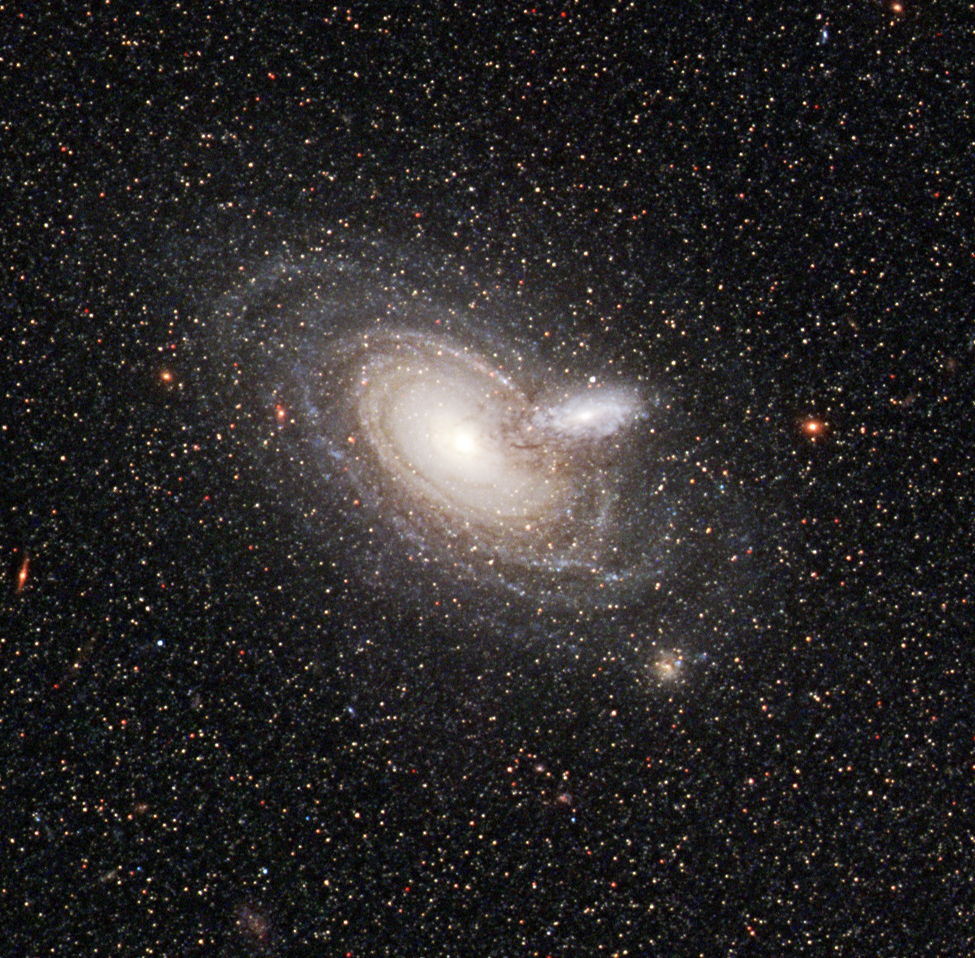
A galactic photobomb!
By a chance alignment, two galaxies overlap in this Hubble image. And another galaxy appears, too – most of the stars sprawled across the background belong to another spiral galaxy called NGC 253, which is out of frame to the right: https://t.co/TyCFOo6a0v
What are these two bands in the sky?
The more commonly seen band is on the left and is the central band of our Milky Way galaxy. Our Sun orbits in the disk of this spiral galaxy so that from inside, it appears as a band of comparable brightness all the way around the sky. The less commonly seen band, on the right, is zodiacal light -- sunlight reflected from dust orbiting the Sun in our Solar System. Zodiacal light is brightest near the Sun and so is best seen just before sunrise or just after sunset. On some evenings, this ribbon of zodiacal light can appear quite prominent. It was discovered only in this century that zodiacal dust was mostly expelled by comets that have passed near Jupiter. The featured image was captured about a year ago from the Atacama Desert in Chile.
Image Credit & Copyright: Julien Looten
The Trump administration fired the scientists who ran the government’s climate website, then shut the site down
The scientists have rebuilt it from scratch and put it back online
The 135th and final shuttle launch! 🚀
July 8 marks the 15th anniversary of the historic final launch of NASA's 30-year Space Shuttle Program. With its crew of 4 astronauts, Atlantis lifted off at 11:29 am to begin STS-135, its last journey to the International Space Station.