Associate Professor of Political Science at Christopher Newport University / Politics, Disaster and Civil Society, East Asia, DC / RT does not mean endorsement
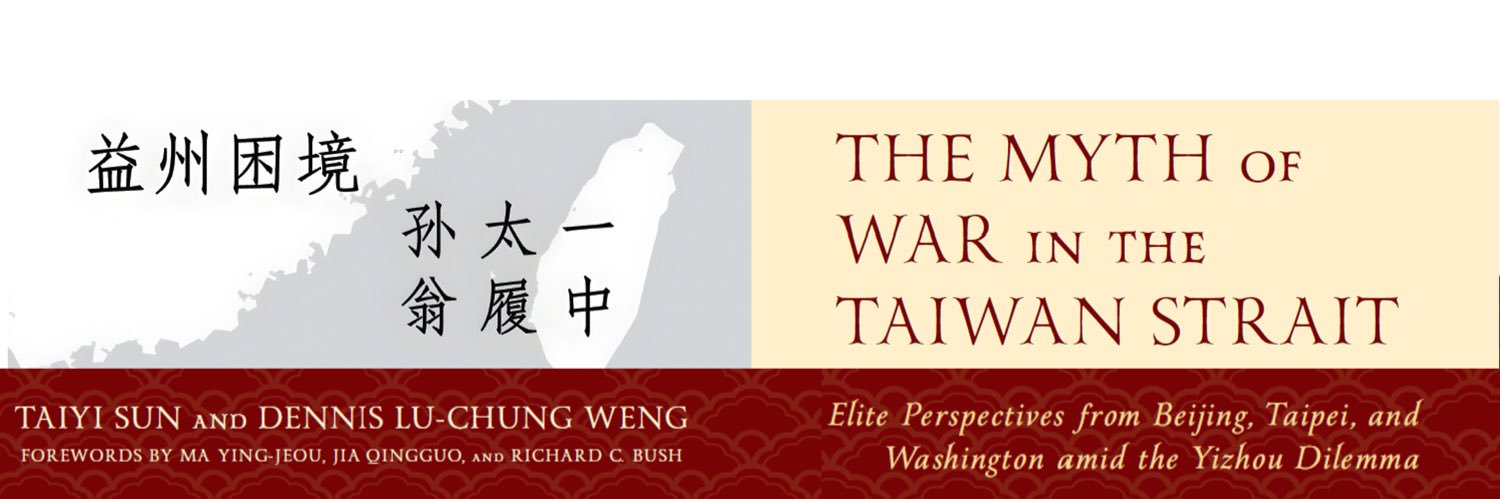
Our new book on Taiwan, featuring three forewords by Ma Ying-Jeou, Jia Qingguo, and Richard C. Bush, is now available for pre-order.
Will there eventually be a war in the Taiwan Strait? If so, when might it occur? What would be the U.S. response? If war does break out, how long will it last, and how will it unfold? Will there be cross-strait unification? Will Taiwan declare independence? These are just a few of the more than 50 questions we asked the experts from Beijing, Taipei, and Washington, in our study. (1/6)
"More weapons for Taiwan do not automatically lead to greater stability. They may deter, but they may also provoke, especially if Beijing reads them not as defensive preparations but as steps toward permanent separation. The danger is not only that Mainland China might one day decide to use force after it deems all peaceful means have been exhausted; the danger is that a cycle of U.S. arms transfers, Taiwanese political signaling, PLA’s military pressure to protest, and American counter-signaling to show resolve, could create an escalatory environment in which each side insists it is acting defensively and responsibly while the situation deteriorates quickly." My latest piece published by the Carter Center's @uscnpm on the implications of Trump's Beijing visit
https://t.co/bpyKO7Bvvx
The Toda Peace Institute from Japan just published my latest report on Trump’s Beijing visit and its implications for bilateral relations. The report cited a few key ideas from my upcoming book “Sino-U.S. Power Play and the Qin Qi Conundrum by Routledge: China–US Relations After Trump’s Beijing Visit: Shifting Stabilizers in an Era of Great Power Competition | Toda Peace Institute https://t.co/mHYbnOCBEm
Our discussion on TRT World regarding China, U.S. and Iran (second half of the show): Washington and Beijing: Rivals or partners over Iran? | Inside America https://t.co/T3DrFes3Ol via @YouTube
…such as soya beans and beef, as well as high-value-added manufacturing products like Boeing aircraft, are natural areas for expansion because they match existing Chinese demand with American export strengths,” Sun told Al Jazeera.
Sun said China could also agree to a “gradual” opening of US firms’ access to sectors such as financial services.
“But those areas are politically and institutionally more sensitive inside China, so progress would likely be incremental rather than immediate,” he said. (2/2)
My assessment was not too far from what actually happened. As I was quoted by Al Jazeera: Taiyi Sun said a “realistic” opening up of the Chinese market is likely to focus on sectors with the most obvious economic complementarity.
“Agricultural goods…(1/3) https://t.co/yV9Jkmp0Gp
Trump's clear message: The USA is now betraying Taiwan as well.
China is a very, very powerful, large country, and Taiwan is a tiny island—as far as their respective chances are concerned. — Trump
Further statements by the US President:
If you look at history: Taiwan developed the way it did only because we had presidents who had no idea what they were doing. They basically stole our chip industry from us.
Anyone manufacturing chips in Taiwan should relocate to the USA.
The Chinese do not want to see this place—let’s just call it a place, because no one knows how to define it—as independent.
I don’t want anyone to become independent. Do we really have to travel 15,000 kilometers to fight a war? I don’t want that.
Sun Taiyi refuted the "Thucydides Trap," which assumed that rising powers and established powers were structurally destined for war, saying that what China and the US are now attempting is not to eliminate competition, but to explore whether the two… https://t.co/bBD7AnQ3hp
Taiyi Sun: What is emerging now [constructive strategic stability] is a more realistic middle ground, neither full confrontation nor full separation is sustainable. — my take on CGTN: Xi's 'Thucydides Trap' question frames new chapter in China-U.S. ties https://t.co/WuwTzzgMj1
Taiyi Sun: The new positioning reflects a new phase in which both sides still compete, but increasingly seek mechanisms, communication channels, and mutual constraints to prevent rivalry from spiraling into systemic crisis" https://t.co/Ei1S7i8k26