WEBINAR TOMORROW!
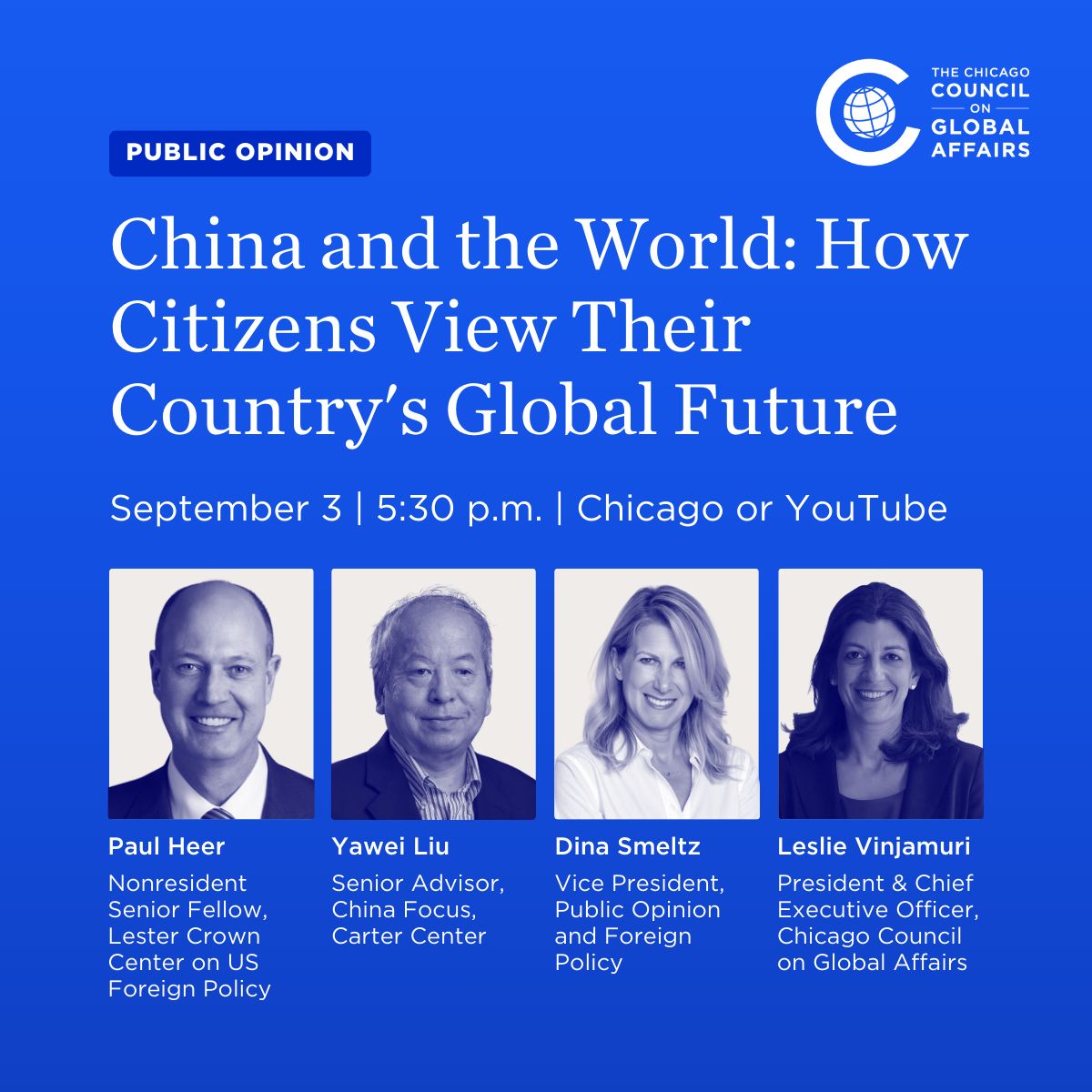
Surveys in the U.S. and China shed light on how Chinese citizens view their economy and politics and international affairs. This roundtable will discuss what they reveal about Chinese opinion on the state, the economy, and the world beyond China’s borders.
.@joy_shuxian_luo: “When the situation becomes tense—when U.S.-China relations deteriorate and frictions intensify over how the U.S. handles its relationship with Taiwan—China will use N. Korea as a counterbalance to…U.S. moves on Taiwan.”
@uscnpm
https://t.co/vH8ivfGyiE
@uscnpm Kritenbrink: “Tit for tat, eye for an eye. And I think Chinese friends believe that approach has worked fairly well for them…The world’s most complex and consequential relationship is primarily competitive.”
https://t.co/A56S3R1ig9
@uscnpm Kritenbrink: “The Trump administration’s China policy feels more improvisational to me than strategic…We’ve still not seen a formal speech on America’s China strategy, and we’ve not seen a written national security strategy or defense strategy yet.”
https://t.co/A56S3R1ig9
Former U.S. senior diplomat Daniel Kritenbrink: “If you talk to Chinese…officials…the main lesson that they learned from the first Trump administration is that if you are…struck by the Trump administration…you must strike back immediately.”
@uscnpm
https://t.co/A56S3R0KqB
No one in America likes their HOA. However, according to @QST85, HOAs are an important site of actually existing democracy in China that depend on a strong state while potentially threatening it. Alice Liu asks him how this could be.
https://t.co/QuN7eEIMRU
As economic tensions escalate between Washington and Beijing, @StimsonCenter 's Yun Sun tells Tyler Quillen why the trade war will ultimately work in China's favor.
https://t.co/8aTffLMfHx
.@zhaot2005: “The story Beijing tells itself is that U.S. hostility stems not from Chinese behavior but from anxiety over an impending power transition. In short, China attributes bilateral frictions to structural change in the balance of power.”
@uscnpm
https://t.co/8iEmkbLAvM
Xiang Biao of the Max Planck Institute explains that alienation in contemporary Chinese society means moving as fast as possible to nowhere.
Read here: https://t.co/sgd0NU4aYY
Sandra Tarte at @UniSouthPacific spoke with Rory O'Connor about how Fiji, Micronesia's most influential state, is navigating U.S.-China tensions.
Micronesia in Macropolitics w/ Sanra Tarte https://t.co/EbAe1e84Sw
Join us for this virtual discussion of what recent studies of public opinion from both sides of the Pacific reveal about how Chinese people see their place in the world.
Register here: https://t.co/EdRyfhbAR2
@CarterCenter@ChicagoCouncil@yawei_liu1960
“There are serious concerns that can—and should—be raised in an independent, non-political manner…The construction of a mega-dam will irreversibly alter the natural landscape; there is no ‘Ctrl + Z’ option to undo such a project.”
@uscnpm
https://t.co/k2iby8BYjR
Antonina Łuszczykiewicz-Mendis on China's new hydropower mega project in Tibet, impacts on India, and the international politics of rivers.
https://t.co/XLnWjVjMzL
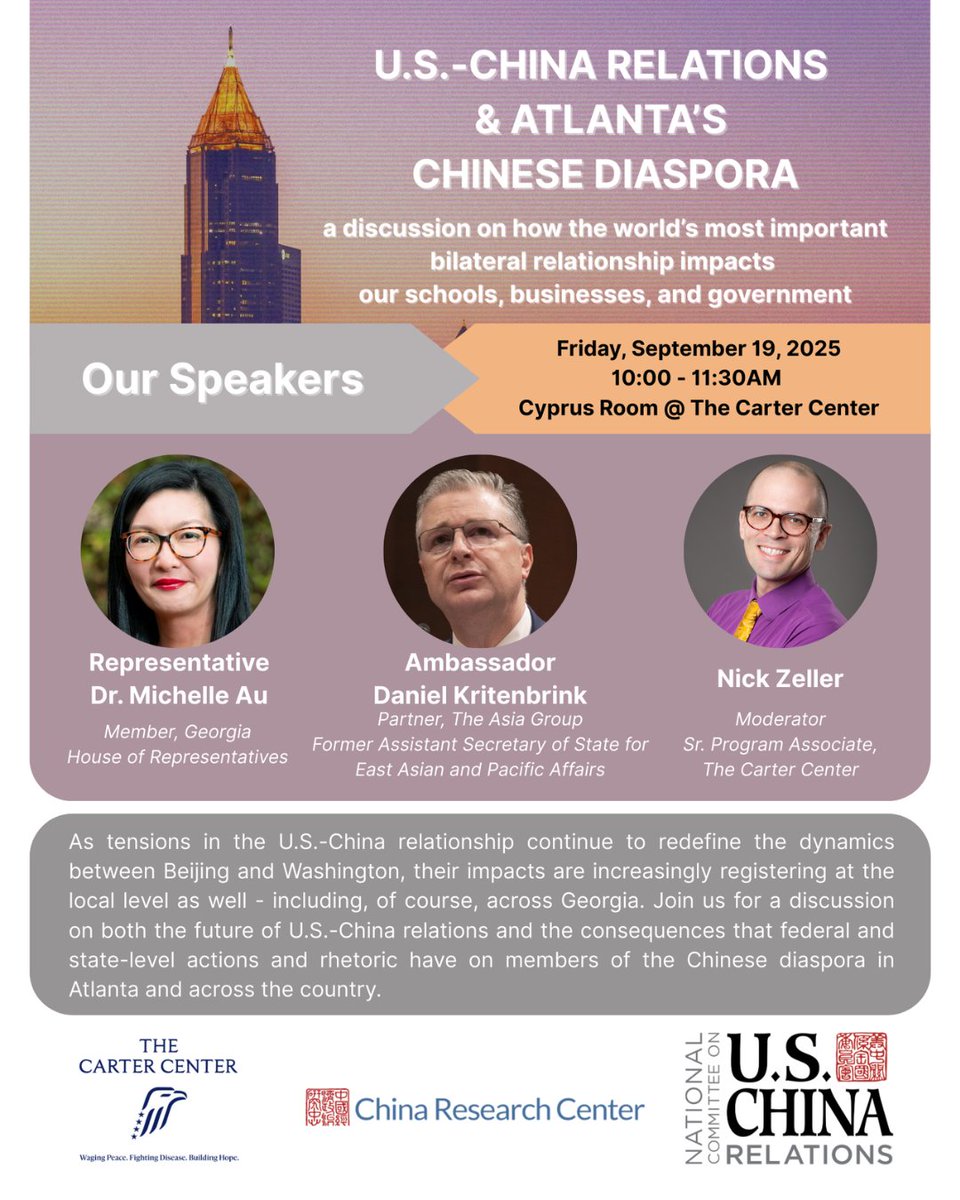
📆 EVENT: Join Ambassador Daniel Kritenbrink, Georgia State Rep. Dr. Michelle Au, and Henry Yu with @uscnpm to discuss how the U.S.-China relationship impacts Georgia.
Time: Friday, September 19, 2025, 10:00 AM
Register: https://t.co/cwWXALO7ZG
Join us Sept 19 10:00-11:30 for a conversation with Amb. Dan Kritenbrink & GA House Rep. Michelle Au on the impacts of the US-China rivalry on the Chinese diaspora nationally and in the southeast.
Register here: https://t.co/GTBC1mzT8j
@NCUSCR
“Nine in 10 Chinese support their country’s active participation in world affairs (90%). Part of this enthusiasm stems from a sense that China is a leading power in the world.”
@uscnpm@ChicagoCouncil
https://t.co/hW4myt4HJP
When people say any leader who becomes soft on the Taiwan issue will lose his mandate of leadership you begin to wonder if public opinion has such a huge impact in China. @CarterCenter@uscnpm