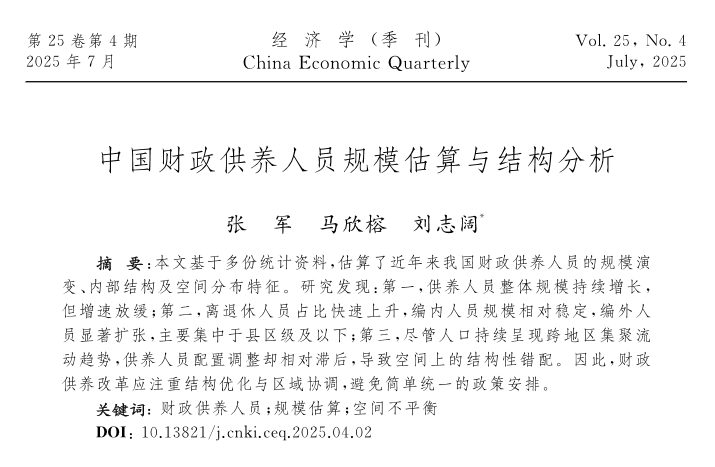
How many people are on China’s public payroll? 🧵
For decades, the size of China’s public payroll was hidden from the public. But a Fudan University research team reverse-engineered the numbers through a statistical reconstruction using indirect data points.
Main findings
1/n
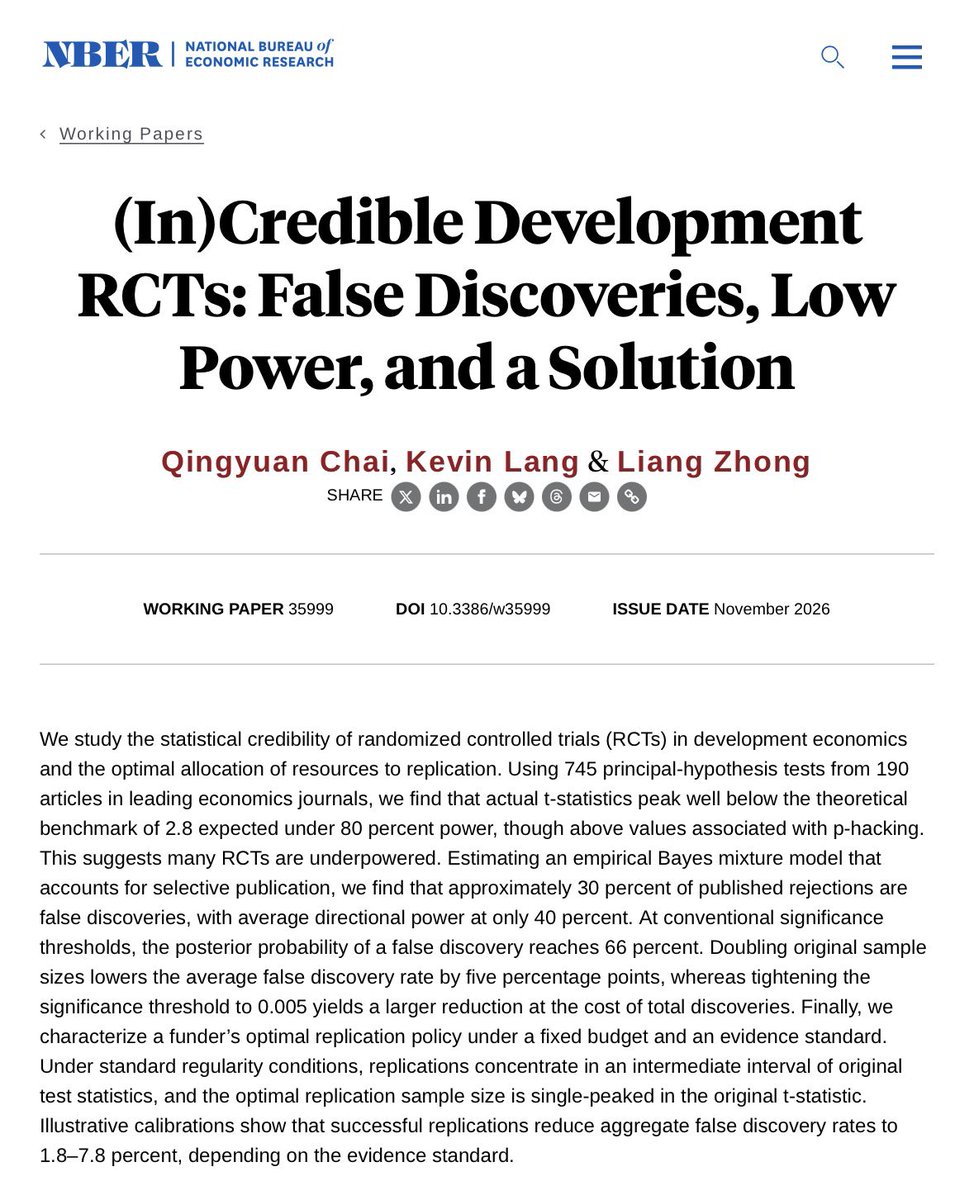
Nearly a third of statistically significant findings in development economics may be false discoveries
In a new NBER working paper, Qingyuan Chai, Kevin Lang, and Liang Zhong question the statistical credibility of randomized controlled trials (RCTs), which have become one of the main tools of modern empirical economics.
The authors analyzed 745 tests of primary hypotheses from 190 papers published in leading economics journals and arrived at some rather troubling findings.
https://t.co/ULKEsy0Xck
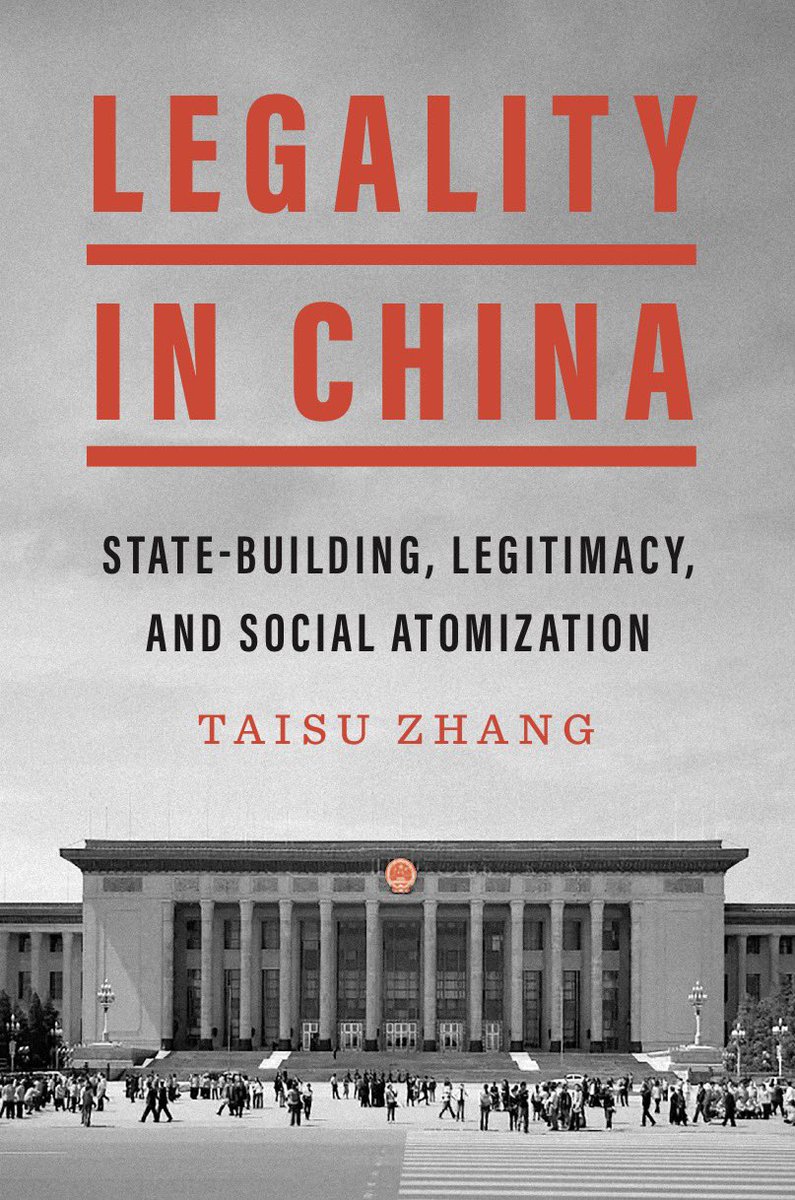
Book page out on the HUP website: https://t.co/65pjqvuVOT. Current date of publication is May 2027, but I’m hoping that at least the ebook can come out somewhat earlier than that.
After so many years, I’m still not impressed by the NYC subway, where trains change routes without explanation or much notice. Or by JFK, where flights get delayed and delayed and gates get changed and changed.
Don't get too confident about prediction markets! MIT finance department PhD job-market candidate working on prediction market shows miscalibration. The long-shot bias exists and exploiting has a historical Sharpe ratio in the neighborhood of 2!
https://t.co/5m4gJGERpM
The election results last night exploded two myths that authoritarian governments sometimes tell about American democracy: 1. divisions will ultimately lead us to tear each other apart 2. Money controls politics. But last night shows that when governance fails, American voters from all walks will come together to send a message and to throw out those they see as responsible in a peaceful manner. And also money is just one ingredient in electoral outcomes. GOP spent nearly 4x as much money as Dems in Texas but the result was a blue wave in Texas
You can test the tool today! We hope it will help make 💯 reproducibility the norm, front and center before papers even reach journals, while making data editors’ jobs much, much easier.
Xi Jinping's longtime PLA anti-corruption czar just became the first person promoted to the Politburo outside of a Party Congress since 1994
Zheng Shengmin, Xi's only deputy on the Central Military Commission, was elevated to the CCP's top 22-man group at the Fifth Plenum
1/
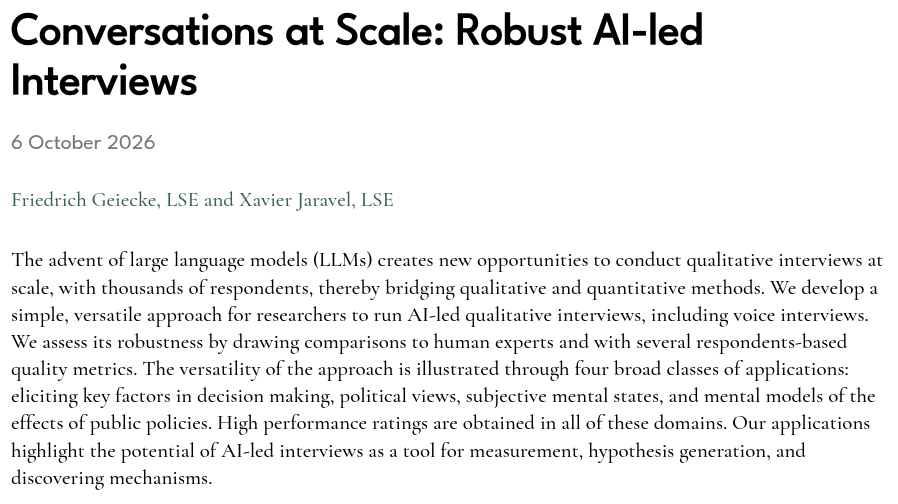
Can AI conduct qualitative interviews with thousands of people? In a new REStud paper, Friedrich Geiecke and @XJaravel develop an open-source approach that combines the depth of qualitative interviews with the scale of surveys.
1/6
We (Jonathan Elkobi, me) are happy that @chinaquarter has accepted our new piece “The End of Fiscal Autonomy. ” Yes, it’s provocatively titled but this is an important data point for analyzing China’s economy. A large literature suggests that local autonomy, including fiscal “federalism” has been a key ingredient to growth and local reform initiatives. If local governments literally have little to no autonomy, their incentives and ability to use local initiatives to generate growth also declines. Below, I summarize our findings with link of pre-pub version at the end.
Quick primer: Chinese budgeting is broken into 1. ordinary budget to finance public services, civil service salaries and 2. Extra budgetary fund (EBF) used to finance land acquisition/sale, infrastructure projects and other discretionary spend. The source of the problem is here—ordinary revenue at the local level has grown very modestly over a 6-year period (21%), while EBF revenue (land income) has not grown at all due to the property crackdown. Central transfers made up the bulk of the growth in non-debt sources of income for local governments. (1/N)
We should rethink the role of human judgment in the review process. Human expert should have a role, but it's no longer about writing 1,500-word essays to summarize findings, check proofs, and so on.
On top of that, any journal that forbids AI usage in the review process should reconsider their position.
My first book, Authoritarian Markets: The Politics of China’s Banking Explosion (Cornell University Press), is officially out today!
It explores the political foundations of China’s banking market development—and how that development both drove the rapid growth of the Chinese economy in the past three decades and incubated its deeply intertwined challenges: shadow banking, the housing bubble, and local government debt.
The China story isn’t sui generis—not once you see how contract-intensive markets expand in other autocracies. Authoritarian states produce authoritarian markets: markets with three coherent properties, the three “Rs”—rationed entry, reflective competition, and rigged regulation. I won’t give away details but post the epigraph to each chapter below :)
I hope you find the book readable, rigorous, and refreshing—a different set of three Rs, but ones I hope characterize the book as much as its argument.
Finally—here’s a promo code (40% off!): 09EXP40.
https://t.co/qe0SMQnLlO
p.s. So many teachers and friends to thank---see my acknowledgement :)
Highly relevant!
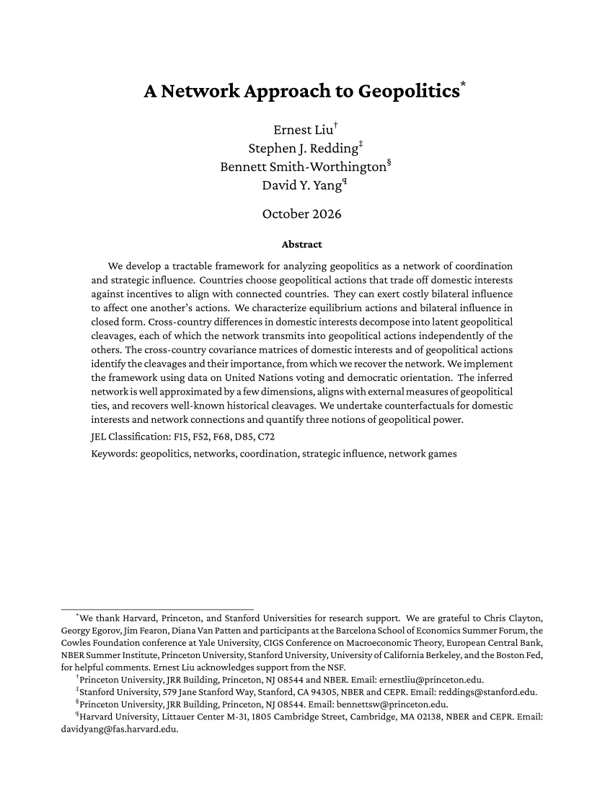
"A Network Approach to Geopolitics" by Ernest Liu, Stephen J. Redding, Bennett Smith-Worthington, and David Y. Yang.
"We develop a tractable framework for analyzing geopolitics as a network of coordination and strategic influence. Countries choose geopolitical actions that trade off domestic interests against incentives to align with connected countries. They can exert costly bilateral influence to affect one another's actions. We characterize equilibrium actions and bilateral influence in closed form. Cross-country differences in domestic interests decompose into latent geopolitical cleavages, each of which the network transmits into geopolitical actions independently of the others. The cross-country covariance matrices of domestic interests and of geopolitical actions identify the cleavages and their importance, from which we recover the network. We implement the framework using data on United Nations voting and democratic orientation. The inferred network is well approximated by a few dimensions, aligns with external measures of geopolitical ties, and recovers well-known historical cleavages. We undertake counterfactuals for domestic interests and network connections and quantify three notions of geopolitical power."
https://t.co/Igq1ebHYAf