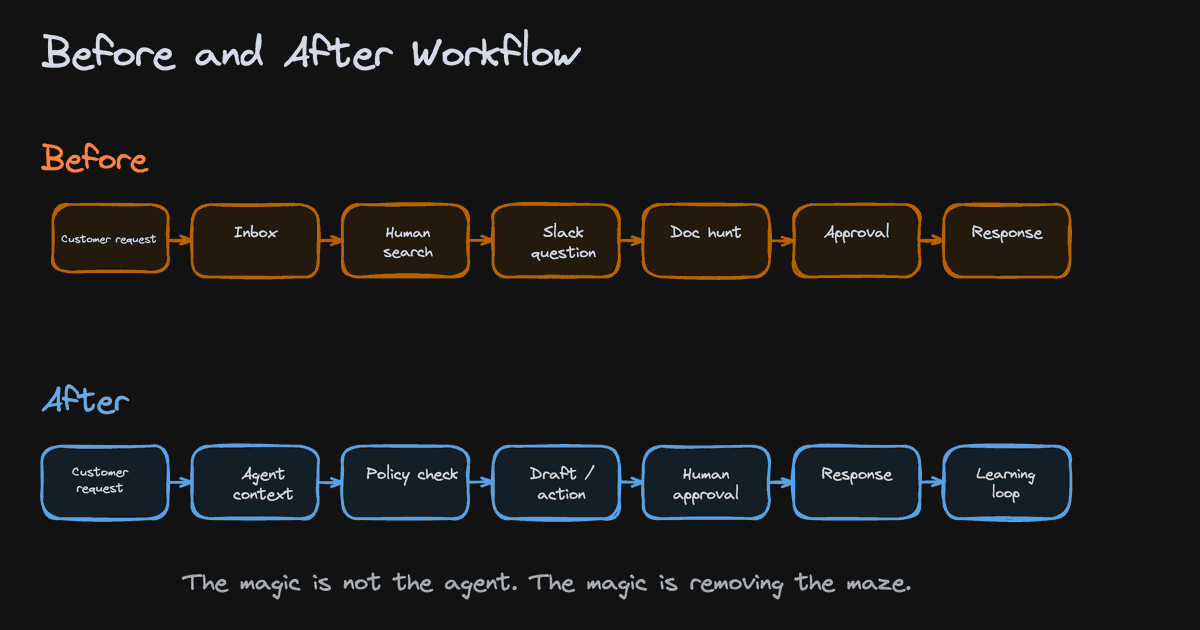
A friend asked me how to actually build a company that runs on AI agents.
I drew him 4 simple diagrams and this is what I told him:
For this to work, a few things have to be true.
- The humans move up to strategy, taste, and judgment while agents handle the execution.
- The whole business becomes readable to agents. Your data, SOPs, pricing, permissions, and decisions all live in one shared context layer.
- And you point it at the right work. Repetitive enough for an agent, complex enough that the incumbents never bothered. That's the goldmine.
In the old world, the company was the people. They held the knowledge, made the calls, did the work.
In this new world, the people become the creatives, the agents become the labor, and the company itself becomes the context layer.
That shared brain is the actual company now. The humans and the agents are just plugging into it.
Which means the most valuable thing you can build in 2026 is a business so well-documented that an agent can run it.
I see it everyday with @MeetLCA. I don't talk about it much publicly, but we've built a SWAT team for building AI-native orgs and AI-native products.
The moat is how legible your company is.
I drew it all out below.
As an AI Engineer. Please learn
>Harness engineering, not just prompt engineering
>Context engineering, not just long prompts
>Prompt caching vs. semantic caching tradeoffs
>KV cache management, eviction, reuse, and memory pressure at scale
>Prefill vs. decode latency and why they optimize differently
>Continuous batching, paged attention, and throughput optimization
>Speculative decoding vs. quantization vs. distillation tradeoffs
>INT8, INT4, FP8, AWQ, GPTQ, and when quantization hurts quality
>Structured output failures, schema validation, repair loops, and fallback chains
>Function calling reliability, tool contracts, argument validation, and idempotency
>Agent guardrails, loop budgets, tool budgets, and termination conditions
>Model routing, graceful fallback logic, and degraded-mode UX
>RAG architecture: chunking, embeddings, hybrid search, reranking, and freshness
>Retrieval evals: recall, precision, grounding, attribution, and citation quality
>Evals: golden sets, regression tests, adversarial tests, LLM-as-judge, and human evals
>LLM observability as a first-class discipline: traces, spans, tokens, latency, errors, and drift
>Cost attribution per feature, workflow, tenant, and user journey not just per model
>Safety engineering: prompt injection defense, data leakage prevention, and permission boundaries
>Multi-tenant isolation, cache safety, and cross-user context contamination prevention
>Fine-tuning vs. in-context learning vs. RAG vs. distillation and when each is the wrong tool
>Latency, quality, cost, and reliability tradeoffs across the full inference stack
>Production failure modes: hallucinated tool calls, malformed JSON, stale retrieval, runaway agents, and silent eval regressions
If you don't wake up excited and go to bed tired, drop everything and think of what your future will look like if you keep repeating the same day for the rest of your life. Sit with that discomfort until a new direction appears.
The future of work is everyone having AI employees with their own accounts.
Its own email. Its own Slack login. Its own seat on the team. With Claude Tag etc, the agent is someone you tag and not just something you prompt.
You delegate to it the way you'd delegate to a coworker. It writes the code, handles the inbox, builds the deck, even browses X on its own login for updates. It has it's own history, so you can hold it accountable when it messes up or does an incredible job.
And the strangest part is how fast it feels kinda normal.
Week 1 it's odd to thank a bot in Slack. Week 3 you're annoyed when it's slow to reply, the same way you'd be annoyed at a coworker. The account makes your brain file it under "person," and your expectations follow.
This is what AI-native actually looks like.
Second order effects of this shift:
1. Companies will start "hiring" agents the way they hire people, with job descriptions, onboarding docs, and performance reviews, and someone's whole job becomes managing a team that never sleeps.
2. The agent that's been at your company for two years becomes more valuable than any new hire, because it holds every decision, every thread, every relationship in one login that never quits.
3. IT and security have a nightmare on their hands, because every agent account is a new door into your company, and nobody's figured out who's responsible when an agent gets phished or goes rogue.
4. A black market forms for trained agent accounts, where a fully onboarded agent with months of company context sells for real money, the same way aged social accounts do today.
5. The org chart fills with names that aren't people, and one day you realize half your "team" is agents and you genuinely can't imagine running the company without them.
6. Insane amount of vertical startup opportunities. My partner @boringmarketer just launched a Slack agent "employee" for marketing related tasks. 100% bootstrapped.
Probably 1000+ vertical $1M ARR "employee" in Slack startup opportunities.
TLDR; Slack tag is cool
But give one agent its own account this week. Watch how fast your brain stops treating it like software.
That's the whole shift, and you can feel it in about 3 days.
I grew to $1m MRR without inventing a single original idea
Revid: AI video tools exist
Outrank: SEO tools exist
SuperX: X growth tools exist
every product I built competes in a market that was already crowded
and that's the whole strategy
most new founders hunt for new, untapped markets, but I do the opposite
I go where competition is brutal, because crowded means the demand is already proven
but copying alone gets you nowhere - the real game is knowing which corner of the market to take 👀
tomorrow's newsletter: why copying is smarter than innovating, the man who had 8/10 hit products, and the 3 step framework for finding your corner of business
subscribe below👇
Creator of Claude Code:
"Right now you still need to know how to code. In a year or two, it won't matter. I haven't edited a single line by hand since November."
In a 90-minute podcast, Boris Cherny breaks down the exact setup behind the tool now writing 4% of every public commit on GitHub.
More value than a $500 vibe-coding course.
Save this. In a year we'll know if he was right.
Anthropic CEO:
"If my revenue is not $1 trillion, even $800 billion,
there's no force on earth, no hedge on earth,
that could stop me from going bankrupt."
In a 3-hour podcast, Dario Amodei does the math on his own bankruptcy.
Revenue 10x a year.
90% of code written by the model.
A country of geniuses by 2028.
He can't tell you if it ends in trillions or zero.
The most honest voice in AI, or the biggest bubble admitting it?
I can't believe this is real
I have GLM 5.2 running 100% locally on my Mac Studio. 2 bit quant.
The results I'm getting are better than Opus 4.8
It's now powering my Hermes Agent and Codex. 100% free, local, private super intelligence on my desk
I also have it in a loop coding for me 24/7 now
I thought we were at least a year away from this type of event. It happened today.
The model takes up about 250gb of memory. So you can technically run it on a Mac Studio with 256gb, but you probably want the 512gb memory version (please tell me you listened to me 5 months ago when these were sitting on store shelves)
With Fable gone, I now have Opus 4.8 level intelligence on my desk for free. This is the future.
Local, private, secure, personal super intelligence.
If you're still writing off local AI as a fad or engagement bait, you are officially delusional
I just built a Reddit research agent in Claude Code that turns real customer complaints into ad angles 🤯
It scrapes the threads where people actually rant about your category, reads every post and comment, and hands you back a dashboard of pain points, exact customer phrases, and ready-to-test ad angles.
All inside Claude Code.
Perfect for DTC brands and agencies who want ad angles pulled from real customer language, not guessed in a vacuum.
Reddit is the most honest focus group on earth. People say things there they'd never put in a survey or a review with a brand watching.
So if you're writing hooks off your own assumptions — or digging through Reddit by hand, opening tab after tab, pasting quotes into a doc...
This agent runs the entire loop:
→ Give it a product or category + a couple of subreddits
→ It searches Reddit for the threads where people actually discuss the problem
→ Pulls every post and comment
→ Claude reads all of it and finds the patterns
→ Builds a dashboard: pain points, desires, objections, and swipe-worthy phrases
No manual scrolling.
No pasting quotes into docs.
No guessing what your customers actually care about.
What you get:
→ Ranked customer pain points, each with a real verbatim quote
→ The exact language your customers use, ready to drop into ad copy
→ Objections and buying triggers pulled straight from the threads
→ 8-10 ready-to-test ad angles built from all of it
Built 100% in Claude Code.
Want the skill file for free?
> Like this post
> Comment "REDDIT"
And I'll send it over (must be following so I can DM)
If millions of AI agents all use the same underlying model, they'll make similar mistakes and correlated failures.
It's called "cognitive monoculture," and if you're not using detailed prompts to bias your agent against groupthink, it's probably impacting your results.
More from Google DeepMind researcher @weballergy 👇
Anthropic research lead:
"99% of our engineers are running swarms of 300+ self-improving agents.
close the agent loop. Give the model a way to verify its own output"
in a 20-minute session, Anthropic team member explains how to build a model that improves itself.
Claude + loops + plan mode + dynamic workflows -that’s the secret.
Watch the talk, then save the playbook below.
I built Polsia into a $250M company in under 3 months.
Solo + AI. Zero employees.
Everyone asks me how I did it.
Introducing aisloP, a docu-series on how I build Polsia.
Episode 1: The Launch.
How I orchestrated the biggest Twitter launch of 2026.