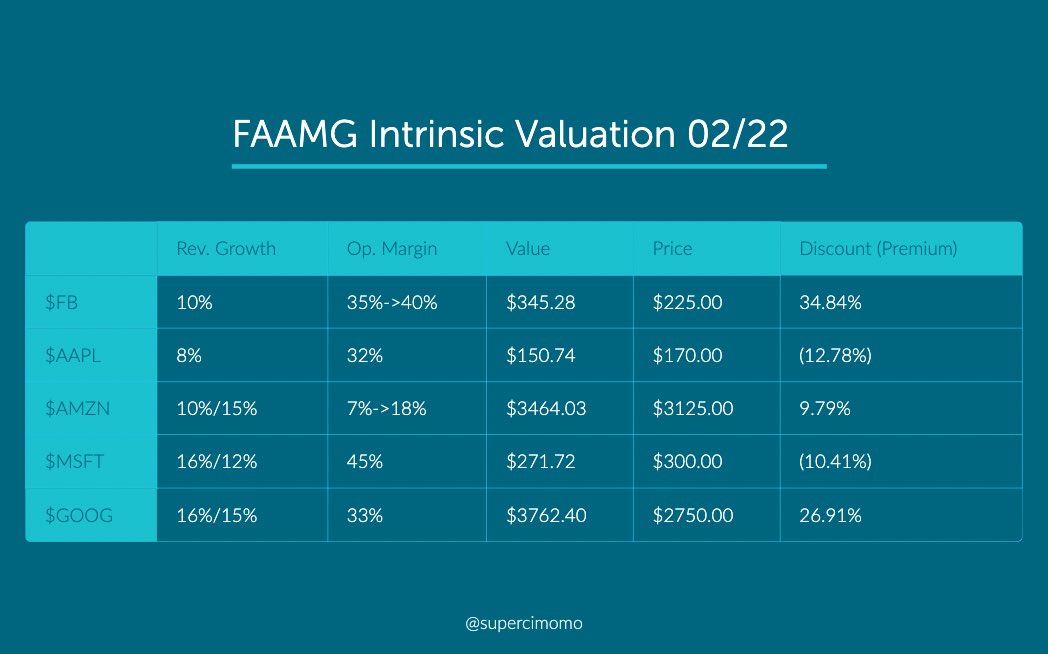
Valuation update on #FAAMG
$GOOGL appears most attractive. $FB could be under-valued if the business does not implode. $AMZN is fairly valued but it requires continued execution on longer term bets. $MSFT $AAPL always trade at premium for good reasons.
Not Financial Advice.
@SixSigmaCapital@tradingchik@qcapital2020@BigBullCap@plantmath1 @bourbonbuddy1 Yea I had what started as a short break from Twitter when I got super busy … but that felt sooo good, so it turned into a long break. 🤣Indeed time to update those models … so much have changed and would be fun to compare.
My portfolio is down 7 figures from ATH. However, I was able to accumulate 3x more shares in $SE, 2x more shares in $SHOP $SQ $CRWD $ROKU, bought back and 5x’d my shares in $UPST. Planning to add to $NVDA $TTD $NET if they enter my strike zone.
@oreoyan Yes a lot have changed since Jan - it’s basically a totally different regime now. Fortunately late Jan was a local bottom (but that was pure luck). Instead of trying to predict the direction of the market, I focus on risk management and make sure I’m ok with a range of outcomes.
@MiltonLWH It’s an uphill battle for sure. Unfortunately right now I have no reason to believe they will. Love the product btw, but they need to find that second S curve to breath life into its growth.
@Floebertus@MiltonLWH Yea I’m not bullish and don’t think it’s necessarily good value here. Just pointing out that there has to be a lesson here underneath this wild round trip.
There’s a quick and dirty way to divide the growth stock universe into low and high quality: It first peaked in 02/2021. Those that never recovered were in general of lower quality. Those subsequently made new ATH in Nov were in general of higher quality. “In general” that is.
@supercimomo Kai, this looks interesting!
Here's a legend for non-finance people like me:
TV: Terminal Value
FCFt: Terminal Free Cash Flow
r: Discount Rate
g: Terminal Growth Rate
Rf: Risk-Free Rate
ERP: Equity Risk Premium
ROIC: Return on Invested Capital
IRR: Internal Rate of Return
With the recent bloodbath, more ppl are saying “valuations do matter”. What if you do the homework, don’t want to overpay, realize that just looking at EV/S won’t cut it, but really don’t want to bring out that DCF spreadsheet?
Well, let me help. 🧵
Alright that’s it. I often tweet about valuations of high quality growth companies. Sometimes I try to unpack the method and relate it to what we intuitively know. Hope you find it helpful.
Have a good weekend!
@screenjiver Ah it doesn’t change much so I thought it wasn’t that useful :p Maybe will do quarterly updates from now on. The only difference from the one above is I’ve added to $GOOGL to make it a top 5 position.
Top 10 holdings end of August:
Small adds in $TCEHY and $AMZN, otherwise left the portfolio alone.
$SE climbed to the top 10 list on its own terms.
$TSLA $MSFT $TCEHY $NVDA $BABA $CRWD $TTD $TSM $SHOP $SE
@TimBain_NC@FromValue Yea I have posted plenty valuation exercises, including the $TSLA one from today below, and the #FAAMG one in the pinned tweet. Those are full-fledged DCFs but if you just look at the terminal year and terminal value portion, it is essentially what I described here.
@chungwinner I’ve been investing for 15 years but have only been serious about valuation for the last 3 years or so. I made plenty mistakes but overall it helped me stay sane last year and stay calm right now.
@TimBain_NC@FromValue Of course the full model also counts interim cash flows and has bells and whistles to adjust debt, non operating assets, etc. But the simplified method is embedded there. https://t.co/j7TFC9fM3E
$TSLA valuation update. At this point I’m pretty comfortable with the 20% target op margin, even without assuming a ton of software revenue. CapEx guide for next couple years shows continued efficiency and high returns. Using slightly more conservative growth rate than guided.
@TimBain_NC@FromValue Yea I have posted plenty valuation exercises, including the $TSLA one from today below, and the #FAAMG one in the pinned tweet. Those are full-fledged DCFs but if you just look at the terminal year and terminal value portion, it is essentially what I described here.