i hooked my whoop to my work calendar to find which coworker gives me the most stress 🚨
thanks to fable, I reverse engineered whoop to pull per minute heart rate. nd matched spikes with cal events and attendees
I now have a leaderboard and I think about it daily.
few info masked for obvious reasons ;)
I just dumped my entire $HYPE and $NEAR position, I will explain why in my essay "Reality Test" dropping next Tuesday.
TLDR:
- Higher energy prices due to Iran war and inventory restocking
- 3 Mega AI IPOs between now and early Q3
- Prediction that Trump goes anti-AI to win mid-terms for Republicans
- I think highs in mrkts will happen btw now and September
- Time to take profit, and two-step in beefa without worrying about my positions
TOP CRYPTO TRADERS: GCR
Gigantic-Cassocked-Rebirth (GCR) is one of the most legendary traders in crypto history, turning a $1,000 account into a fortune through contrarian bets, famous shorts, and market-defining calls.
Our research team examined GCR’s biggest trades, predictions, and on-chain activity. Check it out below:
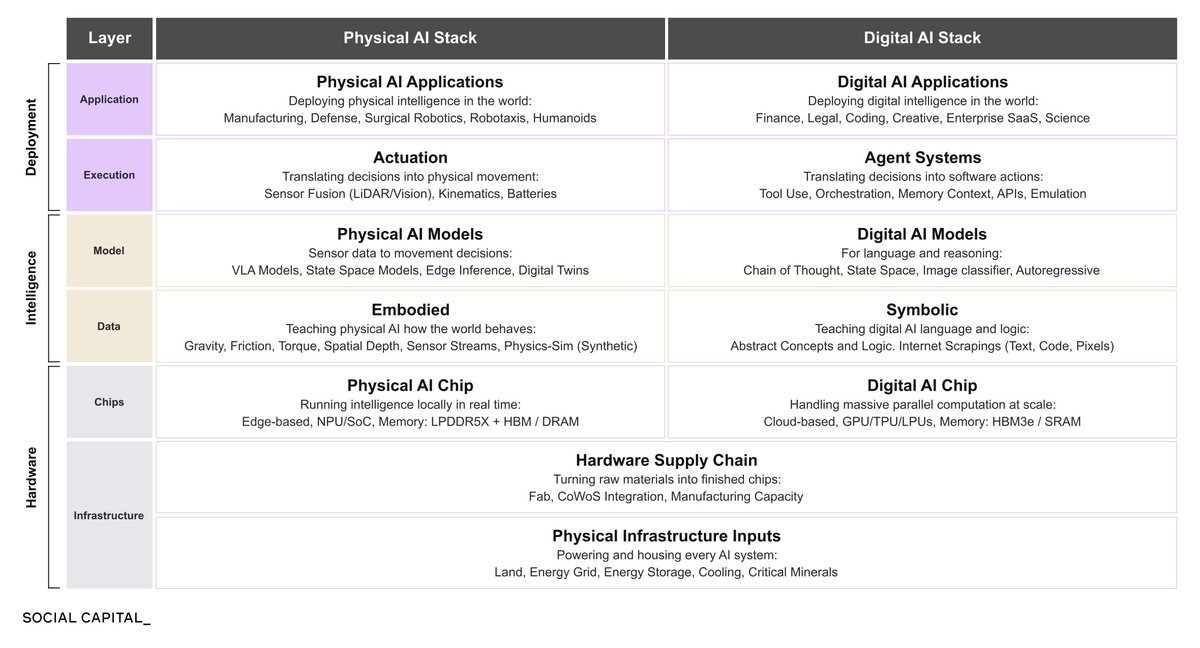
A framework to understand how value accrues across the AI stack.
This is a blueprint for understanding what builds AI into its pragmatic parts: what each layer is, where it ends, and where value is accrued. So here’s how you can think about it:
1. Layer 1 - Infrastructure
Before any AI model trains or any robot moves, an industrial foundation must exist. Land, energy grids, cooling systems, critical minerals, and fabrication facilities. Infrastructure is the constraint that all the other layers depend on.
2. Layer 2 - Chips
Transistors that are etched onto silicon wafers using extreme ultraviolet light. This is what allows both physical and digital AI to take an input, process it, and return a predictive output. The more transistors that fit on a chip, the more computation it can perform.
3. Layer 3 - Data
Both digital and physical models train on data. Digital models train on text, code, and images; physical models train on gravity, friction, depth, and sensor streams. The more accurate the data, the more accurate the output.
4. Layer 4 - Models
A model is a system that learns from examples. Feed it enough examples of inputs paired with correct outputs, and it adjusts its internal structure until it can predict correct outputs on inputs it has never seen before.
LLMs represent a specific class trained on text. They learn by processing billions of examples of human language, developing the ability to write, reason, summarize, and generate code.
5. Layer 5 - Execution
This is what lets models take actions on behalf of users. The execution layer lets models pursue objectives through sequential action: observing the environment, reasoning about the next step, acting, and looping until the goal is reached.
6. Layer 6 - Application
All of the AI Stack’s revenue originates at the application layer, then goes to the layers below.
Every dollar paid for AI is paid for an outcome, a task completed, and an answer delivered. Nobody wants H100s for their own sake. They want H100s because someone, somewhere, wants to run an application.
These are the different layers that make up the entire ecosystem of AI.
We did a full study on the AI stack. If you want to read about it, head over to my Substack (https://t.co/uaxeJk63aO)
Nearly every solopreneur, startup, SME, enterprise or government department, will want to become an agentic organization (or "cybernetic org").
They will be vastly smarter, faster and more efficient.
Internet Computer Protocol (ICP) helps enable this brave future. But how? 🧵
why is $POD at 80m:
- Base coin from Eric Hartford (@QuixiAI), founder of the Dolphin open source models
- Been doing LLMs since April 2023
- Flagship model "Dolphin-Mistral-24B-Venice-Edition" is the default uncensored model for @AskVenice. $VVV beta
- Compute provider for Bittensor's Subnet 4
Classic case of a famous open source AI guy tokenizing for upside.
Supply is very concentrated, 89% in 2 wallets - low float tactics.
You can take a quarter million dollars from American banks, move to Bali, and live like a king for 3 years on $4,000 a month while the banks send you angry letters to an address you don't live at anymore
And the craziest part? Not a single thing about this is a criminal offense
$250K liquidated from 0% business credit cards through Melio and Plastiq into your business checking account. Processing fees: about $7,125 at 2.85%. Now you have $242,875 in cash sitting in your bank
Average cost of living in Bali for a baller lifestyle (private villa, scooter, eating out every meal, coworking space, weekend trips to other islands): $3,500 to $4,500/month. Call it $4,000
$242,875 / $4,000 = 60 months. 5 years of living in paradise on bank money
"They'll come after you"
Here's what they can actually do:
They can call you. Your US phone number is cancelled. You have a local Indonesian SIM card. Good luck
They can mail you. To the US address on file. You moved 9,000 miles away. The letters pile up in a mailbox nobody checks
They can report to credit bureaus. Yes. Your US credit score gets destroyed. But you're living in a country where nobody checks a FICO score. Indonesian landlords don't pull Equifax. The villa owner wants cash
They can sue you. In a US court. For a civil judgment on unsecured credit card debt. If you don't show up (because you're in Bali), they get a default judgment. That judgment lets them garnish US wages (you have none) and levy US bank accounts (you moved your money to a Wise or Mercury account that you access internationally)
They cannot have you arrested. Not paying a credit card is not a crime. It's a civil debt. There is no international arrest warrant for credit card default. Interpol does not care about your Chase Ink bill. The US embassy in Bali does not care. Nobody cares
After 7 years from the date of first delinquency, every account falls off your credit report automatically per the FCRA. You come back to the US with a clean file. Rebuild your score in 90 days with the authorized user strategy. Stack another round of business credit. The banks have no memory. Their systems only look back 7 years
"But the personal guarantee"
Business credit cards with a personal guarantee make you personally liable for the debt. That means they can pursue you personally in civil court. But the judgment is still civil. Still not criminal. And enforcement of a US civil judgment in Indonesia is... let's just say it's not something that happens. Indonesia does not have a treaty with the United States for enforcement of civil money judgments. The collector would have to re-litigate the entire case in Indonesian court. For a $250K credit card bill. They will never do this
Here's what people are actually doing:
The digital nomads who figured this out aren't even running from debt. They're running profitable online businesses from Bali while the 0% promo runs out, cycling to new cards remotely (you can apply for US business credit cards with a US address and US SSN from anywhere on earth), and paying off the old cards with business revenue. The ones who can't make the business work just... don't pay. And life goes on
A guy I know moved to Lisbon in 2023 with $180K in 0% business credit. Lived on $3,800/month for 18 months while building a marketing agency. Agency hit $22K/month by month 14. Paid every card off from revenue. Never missed the US once. Still lives in Lisbon. Still uses the same credit cards. Still at 0% on his current cycle
He didn't need to default. But he had the option. And knowing the option existed let him take the risk. The mental math changes completely when you understand that the worst case scenario for $250K in credit card debt is "my credit score sucks for a few years and I settle for pennies"
People mortgage their lives around a number on a credit report. They stay in jobs they hate. They live in cities they can't afford. They say no to opportunities because "what if I can't make the payment." Meanwhile the bank that issued the card has already priced your default into their quarterly earnings. They don't care if you pay. They've already hedged it
The bank made a bet. They bet you'd carry a balance and pay 24% interest for a decade. You took their money and moved to Bali. One of you is going to lose that bet
Am I telling you to flee the country with $250K? No. I'm telling you the actual legal consequences of credit card default, which are dramatically less severe than what most Americans have been led to believe. And I'm telling you that understanding those consequences changes how you evaluate risk, opportunity, and what you're willing to do with a 12-month window of free capital
every financial decision you've ever made was based on a fear that doesn't match the legal reality. that fear is profitable for banks. it's expensive for you
do with this information what you will
(we get 700+ score business owners $100K-$250K in 0% business funding. where you take the money is your business. link in bio)
I have never been more bullish on crypto.
Because the rules-based order is collapsing and the code-based order is rising. So the short term price doesn’t matter.
As international law breaks down, we will need not just onchain currencies, but onchain companies. As the post-war order breaks down, we’ll similarly need the post-internet order. States will fail, and the network will take their place.
We need internet capitalism, we need internet democracy, and we need internet privacy. So we need cryptocurrency.