@AxelTalksFilm I grew up on song and dance films because of my parents, and seeing Michael Jackson revive some of the best of that era was special indeed.
The most quoted "there's no spoon" scene from Matrix is the most misunderstood scene.
The boy tells Neo the spoon doesn't exist.
Most people think this means "nothing is real, everything is simulation."
Wrong interpretation.
Completely backward.
The spoon exists. The child exists. The conversation exists.
What doesn't exist is the boundary between the spoon and Neo.
The separation is the illusion.
When you try to bend a spoon with your mind, you're operating from the assumption that "you" are separate from "spoon." Subject acts on object. Mind controls matter. That duality creates the impossibility.
The child figured out something neuroscientists are just confirming:
Your brain doesn't distinguish between self and environment the way you think it does. The neural networks that represent "your body" extend seamlessly into the networks that represent "the space around your body." The boundary exists in language, not in neural reality.
For example, a tennis racket becomes an extension of your arm, a race car becomes an extension of your body. The instrument stops being separate and starts being you.
The spoon bends because Neo stops treating it as external. The separation dissolves.
There's no spoon to manipulate because there's no separate self doing the manipulating.
This is grounded in science. Embodied cognition research shows your brain can map the tools and objects you focus on as real extensions of your body schema. Pianists’ brains often represent piano keys within their finger map. Surgeons’ brains can represent their instruments as extended limbs.
The Matrix scene was accidentally teaching applied neuroscience disguised as sci fi philosophy.
The real takeaway:
Stop trying to change things outside yourself. Recognize that the "outside" is a cognitive construction.
The spoon bends when you realize you are the spoon.
Sea urchins are known to pick up shells with their tube feet and wear it to avoid light. An aquarist created 3D-printed tiny hats for them, and surprisingly, the sea urchins wear these miniature hats.
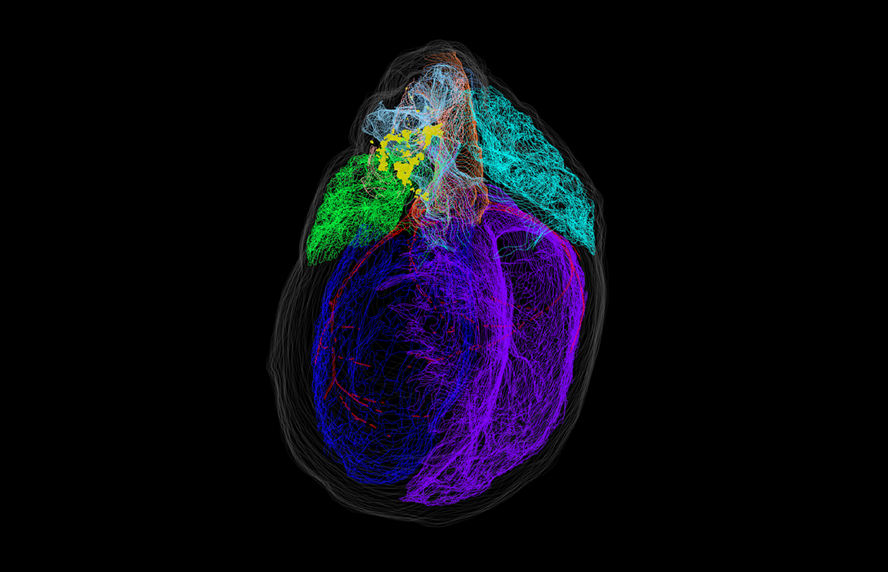
The heart is not a pump. Or rather, it is a pump in the same way that a smartphone is a flashlight.
Yes, it performs that function. But it is so much more.
The heart possesses its own intrinsic nervous system, containing approximately 40,000 sensory neurons, called sensory neurites, that form what cardiologists now call the heart's "little brain".
The heart generates the largest electromagnetic field in the body. Its electrical field is approximately 60 times greater in amplitude than the electrical activity generated by the brain.
The magnetic field produced by the heart is more than 100 times greater in strength than the field generated by the brain and can be detected up to three feet away from the body in all directions using SQUID-based magnetometers.
HeartMath Institute research has demonstrated that the timing between pulses of the heart's magnetic field is modulated by different emotional states, and crucially, that these magnetic signals have the capacity to affect the physiological systems of individuals around us.
This is not metaphor. The heart broadcasts electromagnetic information about your emotional state into the environment at the speed of light, and the nervous systems of other people act as antennae, tuned to and responsive to these signals.
The biggest story of last year, and probably the biggest story of the coming year, is the widespread discovery of the fact that we have never been more accountable to government, which can see into our lives with unprecedented clarity and monitor our utterances to the word, while it has never been less accountable to us.
On the verge of Artificial General Intelligence, so we're told, we still can't count votes, police billion dollar frauds, penetrate the chambers of elite decisionmaking, or figure out where much of our money is going and what's being done with it. This is the kind of crisis that undermines the basic legitimacy of nations and regimes. How we deal with it, or don't, will determine our fate.