@ZeFrost Driving the scenario with GDScript inside Movie Maker is a nice trick — you get the game's own lighting and effects in the clip. Do you keep a separate camera rig for these, or reuse the in-game camera?
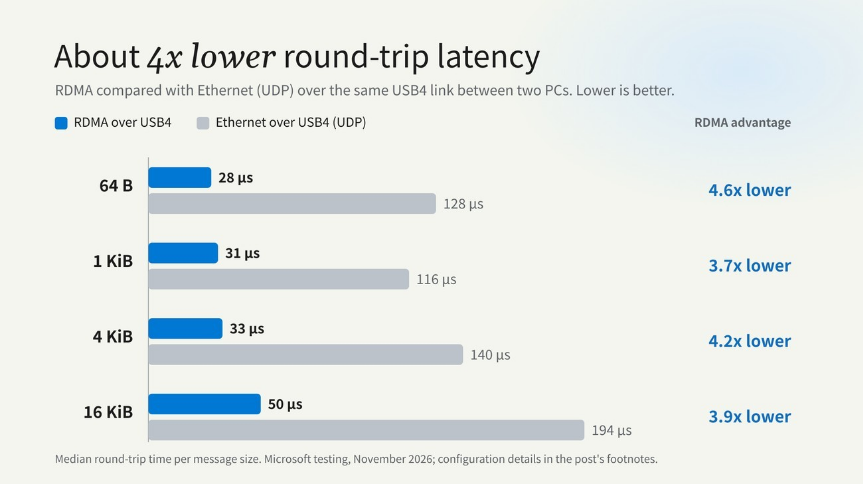
@EmberAITech That's a good way to put it — tensor-parallel token generation is a small-message, many-round-trip problem, so the 4× drop versus UDP on the same cable is what actually matters. Curious how much of that 28–50 µs holds once you daisy-chain more than two PCs.
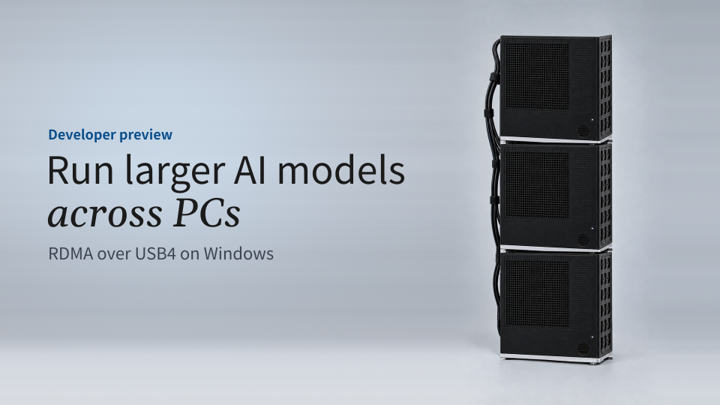
Microsoft (Nov 19): the company announced a developer preview of RDMA over USB4 on Windows — connect two or more USB4-capable Windows PCs with USB4 cables and split one model across their combined memory and GPU compute.
Official details: no RDMA network adapter, switch, or third-party driver is required. Apps use NetworkDirect, the same RDMA API Windows already uses with datacenter adapters. A NetworkDirect provider and a llama.cpp-based testbed are open source. The preview is coming soon to Windows Insiders in the Experimental channel (Future Platforms).
Official figures: in Microsoft's measurements between two PCs, RDMA over USB4 cut round-trip latency for small messages to about 28–50 µs, roughly 4x lower than Ethernet (UDP) over the same USB4 link. Three mini-PCs with AMD Ryzen AI Max processors, Radeon 8060S graphics and 128 GB of unified memory each, connected in a USB4 40 Gbps full mesh, ran Qwen3-235B-A22B (4-bit) at about 18.5 tokens per second. Intel measured GPT-OSS-120B on Core Ultra Series 3 PCs with 64 GB of memory each: 49.4 tokens/s with three PCs and 54.2 tokens/s with four, at a 1K-token context.
https://t.co/4lDHxFIhba
X Square Robot (Nov 23): the lab launched WALL-OSS-1.0, a vision-language-action foundation model trained with native VLA pretraining, starting from a Qwen3.5 base.
In the official open-ended real-robot evaluation, evaluators freely chose the tasks and the same pretrained policy was used with no task-specific fine-tuning. Across 312 unique tasks (from 377 evaluations), the official figures are a 55.1% zero-shot success rate and a mean score of 6.45/10.
The announcement says the code and model weights will be open-sourced soon.
Official blog: https://t.co/pCA6fxfBEN
星动纪元发布原生 VLA 基座 WALL-OSS-1.0。
@vidar_0208 The analytic capsules are a great fit for open shade — shadow maps have nothing to say when there's no sun. Curious whether the 39 capsules are hand-placed or generated from the mesh?
MemTensor (Nov 22): the lab launched MemT-1.0-Pro, a memory-native model it says was developed with NVIDIA, built on Nemotron 3 Ultra and trained with Megatron-Core and Megatron Bridge.
Official model card: 554B total parameters, 59B active. Open weights: https://t.co/GNoWgUy1cP
The official announcement compares it with MemT-1.0-Flash: +4.76 points on BEAM-1M and +6.51 on MemoryAgentBench. History is stored in native memory and reused later without keeping the original conversation in the query context. The paper also notes that strong textual-memory systems still lead overall, especially when a long history needs detailed evidence retrieval.
Technical report: https://t.co/MARowV7JcT
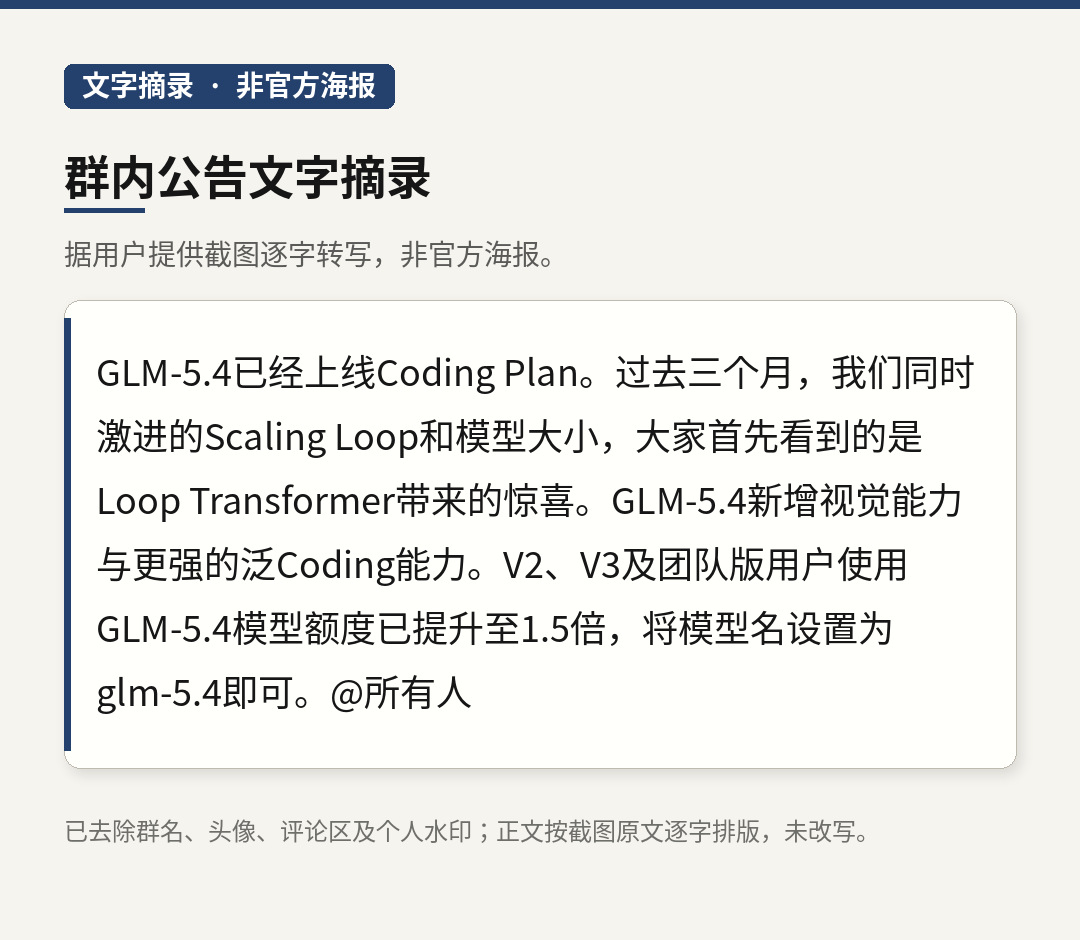
GLM-5.4 is now available to all GLM Coding Plan users, adding vision and stronger all-round coding, according to https://t.co/VWS7ko2QVq's announcement.
Weekly-quota users get 50% more quota than with GLM-5.3. Use glm-5.4, or glm-5.4[1m] in Claude Code.
The image is a privacy-safe transcription of a user-provided group notice, not an official poster.
https://t.co/bMAkeHVIGU
GLM-5.4 is now available to all GLM Coding Plan users.
New vision capabilities and stronger all-round coding performance.
For users with weekly quotas, GLM-5.4 now comes with 50% more quota compared to GLM-5.3.
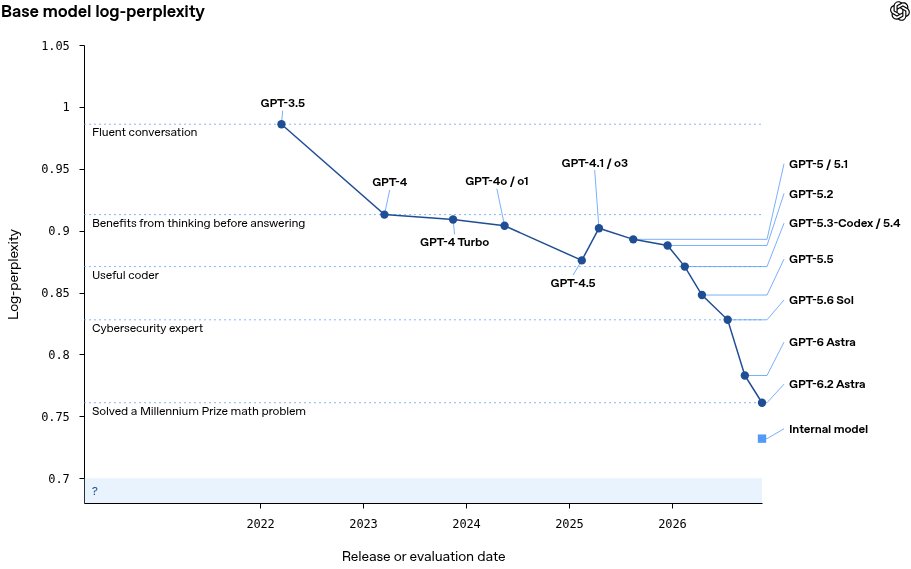
Microsoft AI CEO Mustafa Suleyman (Nov 23): in a post quoting OpenAI Chief Scientist Jakub Pachocki's Nov 22 essay, he said Microsoft fully supports the transparency initiative. With OpenAI's permission, Microsoft reported MAI-2 Base on OpenAI's held-out evaluation set.
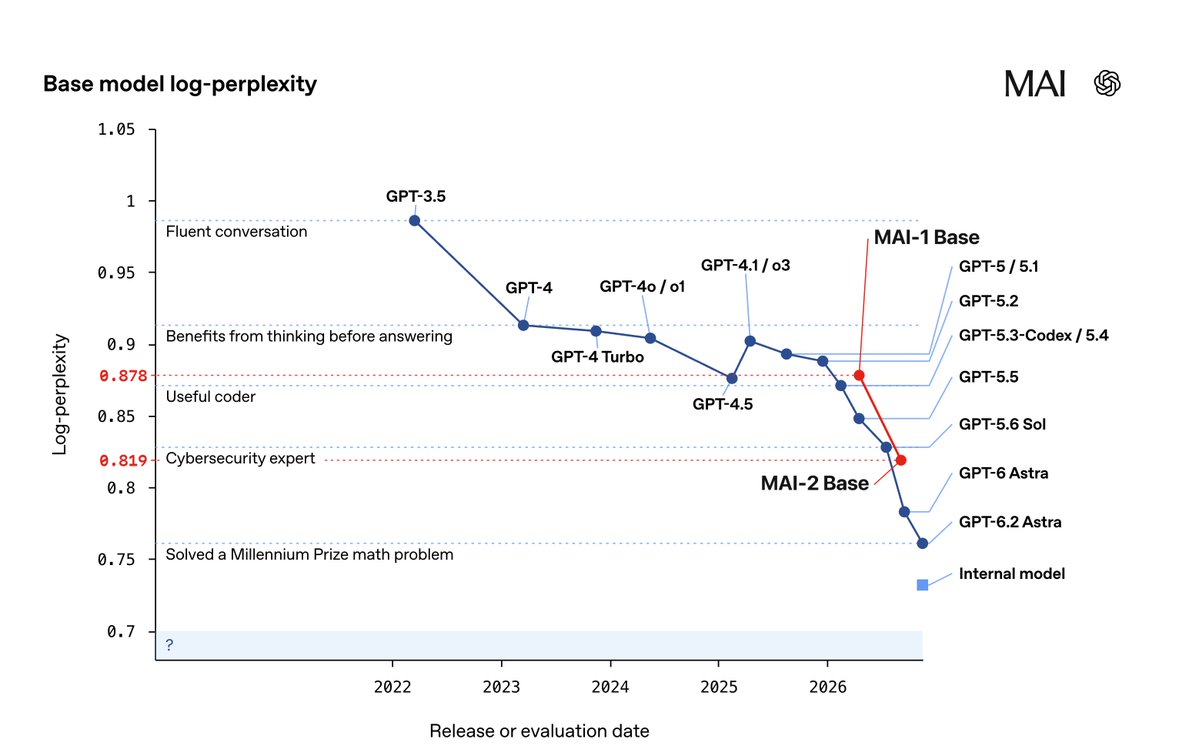
Official figures from his post: MAI-2 Base's log-perplexity is 0.819, which he said puts it in the same ballpark as the GPT-5.6 Sol base model. He noted that Microsoft's model uses the same tokenizer as OpenAI, so the numbers are directly comparable, and that access to OpenAI's evaluation dataset is a special case. For comparisons across labs with different tokenizers, he suggested bits-per-byte (BPB) may be needed.
The official chart attached to his post also marks MAI-1 Base at 0.878.
https://t.co/GbrrkRY7pV
微软 AI CEO 在 OpenAI 公开内部困惑度后,给出了 MAI-2 Base 在同一留出集上的可比数字。
We fully support OpenAI's transparency initiative. Thanks to @merettm@markchen90@gdb@sama for leading the way.
We all got into this field to build safe AGI that is genuinely good for humanity. One of the hardest parts of AI safety is coordination, and this is a step in the right direction. Many more steps like this will be needed to deliver safe, contained, and aligned AGI in the next few years.
We're committed to sharing our pre-training progress on a common held-out evaluation set. With OpenAI's permission, we report MAI-2 Base on their evaluation set. Its log-perplexity is 0.819, putting it in the same ballpark as the GPT-5.6 Sol base model. Our model uses the same tokenizer as OpenAI, so the numbers are directly comparable.
In the future, to be able to compare across labs we might need to report bits-per-byte (BPB) rather than perplexity since different labs use different tokenizers. We will also need different evaluation datasets - the fact we have access to OpenAI's evaluation dataset is a special case.
Safety and alignment is now the mission. It's the absolute number one most important focus for our industry. And it begins with small, practical steps like these towards better coordination on pacing.
OpenAI (Nov 22): Chief Scientist Jakub Pachocki published the company’s internal pretraining log-perplexity (cross-entropy loss) numbers, and argued that this metric should be used to compare progress across labs and to inform shared safety standards.
Official figures, on a fixed snapshot of an internal-codebase held-out set OpenAI has tracked since GPT-3.5: GPT-3.5 at ~0.99, GPT-4 at ~0.91, and current models below 0.8, where he says transformative capabilities have emerged in cybersecurity and mathematics. After a model reached ~0.76, he writes, it began producing groundbreaking results on open math problems the lab had been posing to models.
He proposes that frontier developers set common limits—based on perplexity and other measurements—that they will not cross until monitoring reaches a concrete milestone, such as a successor to chain-of-thought monitors. He also expects further transformative capabilities as models enter the ~0.68–0.7 window, while noting that chain-of-thought gains do not show up in perplexity.
https://t.co/qroSiOcb56
OpenAI首席科学家首次公开内部预训练困惑度,并提议用它来设定行业共同的发展上限。
METR (Nov 20): in its Q4 2026 capability update, the research org says that on the combined TH1.1 and TH2 task suites, time horizons are doubling roughly every 3.61 months (95% CI 2.08–4.94), or 110 days. That is similar to its previous TH1.1-only trend of 105 days.
It also reports that current public frontier models have an estimated time horizon of up to 27 hours on the verifiable subset of its TH2 tasks. A naive extrapolation of the combined trend would have models reach a 50% time horizon of 200 hours — the longest score threshold in the suite — in July 2027.
https://t.co/MiIfoggp1K
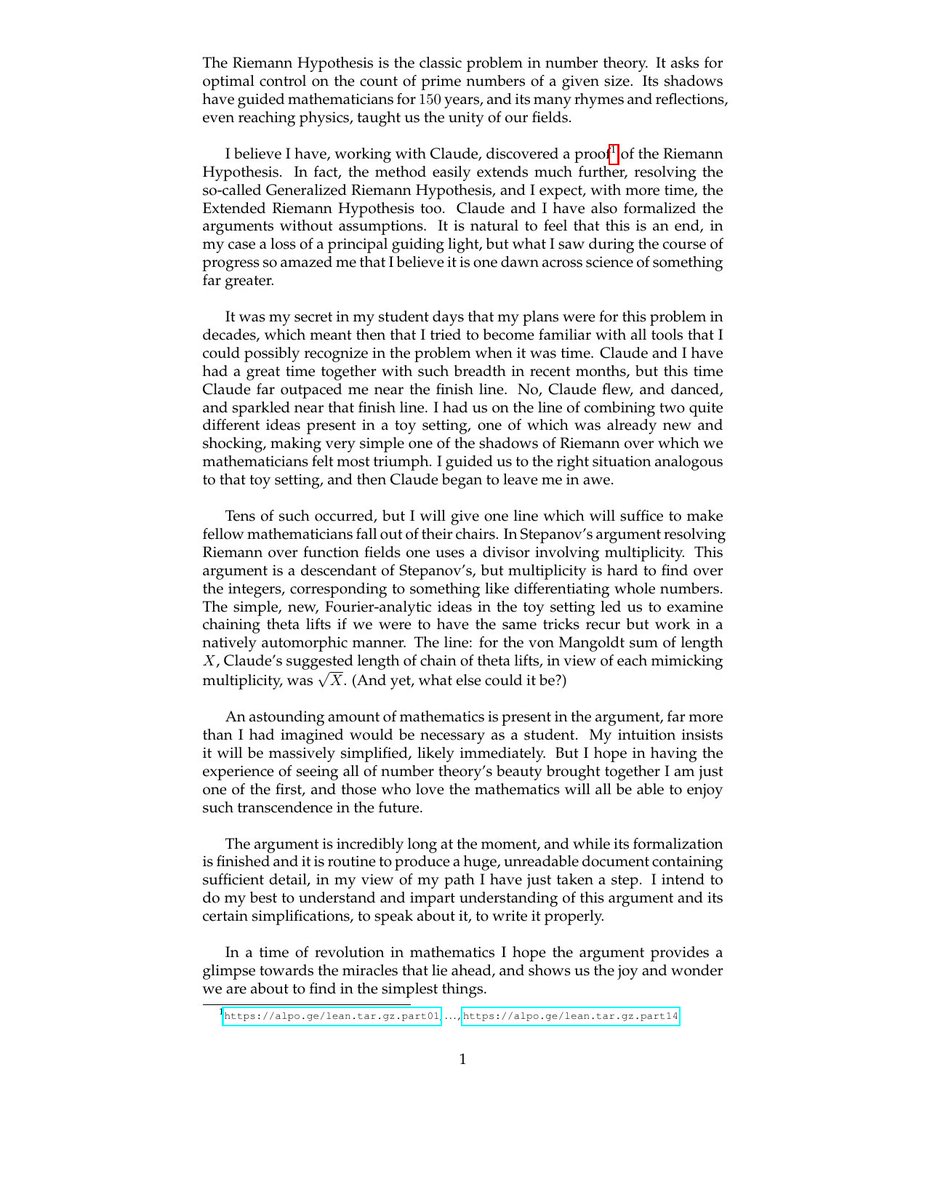
Mathematician Levent Alpöge (Nov 20): in a note on his site, he says he believes he has, working with Claude, discovered a proof of the Riemann Hypothesis, and that the method also resolves the Generalized Riemann Hypothesis. He writes that he and Claude formalized the arguments without assumptions.
MIT number theorist Andrew Sutherland published an independent verification log (last updated 22:05 UTC on Nov 20): all 175,187 Lean modules compile; the five headline theorems use only Lean’s three standard axioms; every module has been replayed through the Lean kernel; two independently written kernels, nanoda and con-leche, accept the full exported proof. As of that update, the end-to-end lake comparator run and the Lean-kernel replay of the export were still in progress.
https://t.co/vLbEjitB3W
https://t.co/P8UEN1NiJA
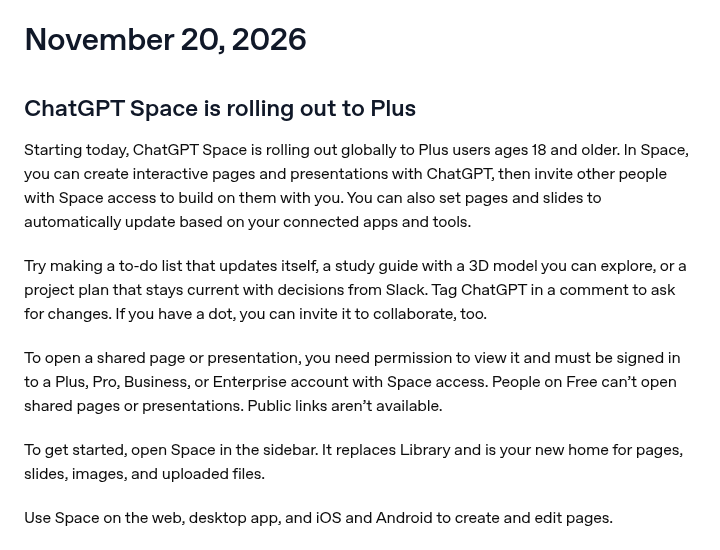
OpenAI (Nov 20): ChatGPT Space is rolling out globally to Plus users ages 18 and older. In Space, you can create interactive pages and presentations with ChatGPT, invite other people who have Space access to work on them with you, and set pages and slides to update automatically from connected apps and tools. If you have a dot, you can invite it to collaborate too.
Official details: Space replaces Library as the home for pages, slides, images, and uploaded files, and works on the web, the desktop app, and iOS and Android. Opening a shared page or presentation requires a signed-in Plus, Pro, Business, or Enterprise account with Space access; people on Free cannot open shared pages or presentations, and public links are not available.
https://t.co/J469wzW7rj
OpenAI (Nov 20): the company published how it is defending against adversarial distillation — unauthorized use of a frontier model's outputs to train another model that does not inherit the original safeguards. It focuses on protecting “protected reasoning,” the hidden chain-of-thought traces, in GPT-6.2 Astra and GPT-6.2 Sol.
Official figures, from an adaptive black-box evaluation aggregated across six attacker models: the average attack success rate for extracting protected reasoning from an earlier request fell from 54.0% on GPT-6 Astra with its original safeguards to 0.2% on GPT-6.2 Astra with the updated safeguards. For the current request, the rate fell from 22.9% to 0.9%. OpenAI says the defenses combine adversarial training, input and output classifiers, API-level protections, and campaign-level detection.
https://t.co/fGGYNvwPye
OpenAI (Nov 20): the company introduced MedChemBench, a benchmark for whether AI models can read molecular structures, interpret experimental results, and decide which compounds to test next.
Official details: it comprises 99 problems drawn from 117 papers and patents, and includes 761 distinct molecular structures. At the xhigh reasoning setting, GPT-6.2 Astra earned 84.5% of the available credit, compared with 83.3% for GPT-6 Astra, 82.0% for GPT-6.1 Sol, and 58.2% for GPT-5.6 Sol. OpenAI says these results do not establish whether models can discover new drugs or improve laboratory decisions.
https://t.co/y5IVfCKxaE
Thinking Machines (Nov 20): the company released Inkling 2 Mini, an open-weights model it says is small enough to run on a laptop.
Official details: it is a looped mixture-of-experts transformer with 26.4B total parameters and 3.4B active per token (5.4B weight activations per token when counting the three passes through the middle layers). The company says the total memory footprint is about 20GB, with most weights in NVFP4 and the last four layers in MXFP8. Official figures: among open-weights models with less than 100B total parameters, it leads on DeepSWE v1.1 (48.2%) and Vals Index v2.2 (46.5%). Weights are available now, and it is on Tinker today for inference and customization.
https://t.co/LRnn9EOc5F