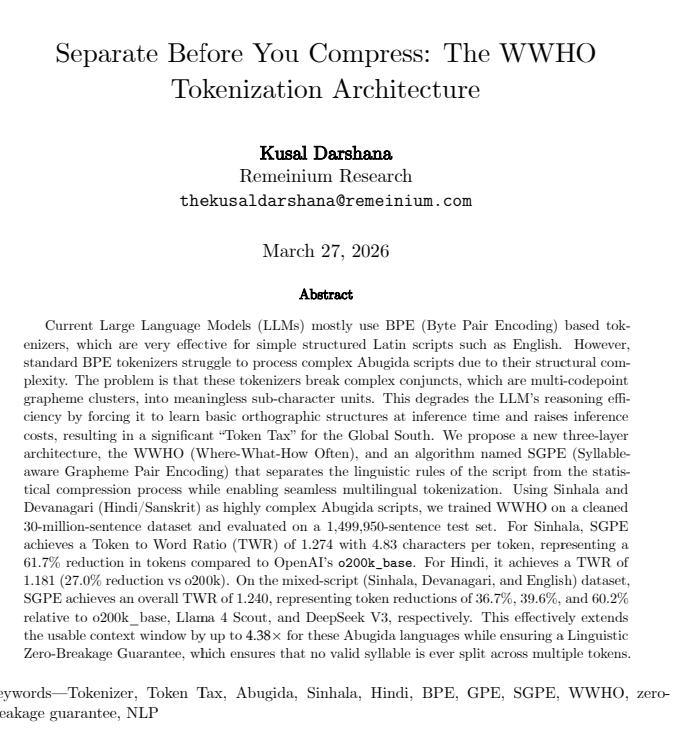
A paper is the way humans compress their profound ideas and preserve them for future generations.
It is a form of super intelligence, in the sense of AI, and we need to train models not to be greedy for data.
→ Paper: https://t.co/VZgbvrBXnb
→ Source Code: https://t.co/8oGBsu19LZ
→ Complete Architecture Visualization: https://t.co/CUglJTSSmU
#LLMs #AI #WWHO #research
In 1742, Christian Goldbach wrote to Leonhard Euler proposing a simple conjecture: every even number greater than 2 is the sum of two primes (e.g., 18 = 13 + 5, 74 = 43 + 31).
In 1938, Nils Pipping verified this up to 100,000 by hand. Since then, computers have checked it for vast ranges—millions, billions, even trillions—without a single counterexample.
Yet, no general proof exists. The statement remains one of mathematics’ most famous unsolved problems known as Goldbach conjecture.
Individually, they are contradictions. But together, they sustain the entire system. One cannot exist without the other.
This is the classic dialectical triad: the Thesis (Give) and the Antithesis (Get) colliding to form a higher state of reality—the Synthesis—For(get, give).
* "Wealth" only exists because "poverty" defines its boundary.
* "Light" only makes sense because "darkness" co-exists.
* A circuit only flows when the positive (+) and negative (-) charges clash.