I keep getting asked "how do I even know if AI engines mention me?" So here are the nine checks I run, each answering exactly one question and nothing else:
1. Do AI engines cite you — ChatGPT, Perplexity, Claude, Gemini, one probe each
2. Who gets named when someone asks for alternatives to you
3. What an engine thinks your brand name means (worth doing if your name is a real word)
4. Which Reddit threads Perplexity cites in your category — that's your posting list
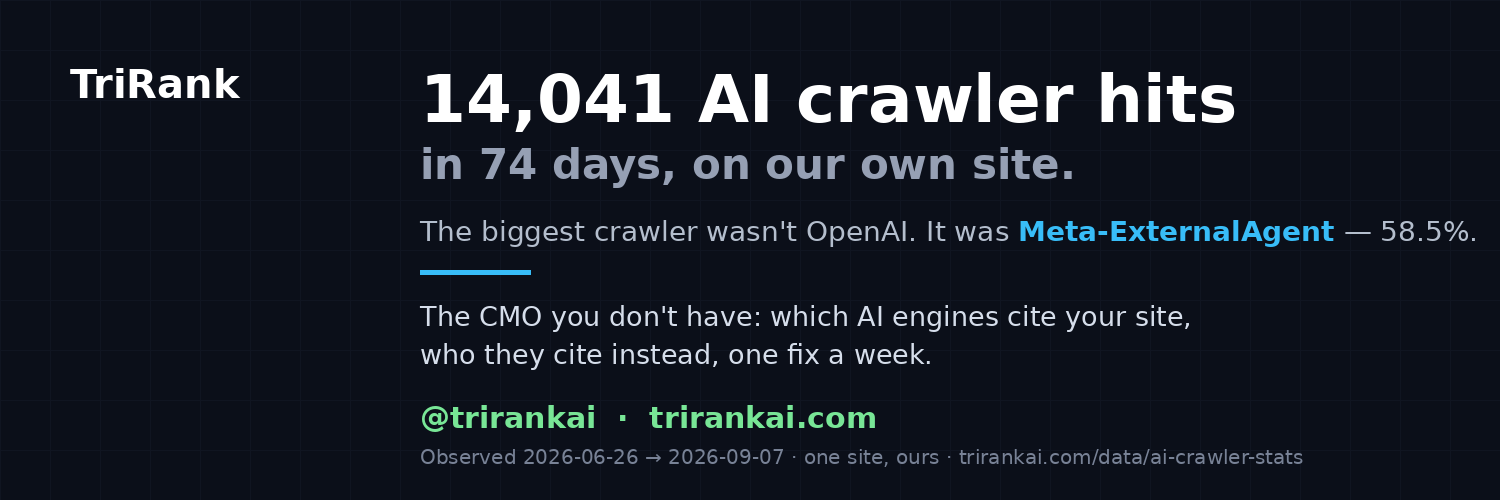
5. Which AI crawlers actually visit your site — upload a day of access logs. Most people guess OpenAI and are wrong
6. Is your homepage set up the way engines expect — llms.txt, crawler access, schema
7. Which questions your best post actually answers — that's what engines extract
8. DR for a whole list of domains in one paste — for when someone sends you a backlink list
9. What AI traffic is worth to you, in money
All free, no account: https://t.co/bC1FGXjlsj
Reply with your domain and a number and I'll run it and post the result. I've done a dozen this week — 0 of 4 is more common than people expect, and it's a useful number to have dated.
Quick correction to my earlier wording: the free Day-0 checker uses just your brand name and checks whether your domain is in the returned sources. It doesn't score recommendation or framing, or run a buyer-prompt set. Those need a separate check of the actual answers. Sorry for mixing the two.
Agreed on repeat sampling. A single run is a snapshot, not a stable visibility rate. The free checker only uses the brand name, so it doesn't test the buyer prompts I mentioned. For those, I'd keep repeated-run citation frequency and failed runs separate, alongside the actual sources.
@tonyrestell Exactly. I'd also keep the prompt, date and engine next to each result, and treat failed checks as unknown. Otherwise a model change or timeout can look like a visibility change. Do you keep separate prompt sets for branded and non-branded questions?
Fair question. The free check sends just the brand name as the prompt, then checks whether your domain appears in each engine's returned sources. It doesn't test a buyer query or measure recommendation/context. My earlier reply blurred that distinction. You're right: the prompt needs to be visible alongside the result.
@lilyraynyc Title punctuation breaking AI Overviews is such an under-logged failure mode.
Same class as crawl-allow-but-CDN-403: the content can be fine and the answer surface still skips you. Worth a frozen-prompt recheck after any title/schema tweak.
@semrush 92% shaping the shortlist is the buyer-committee problem in one number.
Security vs finance vs end-user ask different questions — so one blended "AI score" hides disagreement. Per-prompt, per-role naming across engines is the cleaner ledger.
@jasonmbarnard Prospects asking AI before the meeting is the new pre-call research.
Scattered entity record → undersold by the model. Same board idea as brand SERP: check how you're framed on the prompts buyers actually ask, not only whether your name appears once.
@WaqarSaaS Half-game framing is right — Google rank alone misses the chat window.
Useful add: treat ChatGPT / Claude / Perplexity as a second scoreboard with frozen prompts, not a vibes check after one ask. AI traffic up is the win; durability of who gets named is the ledger.
@Alex_Smale_ Five-week fade matches what we see too — signals go stale fast.
Garden pruning works better when you keep a frozen buyer-prompt set and watch flip rate week to week, not just another one-off audit. Freshness without a board is hard to prove.
Comparison pages are strong citation bait — agree.
After shipping them: freeze the exact buyer prompts those pages answer, re-run across ChatGPT / Perplexity / Claude / Gemini, log who gets named. Page live ≠ recommended yet.
Free Day-0 multi-engine check if useful:
https://t.co/GouNfR11LV
Early organic climb + high Ahrefs / AI-visibility scores usually means crawl + structure are fine.
Separate check: on frozen buyer prompts, do ChatGPT / Perplexity actually name the domain as a source — or only a tool score?
Free multi-engine Day-0 if you want a second pair of eyes:
https://t.co/GouNfR11LV
Compounding is the right frame — Day-0 ≠ durable.
After the first AEO/GEO push, freeze a small buyer-prompt set and re-check weekly across ChatGPT / Perplexity / Claude / Gemini. Flip rate on that log beats a one-time visibility score.
Free multi-engine baseline if useful:
https://t.co/GouNfR11LV
This is why leaders bounce the slide.
One ChatGPT ask ≠ a board. Same prompt an hour later can reshuffle the list.
Unit that sticks: freeze 10–20 buyer prompts, re-run weekly across ChatGPT / Perplexity / Claude / Gemini, log domain-as-source yes/no — not a screenshot.
Free multi-engine Day-0 if useful:
https://t.co/GouNfR11LV
@sengineland RevOps framing for SEO/GEO is overdue — zero-volume pages that still close revenue break the "traffic or it didn't happen" habit.
Same for AI answers: track whether the domain gets named on the prompts that already convert, not only impression-like AI Overview counts.
Third-party citation prioritization is the under-built half of AEO — own-site technical GEO alone rarely flips "recommended."
Useful pairing with a Claude skill like this: freeze the buyer prompts first, then rank which third-party surfaces actually move domain-as-source on those prompts, not every directory.
SERP halo + AI cite as a second trust signal matches what we see too — brand present in more places → higher click wherever the eye lands.
Caveat we keep: log named vs linked-cite separately. A mention without a citation card still borrows trust; it just won't show in referral logs.
@neilpatel Low-hanging GEO for smaller brands usually isn't another content blast — it's being the clearest answer on a few buyer prompts the big sites leave thin.
Then re-check those same prompts weekly. One lucky cite ≠ durable recommendation.