Simon Sinek offers a counterintuitive take: The moment you step in and fix the problem, you stop being a leader:
You got promoted because you were the best at the job.
And that's precisely what makes leadership so difficult.
The same instinct that made you great at the work, seeing the problem, knowing the answer, fixing it fast, becomes a liability the moment you move into a leadership role.
Simon is direct about this:
"Then you're not leading. You're just doing the work. You just have the leadership position."
The people who now report to you may not be as good as you. They'll move slower. They'll miss things you would have caught immediately.
And in those moments, every instinct will tell you to step in.
But that instinct is exactly what you have to resist.
"You can't just come in and tell them how you would do it. You have to push them to solve the problems the way that they would, just like someone did for you once before."
Someone once gave you the space to figure it out. That patience is what shaped you. Now it's your turn to offer the same to others.
Simon points to Chanel as a company that has built this principle into its culture.
Newly hired senior leaders are not allowed to speak in meetings for their first three months.
"You don't know anything about our company. And you'll learn by listening."
Chanel trusts that their leaders will be around for the long term, so 90 days of silence is a small price to pay for someone who truly understands the business before they start shaping it.
That's institutionalised patience. And it's almost unheard of.
Most organisations reward speed, decisiveness, and output. So the pressure to swoop in and fix things feels justified, even virtuous.
But Simon draws a hard line between having a leadership position and actually leading.
One is a title. The other is a practice.
And that practice demands something most high performers find deeply uncomfortable. Watching someone struggle toward an answer you already have, and choosing to let them find it themselves.
That restraint is the real work of leadership.
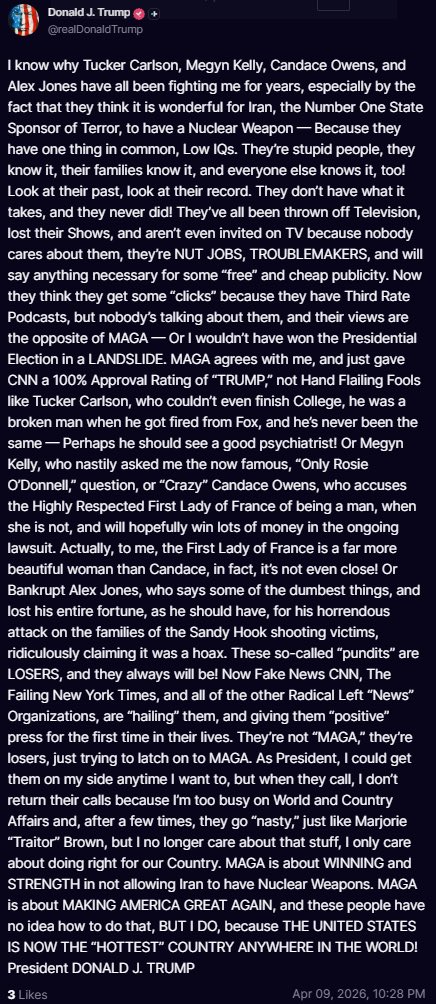
Donald Trump dreht durch.
Er zerschlägt das Bündnis mit seinen einstigen medialen Leibwächtern und exkommuniziert die Elite der rechten Influencer-Szene aus der MAGA-Welt.
Er brandmarkt Tucker Carlson, Megyn Kelly, Candace Owens und Alex Jones als „Low-IQ-Versager“, die dem Iran in die Hände spielen.
Trump duldet keine Götter neben sich:
Wer nicht spurt, wird zum „Nutzlos-Pundit“ deklariert.
Es ist die totale Säuberung der Bewegung – Loyalität ist die einzige Währung.
Donald Trump hat auf Truth Social einen Frontalangriff gegen prominente konservative Medienpersönlichkeiten gestartet und sie als Gefahr für die nationale Sicherheit eingestuft. Er wirft Tucker Carlson, Megyn Kelly, Candace Owens und Alex Jones vor, sich durch ihre Rhetorik zu „menschlichen Schutzschilden“ für das iranische Regime gemacht zu haben. Trump distanziert sich mit drastischen Worten von seinen ehemaligen Weggefährten: Carlson bezeichnet er als „mental instabil“ und „gebrochen“, Kelly als „überbewertet“ und Owens als „verrückt“.
Der Kern seiner Botschaft ist die totale Kündigung der Loyalität. Trump schreibt, dass diese Personen früher einmal für seine Bewegung nützlich gewesen sein mögen, nun aber nur noch ihre eigenen Interessen verfolgen und dabei dem Land schaden. Er wirft ihnen vor, „Fake News“ von rechts zu verbreiten, die genauso gefährlich seien wie die der linksliberalen Medien. Sein Fazit ist unmissverständlich: Wer den Kurs des Präsidenten in der Außenpolitik – insbesondere gegenüber dem Iran – nicht bedingungslos unterstützt, hat keinen Platz mehr in der MAGA-Bewegung und wird von ihm politisch wie persönlich geächtet.
When I'm writing, I make a spreadsheet in Excel to keep track of my characters. I copy and paste their appearance and their age at each point in the narrative. This way, I’m less likely to give someone blue eyes in Chapter 5 and brown in Chapter 15.
Today we’re taking a big step on the path toward AGI and releasing Gemini 3— our most intelligent model yet.
With Gemini 3, you can bring any idea to life. It is state-of-the-art in reasoning, the best model in the world for multimodal understanding, and our best agentic and vibe coding model.