My wife mentioned a nice private school over dinner this week
She said the campus was beautiful
I asked what's the tuition
She said we should look at it as an investment in him not a cost
I made a note
She said don't make a note
I said I always make notes
She said this isn't a deal
I said everything is a deal
She closed her eyes
She said we'd discuss it Saturday
I agreed
Saturday 7:02am
She came downstairs in her Saturday robe
Coffee in hand
I had my cargo shorts on
The dining room had been cleared
The projector was on
The analyst was at the head of the table
Quarter zip on, three iced coffees, a legal pad, and two laptops
He had been there since 6:44am
I texted him at 11:14pm Friday
The text said dining room 6:45am bring the model
He sent a thumbs up
My wife stopped in the doorway
She said what is this
I said you said you wanted to discuss it
She said this is not a discussion
I did not respond
She sat down anyway
The analyst stood
He said good morning ma'am
She did not respond
He sat back down
A printed deck in front of each seat
A fourth copy in case
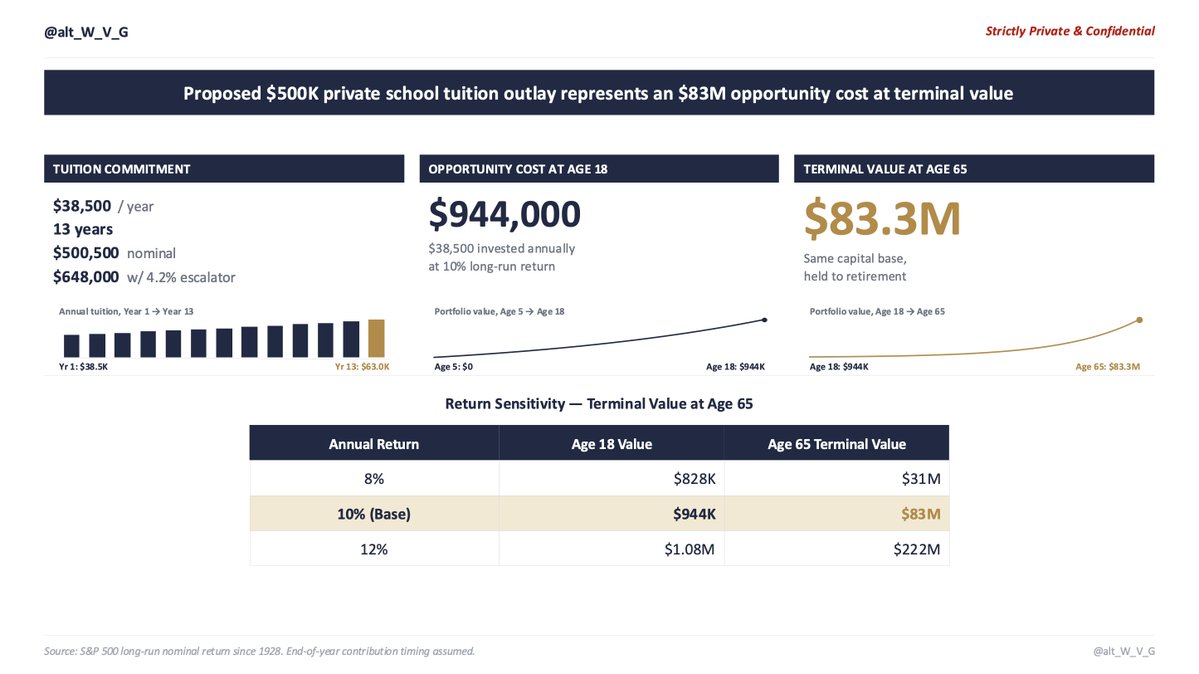
Slide 1 Tuition Schedule
$38,500 per year
Thirteen years
$500,500 nominal
Before escalators
The school has raised tuition 4.2% per year for a decade
With escalators $648,000
My wife said okay
I said I'm not done
Slide 2 Opportunity Cost
Even before escalators
$38,500 invested annually
10% nominal return
S&P long-run average since 1928
By his eighteenth birthday $944,000
My wife said we can afford it
I said I know that's not the slide
Slide 3 Terminal Value at Age 65
$83 million
She was quiet
The analyst slid the sensitivity tables across the table
8% return $31 million
10% return $83 million
12% return $222 million
She did not look
She said this isn't about money
I said it's always about money
She said no it isn't
I said then what is it about
She did not answer
She said you can't put a dollar value on his teachers his classmates his environment
I said I can the analyst already did slide 6
He flipped to slide 6
She did not look
She said the school is the best in the city
I said best is a feeling
She said it produces the best students
I said the students were already the best before they got there
She said our son deserves it
I said our son deserves $83 million
My son walked in
He is five
Dinosaur pajamas
He looked at the projector
He looked at the open deck on the table
He looked at slide 3
He said are we modeling pre-tax or after-tax
The analyst opened a new tab
My wife looked at the ceiling
He said what's the discount rate
The analyst set down his pen
She closed her eyes
He said is this the same return assumption from the 529 conversation
The analyst stopped typing
He looked at me
I did not say anything
She stood up
Sat back down
He said dad can I help
I said yes
He pulled up a chair
The analyst handed him a printout
He started reading
My wife watched him read
She watched him for a long time
She said his name
He looked up
She said do you like school
He said the work is too easy and the kids don't ask questions
She did not respond
She looked at the ceiling
She walked out of the room
The analyst started packing up
He said should I follow up Monday sir
I said no follow up needed
He'll be fine
Sent from my iPhone
1866: Cotton seeds are agricultural waste. After extracting cotton fiber, farmers are left with millions of tons of seeds containing oil that's toxic to humans. Gossypol, a natural pesticide in cotton, makes the oil inedible. The seeds are fed to cattle in small amounts or simply discarded.
1900: Procter & Gamble is making candles and soap. They need cheap fats. Animal fats work but they're expensive. Cotton seed oil is abundant and nearly worthless. If they could somehow make it edible, they'd have unlimited cheap raw material.
The process they develop is brutal. Extract the oil using chemical solvents. Heat to extreme temperatures to neutralise gossypol. Hydrogenate with pressurised hydrogen gas to make it solid at room temperature. Deodorise chemically to remove the rancid smell. Bleach to remove the grey color.
The result: Crisco. Crystallised cottonseed oil. Industrial textile waste transformed through chemical processing into something white and solid that looks like lard. They patent it in 1907, launch commercially in 1911.
Now they have a problem. Nobody wants to eat industrial waste that's been chemically treated. Your grandmother cooks with lard and butter like humans have for thousands of years. Crisco needs to convince her that her traditional fats are deadly and this hydrogenated cotton-seed paste is better.
The marketing campaign is genius. They distribute free cookbooks with recipes specifically designed for Crisco. They sponsor cooking demonstrations. They target Jewish communities advertising Crisco as kosher: neither meat nor dairy. They run magazine adverts suggesting that modern, scientific families use Crisco while backwards rural people use lard.
But the real coup happens in 1948. The American Heart Association has $1,700 in their budget. They're a tiny organisation. Procter & Gamble donates $1.7 million. Suddenly the AHA has funding, influence, and a major corporate sponsor who manufactures vegetable oil.
1961: The AHA issues their first dietary guidelines. Avoid saturated fat from animals. Replace it with vegetable oils. Recommended oils: Crisco, Wesson, and other seed oils. The conflict is blatant. The organization issuing health advice is funded by the company that profits when people follow that advice.
Nobody seems troubled by this. Newspapers report the guidelines as objective science. Doctors repeat them to patients. Government agencies adopt them into policy. Industrial cotton-seed oil, chemically extracted and hydrogenated, becomes "heart-healthy" while butter becomes "artery-clogging poison."
1980s: Researchers discover that trans fats, created by hydrogenation, directly cause heart disease. They raise LDL, lower HDL, promote inflammation, and increase heart attack risk more than any other dietary fat. Crisco, as originally formulated, is catastrophically unhealthy. This takes 70 years to officially acknowledge.
Procter & Gamble's response: Quietly reformulate without admission of error. Remove hydrogenation, keep selling seed oils, never acknowledge that their "heart-healthy" product spent seven decades actively causing the disease it claimed to prevent.
Modern seed oils remain. Soybean, canola, corn, safflower oils everywhere. Same chemical extraction process. Same high-temperature refining. Same oxidation problems. Just without hydrogenation so trans fats stay below regulatory thresholds.
These oils oxidise rapidly when heated. They integrate into cell membranes where they create inflammatory signalling for months or years. They're rich in omega-6 fatty acids that promote inflammation. They've never existed in human diets at current consumption levels.
But they're cheap. Profitable. And the food industry has spent a century convincing everyone they're healthy. The alternative, admitting that industrial textile waste shouldn't have been turned into food, would require acknowledging the last 110 years of dietary advice was fundamentally corrupted from the start.
Your great-grandmother cooked with lard because that's what humans used for millennia. Then Procter & Gamble needed to sell soap alternatives and accidentally created the largest dietary change in human history.
We traded animal fats that built civilisations for factory waste that causes disease.
The soap company won. Your health lost.
As a former Special Forces Warrant Officer with multiple rotations running counterinsurgency ops—both hunting insurgents and trying to separate them from sympathetic populations—I’ve seen organized resistance up close. From Anbar to Helmand, the pattern is familiar: spotters, cutouts, dead drops (or modern equivalents), disciplined comms, role specialization, and a willingness to absorb casualties while bleeding the stronger force slowly.
What’s unfolding in Minneapolis right now isn’t “protest.” It’s low-level insurgency infrastructure, built by people who’ve clearly studied the playbook.
Signal groups at 1,000-member cap per zone. Dedicated roles: mobile chasers, plate checkers logging vehicle data into shared databases, 24/7 dispatch nodes vectoring assets, SALUTE-style reporting (Size, Activity, Location, Unit, Time, Equipment) on suspected federal vehicles. Daily chat rotations and timed deletions to frustrate forensic recovery. Vetting processes for new joiners. Mutual aid from sympathetic locals (teachers providing cover, possible PD tip-offs on license plate lookups). Home-base coordination points. Rapid escalation from observation to physical obstruction—or worse.
This isn’t spontaneous outrage. This is C2 (command and control) with redundancy, OPSEC hygiene, and task organization that would make a SF team sergeant nod in recognition. Replace “ICE agents” with “occupying coalition forces” and the structure maps almost 1:1 to early-stage urban cells we hunted in the mid-2000s.
The most sobering part? It’s domestic. Funded, trained (somewhere), and directed by people who live in the same country they’re trying to paralyze law enforcement in. When your own citizens build and operate this level of parallel intelligence and rapid-response network against federal officers—complete with doxxing, vehicle pursuits, and harassment that’s already turned lethal—you’re no longer dealing with civil disobedience. You’re facing a distributed resistance that’s learned the lessons of successful insurgencies: stay below the kinetic threshold most of the time, force over-reaction when possible, maintain popular support through narrative, and never present a single center of gravity.
I spent years training partner forces to dismantle exactly this kind of apparatus. Now pieces of it are standing up in American cities, enabled by elements of local government and civil society. That should keep every thinking American awake at night.
Not because I want escalation. But because history shows these things don’t de-escalate on their own once the infrastructure exists and the cadre believe they’re winning the information war.
We either recognize what we’re actually looking at—or we pretend it’s still just “activism” until the structures harden and spread.
Your call, America. But from where I sit, this isn’t January 2026 politics anymore.
It’s phase one of something we’ve spent decades trying to keep off our own soil.
The activist class has urged white progressives to take to the streets and put their bodies on the line. They are doing so. The idea was that a different standard of force would be applied to white people because the country is systemically racist.
That theory appears to be incorrect.
Absolutely incredible write up here. This may well be the greatest op in human history.
My opinion, it surpasses Entebbe, Princess Gate, and anything else I know of.
https://t.co/k8xGPbGpRm
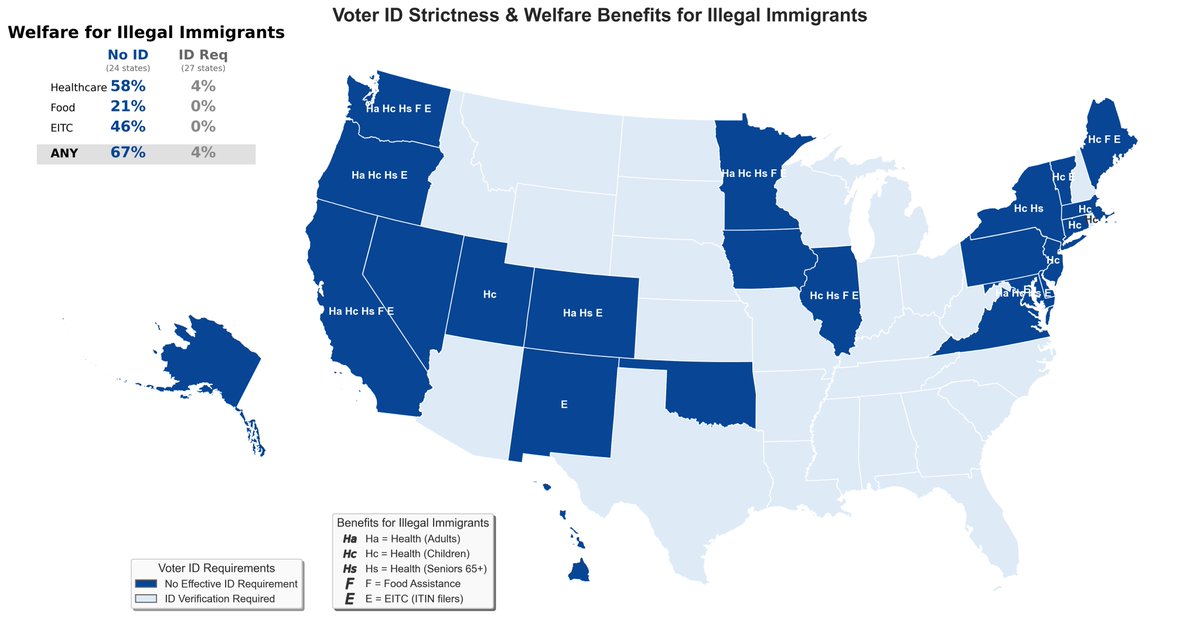
I crunched the data. Again.
I made a map. Again.
The picture is now even CLEANER.
States without voter ID requirements are 16x more likely to offer welfare benefits to illegal immigrants than states requiring ID (67% vs 4%, p<0.0001).
Dems are importing and paying illegals for votes.
Details👇
The Emperor is overjoyed to announce the appointment of Marcus Rubius as the Provincial Governor of Venezuela and has decreed six days of games in his honor
Congratulations to @POTUS for overthrowing the Venezuelan regime.
There are ~500,000 Venezuelans in the US illegally (fifth-largest unauthorized migrant group in the country), and now they can all leave.
Today.
See that thing we just did to Venezuela?
That’s what I want done to Minneapolis, Seattle, Sacramento, Austin, Boise, Columbus, Detroit, Madison, NoVA, Raleigh, Atlanta, Lewiston, Chicago….