Life science companies have been practising AEO for years without realising it.
Recent research found that a reliable way to get content cited up to 40% more often by AI tools was to include quotes from named people, back up claims with citations and use data wherever possible.
But that’s what many life sciences companies already do as part of their content marketing strategy and now it’s the same formula that gets AI models to cite you as a source.
Not only that, but for a long time having a niche specialism has been a key way for a life sciences organization to differentiate itself. Now the same appears to be true when it comes to AI visibility.
For example, at Supreme we're increasingly seeing clients win AI citations with specific, application-focused content covering precise use cases. This suggests the more specialist your expertise and content, the more likely you are to be cited for relevant search queries.
For life science marketing teams building an AEO content strategy, we suggest you start with one question: what are the three to five topics where your organization has genuine, defensible expertise and can realistically become a deep authority? Then focus your AEO content efforts there.
Paul Avery, Lauren Whitehead, Dean Hallam and Eric Southwell talked about this and the fundamentals of Life Sciences AEO strategy in the latest episode of the Supreme Pod. Link in comments.
AI adoption is not easy. Changing fundamentally how you do your job is hard.
The changes at Supreme Group happened from the frontlines up, not just from the top down. Adoption moves faster and sticks better when it comes from a colleague solving their own problem and sharing the results, rather than from a rollout memo or a mandatory training session.
You can use every AI tool on the market and still fail to build an AI-native organization.
As Sheldon Zhai, Chief AI Officer at Supreme Group, says: "Hire curious people. Give them the tools and the safety to fail fast. Then get out of their way".
AI-Native vs AI-Dependent. There's a massive difference.
AI-native means using tools to amplify your expertise. AI-dependent means handing off your thinking entirely.
When AI gets it wrong, AI-dependent people don't catch it. They've stopped trusting or using their own judgment.
If you've spent years building expertise in regulated marketing, you have something no AI tool can generate on its own. It's that accumulated expertise that catches a plausible-sounding but incorrect output before it goes to a client.
At Supreme Group we know that AI doesn't replace that kind of judgment. It can make you ten times more leveraged, but you still have to bring something to leverage.
No single AI company makes the best model for every job.
The best model for drafting clinical content is rarely the best for writing code, and different again for analysing complex clinical data. An AI partner who works across all of them can identify the right model for each requirement.
Many of the major AI companies now offer a version of a Forward-Deployed Engineer model, where someone is embedded in your organization to help you build custom AI solutions.
But when a vendor’s model is tied to a specific platform, their definition of the best solution will naturally centre on that platform. The incentive structure simply points one way and the question is whether that alignment serves your goals.
At Supreme Group, we're agnostic.
We use whatever is state-of-the-art for the problem at hand, because our revenue is tied entirely to client outcomes.
For healthcare and life sciences companies evaluating an AI deployment partner right now, that type of flexibility is worth factoring in.
Sheldon Zhai, Chief AI Officer at Supreme Group discusses this and more with Paul Avery on the latest episode of the Supreme Pod. Link in comments to watch the full episode.
Our Supreme Group team are in Chicago this week for the 2026 ASCO Annual Meeting. Elizabeth Yi, Shannon Carlson, and Kiana Marin are connecting with clients and discussing the science shaping the future of cancer care.
The infection was potentially deadly. The new product worked better. And that still was not the full story.
On a recent episode of The Supreme Pod, we talked about an antifungal launch example that says a lot about what customer insight is really for.
The team could have built the story around the fungal infection itself. The severity, the lack of treatment progress, the clinical need, the product advantage.
All of that mattered but it didn’t take into account the wider story.
These patients were often already dealing with cancer, HIV, transplant, or another serious underlying condition. The infection was one interruption in a much larger treatment journey.
This key insight fundamentally changed the product’s positioning.
And the stronger story helped physicians see how the product could get patients back to the treatment path they were already fighting to protect.
That is the difference between focusing too much on the product and not enough on the world it enters.
Most AI pilots in Healthcare and Life Sciences don't fail because of the technology. They fail due to a lack of time and expertise internally to successfully implement AI within a complex, highly regulated environment.
That's why last week, Supreme Group launched Supreme Intelligence FDE+: the first Forward Deployed Expert model, purpose-built for Healthcare and Life Sciences, to help address exactly this.
Where traditional FDE models use AI engineers, Supreme Group deploys experts who are both AI-native and fluent in therapeutic science, regulatory environments and MLR workflows. All with the full backing and security of the Supreme Intelligence™ platform.
Learn more about FDE+ here: https://t.co/NM1Of0ztUd
Why can the leading ai-native companies like @supremegroup_ai price war? Because literally we have well over 1,000+ agents baked into our entire infrastructure that are always ready for war 24/7 that run on the latest intelligence. Our competitors don't, so they can have fun playing catch up (hint: once your company is behind in AI, you can't catch up since we're accelerating 😁)
Everyone always says that you should not compete on price but being AI-native, we're not competing on price. We're competing on price, quality, and speed all at the same time. Give us any competitive bid and we will beat it on all 3. The client wins and we win because we know how to be profitable + deliver massive value with our AI infrastructure, Supreme Intelligence. @supremegroup_ai
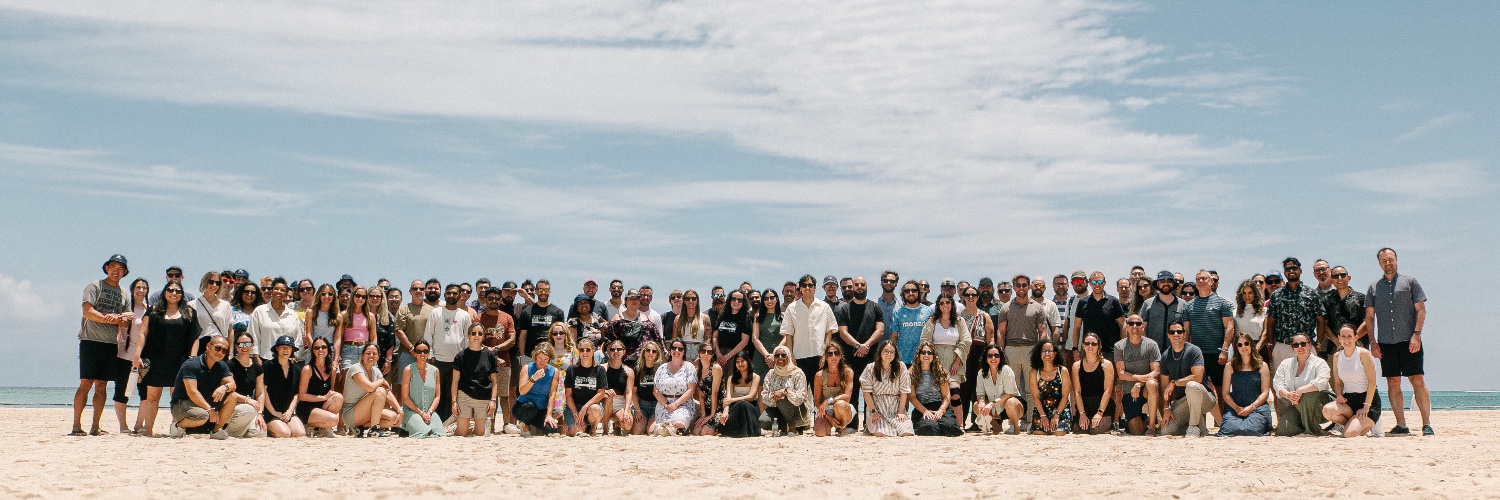
This year, 120+ employees across digital and AI teams showed up at Supreme Group's AI offsite and annual retreat in the Dominican Republic. Culture is the driving force of what makes an organization great and also the single most important factor for success in the Age of AI.
A great culture allows us to overcome adversity, drive innovation and reinvent ourselves with speed as a differentiator to become the #1 AI-native healthcare & life sciences commercialization partner in the world.
97% of @supremegroup_ai uses AI on a daily basis. Over a year ago we made a bet that real AI leverage at scale wouldn't come from giving everyone a chatbot and hoping for the best. It would require a secure, scalable AI platform with curated tools, custom repeatable workflows, one source of truth.
So we built and launched Supreme Intelligence (SI) 2 months ago. Last week, 76% of our company used SI, with an average of 22 events per user/day. We expect this number to be >95% by the end of the month.
Interestingly, building top-down is what made bottom-up adoption actually work. One proprietary AI workspace means one person's breakthrough becomes everyone's breakthrough. A skill, agent, or custom workflow built on Monday is available to 450+ people by Tuesday. The engineering team swaps models in the background meaning silent upgrades for continual intelligence boosts requiring no retraining.
Every week the gap widens between companies experimenting with AI and companies operating on it. We're in the second camp giving our customers a true, highly differentiated advantage when working with us.
That's what ai-native actually means to us.
Very proud of the Supreme journey and all of our new friends we’ve met along the way. Culture is the thing we’re the most proud of and it’s also by far the hardest thing to get right and maintain. It’s one of those things where it’s hard to understand unless you experience it. @supremegroup_ai
Here's a hint. If your AI pilot has taken months and you still haven't seen real value, it means that the pilot is bad, so just kill it. With AI, you should be able to demonstrate real value, usable value, not just AI slop, within one week.
AI moves so fast that a pilot from 3 months ago is already outdated from what AI can do today. In fact one of the main purposes of the pilot to see if your partner can help you innovate and surf the AI Tsunami while delivering value at the same time.
“Our fundamental promise to our clients is to solve complex business problems.” — Tom Donnelly, CEO of Supreme Group. It’s why our team developed Supreme Intelligence to turn complexity into measurable business impact. 👉 https://t.co/zXs6C6FjMl
This International Day of Women and Girls in Science, we’re proud to celebrate the women behind our work. Many at @supremeopti are Life Sciences PhDs leading across strategy, data, content, and performance, bringing rigor and evidence-based thinking to everything we do.
🔬 Supreme Optimization is hiring a Scientific Digital Marketing Strategist, 📍 Remote | Full-time. No marketing experience required, training provided. Work on SEO, UX, content strategy & paid ads for life science + pharma companies 👉 https://t.co/XbOq3zZtrt
Not sure what to prioritize in a tight market?
👉 Start with the channels where you can put your message directly in front of your buyer persona.
Catch the full interview for more practical advice: https://t.co/4Xg3stvQ3C
@supremeopti @AmendolaComm#marketingbudgets
Ready to set your marketing strategy for a winning 2026?
Join our webinar with Dr. Paul Avery, where we unveil 10 proven strategies for life science marketers.
In just 40 mins, discover how to maximize impact! 💡
https://t.co/sqVfSdoxOX
Maximize your marketing impact on a budget! Join our webinar with Dr. Paul Avery VP of Marketing at SupremeGroup, for 10 effective strategies. In 40 mins, learn to:
🔹Use low-cost tactics
🔹Fine-tune messaging
🔹Drive more leads and more...
Register now 👉 https://t.co/cVIvGwoeqR