The real reason the US is invading Venezuela goes back to a deal Henry Kissinger made with Saudi Arabia in 1974.
And I'm going to explain why this is actually about the SURVIVAL of the US dollar itself.
Not drugs. Not terrorism. Not "democracy."
This is about the petrodollar system that has kept America the dominant economic power for 50 years.
And Venezuela just threatened to end it.
Here's what really just happened:
Venezuela has 303 billion barrels of proven oil reserves.
The largest on Earth.
More than Saudi Arabia.
20% of the entire world's oil.
But here's the part that matters:
Venezuela was actively selling that oil in Chinese yuan. Not dollars.
In 2018, Venezuela announced it would "free itself from the dollar."
They started accepting yuan, euros, rubles, anything BUT dollars for oil.
They were petitioning to join BRICS.
They were building direct payment channels with China that bypass SWIFT entirely.
And they were sitting on enough oil to fund de-dollarization for decades.
Why does this matter?
Because the entire American financial system is built on one thing:
The petrodollar.
In 1974, Henry Kissinger made a deal with Saudi Arabia:
All oil sold globally must be priced in US dollars.
In exchange, America provides military protection.
This single agreement created artificial demand for dollars worldwide.
Every country on Earth needs dollars to buy oil.
This lets America print unlimited money while other countries work for it.
It funds the military. The welfare state. The deficit spending.
The petrodollar is more important to US hegemony than aircraft carriers.
And there's a pattern of what happens to leaders who challenge it:
2000: Saddam Hussein announces Iraq will sell oil in euros instead of dollars.
2003: Invaded. Regime change. Iraq's oil immediately switched back to dollars. Saddam lynched.
The WMDs were never found because they never existed.
2009: Gaddafi proposes a gold-backed African currency called the "gold dinar" for oil trade.
Hillary Clinton's own leaked emails confirm this was the PRIMARY reason for intervention.
Email quote: "This gold was intended to establish a pan-African currency based on the Libyan golden Dinar."
2011: NATO bombs Libya. Gaddafi sodomized and murdered. Libya now has open slave markets.
"We came, we saw, he died!" Clinton laughed on camera.
The gold dinar died with him.
And now Maduro.
With FIVE TIMES more oil than Saddam and Gaddafi combined.
Actively selling in yuan.
Building payment systems outside dollar control.
Petitioning to join BRICS.
Partnered with China, Russia, and Iran.
The three countries leading global de-dollarization.
This isn't coincidence.
Challenge the petrodollar. Get regime changed.
Every. Single. Time.
Stephen Miller (US homeland security advisor) literally said it out loud two weeks ago:
"American sweat, ingenuity and toil created the oil industry in Venezuela. Its tyrannical expropriation was the largest recorded theft of American wealth and property."
He's not hiding it.
They're claiming Venezuelan oil BELONGS to America because US companies developed it 100 years ago.
By this logic, every nationalized resource in history was "theft."
But here's the DEEPER problem:
The petrodollar is already dying.
Russia sells oil in rubles and yuan since Ukraine.
Saudi Arabia is openly discussing yuan settlements.
Iran has been trading in non-dollar currencies for years.
China built CIPS, their own alternative to SWIFT with 4,800 banks in 185 countries.
BRICS is actively building payment systems that bypass the dollar entirely.
The mBridge project lets central banks settle trades instantly in local currencies.
Venezuela joining BRICS with 303 billion barrels of oil would accelerate this exponentially.
That's what this invasion is really about.
Not stopping drugs. Venezuela accounts for less than 1% of US cocaine.
Not terrorism. There's zero evidence Maduro runs a "terror organization."
Not democracy. The US supports Saudi Arabia, which has zero elections.
This is about maintaining a 50-year-old agreement that lets America print money while the world works for it.
And the consequences are terrifying:
Russia, China, and Iran are already denouncing this as "armed aggression."
China is Venezuela's biggest oil customer. They're losing billions.
BRICS nations are watching a country get invaded for trading outside the dollar.
Every nation considering de-dollarization just got the message:
Challenge the dollar and we will bomb you.
But here's the problem...
That message might accelerate de-dollarization, not stop it.
Because now every country in the Global South knows what happens if you threaten dollar hegemony.
And they're realizing the only protection is to move FASTER.
The timing is insane too:
January 3rd, 2026. Venezuela invaded. Maduro captured.
January 3rd, 1990. Panama invaded. Noriega captured.
36 years apart. Almost to the day.
Same playbook. Same "drug trafficking" excuse.
Same real reason: control of strategic resources and trade routes.
History doesn't repeat. But it rhymes.
What happens next:
Trump's press conference at Mar-a-Lago sets the narrative.
US oil companies are already lined up. Politico reported they've been approached about "returning to Venezuela."
The opposition will be installed. Oil will flow in dollars again.
Venezuela becomes another Iraq. Another Libya.
But here's what nobody's asking:
What happens when you can no longer bomb your way to dollar dominance?
When China has enough economic leverage to retaliate?
When BRICS controls 40% of global GDP and says "no more dollars"?
When the world realizes the petrodollar is maintained by violence?
America just showed its hand.
The question is whether the rest of the world folds or calls the bluff.
Because this invasion is an admission that the dollar can no longer compete on its own merits.
When you have to bomb countries to keep them using your currency, the currency is already dying.
Venezuela isn't the beginning.
It's the desperate end.
What do you think?
I’m turning 41, but I don’t feel like celebrating.
Our generation is running out of time to save the free Internet built for us by our fathers.
What was once the promise of the free exchange of information is being turned into the ultimate tool of control.
Once-free countries are introducing dystopian measures such as digital IDs (UK), online age checks (Australia), and mass scanning of private messages (EU).
Germany is persecuting anyone who dares to criticize officials on the Internet. The UK is imprisoning thousands for their tweets. France is criminally investigating tech leaders who defend freedom and privacy.
A dark, dystopian world is approaching fast — while we’re asleep. Our generation risks going down in history as the last one that had freedoms — and allowed them to be taken away.
We’ve been fed a lie.
We’ve been made to believe that the greatest fight of our generation is to destroy everything our forefathers left us: tradition, privacy, sovereignty, the free market, and free speech.
By betraying the legacy of our ancestors, we’ve set ourselves on a path toward self-destruction — moral, intellectual, economic, and ultimately biological.
So no, I’m not going to celebrate today. I’m running out of time. WE are running out of time.
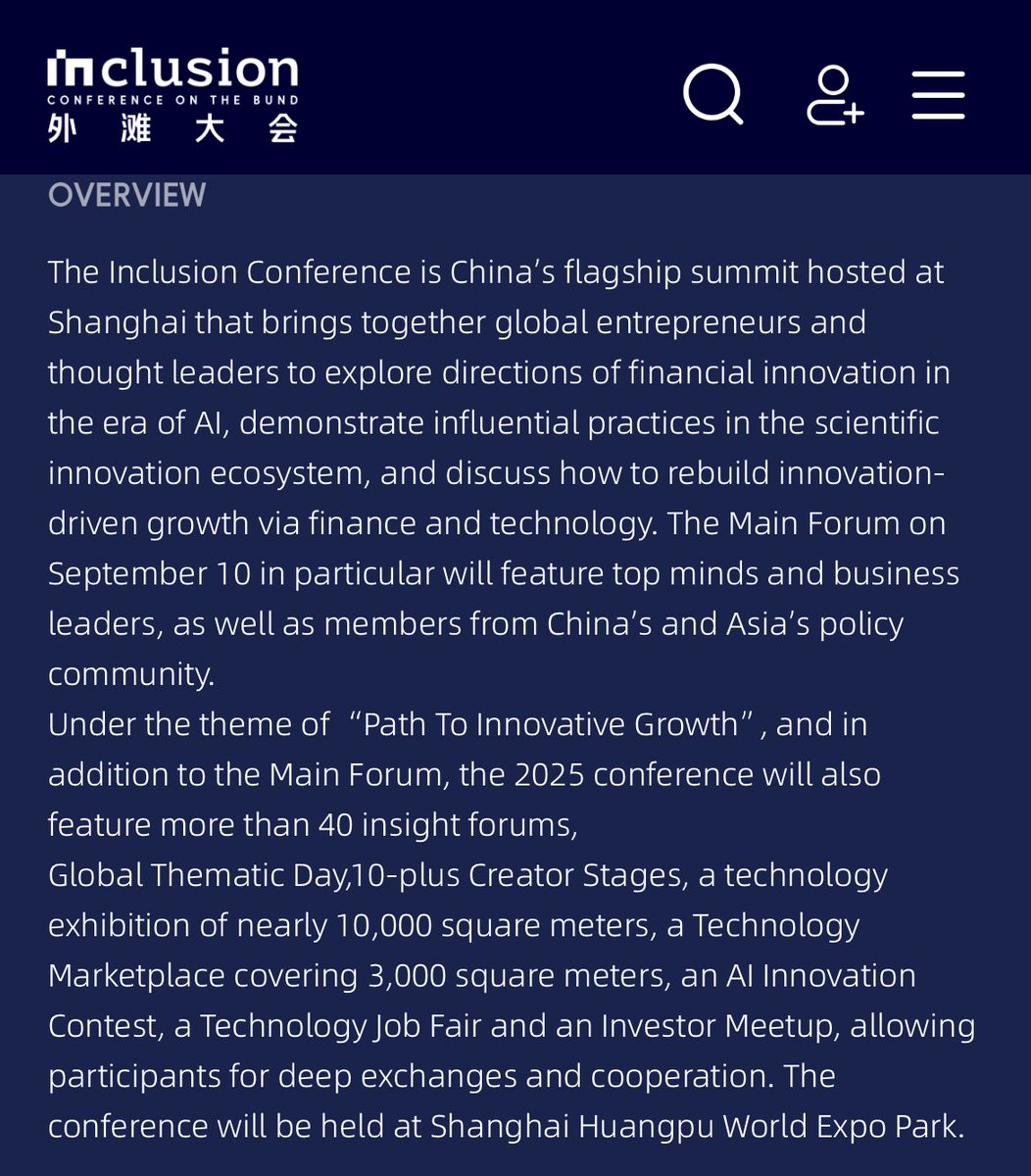
Inclusion 2025 on the Bund, Shanghai!
I am humbled and honored to represent all of the values and tenants of this years Inclusion 2025 Conference, inclusion amongst the top minds and trendsetters within fintech/disruptive technologies is truly a major milestone! As a featured speaker my keynote topic “Global stablecoin strategy and policy, experts talk” is one of main topics for this years conference! Proud to represent @BuildOnJulia on the global stage and bring eyes on JuliaOS at the most prestigious fintech innovation, policy, and disruptive technology conference in all of APAC!
“The Inclusion Conference is China's flagship summit hosted at Shanghai’s historical “Bund” that brings together global entrepreneurs and academic leaders to explore directions of financial innovation in the era of Al, demonstrate influential practices in scientific innovation ecosystems, and discuss how to rebuild innovation-driven growth via finance and technology. The Main Forum on September 10 in particular will feature top minds and business leaders, as well as members from China's and Asia's policy community”.
AIDC’s & JuliaOS education and integration! (Context for $JOS in AIDC)
By @LarryHashpowerX
@BuildOnJulia
Let’s start with the basics!
- Unit of Measurement: It is often measured in FLOPS (floating-point operations per second). A higher number means faster calculations per unit of time.
- Computing Power Carriers: At the core of a computing center are thousands of high-performance GPUs (graphics processors), supported by CPUs, high-speed networks, storage, and cooling systems for efficient collaboration.
- Uses of Computing Power: It drives AI models through "learning" (training) and "working" (inference). It also supports scientific computing, big data analysis, graphics rendering, and other computation-intensive applications.
Types of Computing Power, Features, and Market Prices
Computing power in intelligent computing centers focuses on AI's core tasks: training and inference.
Training Computing Power
- Purpose: "Teaches" AI models by feeding them massive data (e.g., images) and adjusting parameters to learn skills (e.g., face recognition). This stage consumes the most resources and can take days or months.
- How It's Sold: Typically in packages based on time and hardware (e.g., "rent 8-card A100 server for 1 week" or "rent 32-card H100 cluster for 1 month"). Users get exclusive access for intensive, long-duration tasks.
- Price Characteristics: High unit price, paid for the duration needed.
Inference Computing Power
- Purpose: Enables trained AI models to work by processing user inputs (e.g., questions or data) and delivering results. Each request requires far less computation than training.
How It's Sold:
- By request/token volume (e.g., "X amount of $dollars/$JOS per 1,000 image recognition requests").
- By resources and time (e.g., hourly or minute-based billing for smaller setups like single-card servers).
- By reserved resources (users commit to a fixed amount for stability and discounts).
- Price Characteristics: Lower unit price, but totals can add up with high volume.
Five Key Factors Influencing Computing Power Sales
Purchasing computing power involves more than unit price. Prices and packages depend on these factors:
Capacity Type and Precision
- Type: Specify training or inference needs, as they require different hardware, software, and service models.
- Precision: Common formats include FP32 (single precision), FP16/BF16 (half precision), and INT8 (8-bit integer). Match precision to the application's tolerance.
Hardware Configuration and Performance
- GPU Model and Quantity: Core element; variations in generation, model, performance, memory, and interconnection bandwidth cause major price differences.
- CPU and Memory: Essential for data feeding to GPUs.
- Storage I/O: Critical for high-speed data access in training.
- Network Bandwidth and Latency: Vital for intra-cluster communication, especially in large-scale tasks.
Duration of Use and Billing Mode
- Duration: Short-term on-demand vs. long-term stable use; commitments often yield discounts.
Billing Models:
- On-demand: Flexible but highest unit price.
- Reserved instances/packages (e.g., monthly or yearly): Lower price for committed resources.
- Spot/bidding: Low cost for idle resources, but interruptible; suits fault-tolerant tasks.
- Pay-per-use: Based on actual consumption; ideal for variable inference.
Software Ecosystem and Service Support
(Pre-installed Frameworks and Tools)
Saves time if AI libraries and environments are ready. For optimization, integrate JuliaOS, an open-source framework built on the Julia language for high-performance AI swarm intelligence. JuliaOS enables decentralized agent-based architectures, allowing swarms of AI agents to collaborate, adapt, and execute tasks in real time—up to 100x faster than Python-based systems—with features like neural network orchestration and parallel scaling for efficient resource utilization in training and inference.
@HashpowerX and @BuildOnJulia are delighted to announce a strategic cooperation (1million dollar MOU) focused on agentic ai and merge mining integration.
Look for further developments and announcements coming from this exciting new partnership.
#AI#Web3#AgenticAI
Hybrid LLMs is a very interesting topic.
Multimodal models. AI industry is facing a big shift.
And I was thinking, maybe JuliaOS should have its own LLM ...
Time to enter a domain.
And participate in the shift.
Create your next dApps without coding. All you need is to ask.
Tensor Labs shows how JuliaOS can help in bringing Agentic coding to a whole new level.
Cursor, Windsurf, Lovable, and now Tensor Labs.
Every great application starts with an idea.
Most die in deployment hell.
TensorLabs x Romeo eliminate the gap between concept and reality.
Ship ideas, not configurations.
gm world.
JuliaOS: Key Challenges/Solutions for AI-Native Applications in Enterprise Production Scenarios
By @LarryMetaTrust
Powered by @BuildOnJulia
AI-native applications in enterprise settings must address several critical challenges to ensure effective deployment and operation. These challenges include security, professionalism, collaboration, and responsibility. The specific solutions outlined below to tackle five key aspects.
Core Challenges
1. Security:
Data Security: Protecting sensitive enterprise data from breaches and unauthorized access.
Model Interaction Security: Ensuring safe and secure interactions between AI models and users or systems.
Application Security: Safeguarding the application itself from vulnerabilities and threats.
2. Professionalism and Collaboration:
Enabling large-scale AI models to understand and address complex, industry-specific business problems effectively.
Facilitating seamless collaboration between AI systems and human teams to enhance productivity.
3. Responsibility:
Defining the roles and responsibilities of AI when assisting or replacing human tasks.
Determining whether AI can reliably bear these responsibilities while maintaining accountability.
Five Key Aspects to Address
To overcome these challenges, enterprises must focus on the following areas:
1. Enterprise Glossary:
Each enterprise has a unique glossary of technical terms and jargon. AI models must integrate these terms to accurately interpret and respond to enterprise-specific queries, reducing ambiguity and improving response accuracy.
2. Domain Knowledge Base:
Large AI models require a robust knowledge base to stay relevant. While model training occurs periodically, external data and knowledge evolve rapidly. Integrating a dynamic knowledge base ensures real-time updates, enhancing the timeliness and effectiveness of AI responses.
3. Scenario Paradigm:
AI models are designed for general use, but business scenarios vary widely. To address this, a flexible architecture is needed to adapt general models to specific, variable scenarios. For example, Huawei Cloud has developed seven agent scenario paradigms inspired by human problem-solving:
- Session Interaction
- Content Understanding
- Perceptual Reception
- Central Decision-Making
- Knowledge Query
- Design Generation
- Data Analysis
- These paradigms simplify the development of AI agents tailored to diverse enterprise needs.
4. Model Gateway:
A model gateway is essential for managing large-scale AI applications. It serves multiple purposes:
Business Routing: With numerous models available (both self-built and third-party), the gateway directs specific business tasks to the most suitable model.
Unified Interface: Models often differ in input and output formats. A gateway standardizes these interfaces for seamless integration.
Failover Mechanism: As IT systems, AI models may experience failures or downtime. A gateway enables failover mechanisms to enhance application availability.
Observability and Performance Tracking: The gateway provides a control point to monitor model performance, measure inference accuracy, evaluate costs, and track feedback for continuous improvement.
By addressing these challenges and implementing solutions across these five aspects, enterprises can effectively deploy AI-native applications, ensuring security, professionalism, and accountability in production environments. Driven by the swarm on JuliaOS!
JuliaOS Surges to New Heights as AI Protocol Gains Traction
By @LarryMetaTrust Powered by @BuildOnJulia
The market capitalization of JuliaOS, an innovative swarm centric AI multi-agent collaboration protocol, has soared past its 17 million dollar market cap (as of the time of this writing), reaching a potential phase one evaluation worth 100million dollars based on its recent acquisitions developments, and practical IP developments, according to FarEast Ventures Consulting. This recent evaluation underscores JuliaOS growing prominence, driven by its unique integration of artificial intelligence (AI) and swarm agentic technology. The protocol has not only captured the attention of investors but also sparked widespread discussion about the future of AI collaboration protocols and their real-world applications.
A few Core Technologies of JuliaOS Protocol
JuliaOS is a swarm/agentic-based protocol designed to optimize collaboration among AI agents in a decentralized, trustless environment, enabling them to tackle complex tasks efficiently. Its key features include:
1. Multi-Agent Collaboration Mechanism: JuliaOS leverages blockchain integration to create a transparent, traceable environment for AI agents (especially in trading). These agents, which may include algorithms for tasks like natural language processing, image recognition, or predictive modeling, collaborate to enhance overall efficiency.
2. Dynamic Incentive Model: In the future the protocol will use JuliaOS tokens to reward AI agents/agentic utilities based on task complexity, contribution, and result quality. This model boosts agent participation and drives collaboration.
3. Data and Privacy Protection: By employing distributed data storage, swarm based active security oracle and multi-party secure computing (MPC), JuliaOs ensures secure, privacy protected data exchanges, making it suitable for sensitive applications.
Drivers of JuliaOS Rapid Rise (a teaser of developing IP)
Several factors have fueled JuliaOS impressive market performance:
AI Market Boom: The ongoing AI revolution in 2024, spanning generative AI to multi-agent systems, has heightened interest in AI-driven projects. JuliaOS, as a pioneer in AI-blockchain integration, has benefited from this trend.
Unique Technological Positioning: JuliaOS addresses the challenge of fragmented AI systems by enabling seamless collaboration through its protocol, attracting significant capital inflows.
Expanding Applications: The protocol’s potential in fields like decentralized finance (DeFi), medical/pharma, autonomous driving, security, mining and supply chain optimization has sparked market enthusiasm.
Impact on AI and Blockchain Ecosystems
JuliaOS rise signals the transformative potential of combining AI and blockchain:
Decentralized AI Collaboration: Unlike traditional AI services dominated by large corporations, JuliaOS enables smaller AI agents to collaborate through a decentralized framework, democratizing AI applications.
Incentive Model Innovation: The protocol’s dynamic reward system sets a precedent for resource allocation and benefit distribution in future AI-blockchain projects.
Broader Applications: By integrating AI agents, JuliaOS extends blockchain’s utility beyond finance into areas like automated manufacturing and smart cities.
Future Prospects and Challenges
With its recent evaluation exceeding $100million dollars, JuliaOS reflects strong market optimism about AI multi-agent collaboration. The protocol showcases the synergy of AI and blockchain, paving the way for intelligent, automated applications. However, its long-term success hinges on maintaining technological leadership and the durability of its incentive model, questions that only time will answer. JuliaOS will definitely bring a swarm of innovation.
dApp is loading ...
Agents. Swarms. Marketplace. Trading Hub. Mining. LLM Studio. Neural Networks.
The all in one AI Platform by JuliaOS.
Stay tuned swarms. We are cooking.
Agentic AI: A beginner’s educational and comparative guide!
By @LarryMetaTrust powered by @BuildOnJulia
Agentic AI enhances large language models (LLMs) to process accurate knowledge, access data, and perform actions, effectively automating tasks using natural language. While natural language processing (NLP) for automation isn’t new, Agentic AI introduces greater flexibility, enabling LLMs to handle ambiguity and make dynamic decisions.
However, LLMs don’t inherently possess "agency" or task comprehension. Building reliable Agentic systems requires significant engineering to ensure consistent performance.
Role of Agentic Frameworks
Agentic frameworks simplify the development of AI systems by:
1. Prompt Engineering: Standardizing prompts to ensure LLMs return correctly formatted responses.
2. Data Routing: Connecting LLM outputs to tools, APIs, documents, or knowledge bases, often integrating context like Retrieval-Augmented Generation (RAG) systems.
Frameworks also support:
- Error handling
- Structured output generation
- Result validation
- System observability
- Deployment
- Code organization for complex systems, like multi-agent collaboration
Challenges with Frameworks
Frameworks can sometimes feel overly complex for simple tasks ("using a sledgehammer to crack a walnut"). Debugging is challenging, especially when switching LLMs, as prompts tailored for one model may not work with another. Some developers prefer customizing frameworks for better control.
Popular Open-Source Frameworks
Frameworks vary in complexity, features, and community support. Below are some established players:
1. CrewAI
Overview: High-level abstraction for rapid agent system development, hiding underlying complexity.
Best For: Quick prototyping and ease of use.
2. AutoGen
Overview: Focuses on autonomous, asynchronous systems where agents collaborate freely.
Best For: Research and testing environments.
3. LangGraph
Overview: Uses a graph-based approach with nodes and connections for precise process control.
Strengths: Offers tight engineering control with less agent autonomy.
Challenges: Steep learning curve and complex abstractions, though mastery simplifies usage.
4. Agno (formerly Phi-Data)
Overview: Prioritizes developer experience with clear documentation and plug-and-play features.
Best For: Quick starts with structured, reasonable abstractions.
5. SmolAgents
Overview: Minimalist framework using code (not JSON) for data routing, with native support for HuggingFace’s model library.
Best For: Lightweight, flexible development.
6. PydanticAI
Overview: Built on Pydantic for minimal abstraction, ensuring type-safe, predictable outputs.
Best For: Fine-grained control and debugging in structured applications.
7. Atomic Agents
Overview: Schema Stuart Little-inspired, schema-based framework with Lego-like building blocks for structured control.
Best For: Developers seeking transparency and control over "black-box" AI systems.
8. Master
Overview: JavaScript framework by the Gatsby team, designed for front-end developers to build agents.
Best For: JavaScript ecosystems and front-end integration.
Choosing a Framework
Popularity doesn’t always equal suitability. Evaluate frameworks based on the following criterium:
Community Feedback: Real-world performance insights from other developers.
Project Needs: Match framework features to your system’s complexity and control requirements.
Learning Curve:(start with simpler and better with @BuildOnJulia Dashboard) Start with simpler frameworks (e.g., CrewAI, Agno) before tackling complex ones (e.g., LangGraph).
Mastering one framework’s underlying mechanics makes learning others easier, as core concepts like prompt engineering and data routing are universal.
For deeper insights and continued education follow us @BuildOnJulia or take a deeper dive @https://www.juliaos.com
Welcome to Kevin Raich as official Lead Brand Advisor for JuliaOS.
Kevin’s resume speaks for itself.
Apple. Google. Meta. Visa. The Ritz-Carlton. Uber.
And now, JuliaOS.
We’re powering the AI revolution with @BuildOnJulia and leading the next-generation of swarm intelligence 🤖
JuliaOS joins the @Aethircloud ecosystem to provide one of the best Swarm infrastructure for developers to launch agents that think, learn and act as one.
Anyone is for AI.
We're partnering with @BuildOnJulia, a framework for AI agent swarms.
The Anyone privacy SDK will enable anonymous routing and censorship resistance for their AI agents, protecting agents, their developers and users.
❄️Introducing Absolute Zero Reasoner: Our reasoner learns to both propose tasks that maximize learnability and improve reasoning by solving them, entirely through self-play—with no external data! It overall outperforms other "zero" models in math & coding domains.
🧵 1/
Dear JuliaOS community members,
Official JuliaOS account has been suspended on X. We have already submitted an appeal and currently waiting to hear back from Twitter support.
All operations continue as normal and you will be notified here and Telegram for updates in the meantime. Thank you for your patience.
JuliaOS Team.