The Japanese media has been airing footage of the Chinese adjusting the height of the stairs outside Takaichi's airplane to a level that was probably uncomfortable for the PM, who has rheumatoid arthritis and an artificial joint in her leg/knee:
District line and Piccadilly lines are shut due to strike action and @TfL has laid down such a shoddy infrequent busy connectivity on top to make almost impossible to go to centre from Hammersmith @LBHF! @MayorofLondon@hammersmithandy
World-leading cardiac surgeon Asif Hasan was surrounded by the children who received the gift of life thanks to his unerring skills at the emotional climax of another memorable Pride of Britain ceremony. 🥹
Now 70 years old, Mr Hasan has just retired after 35 years of service at the Freeman Hospital in Newcastle upon Tyne, but just after receiving his Lifetime Achievement Award, he had an extra special surprise: a cast of patients who would not be alive without him. ❤️
In awarding this year’s #NobelPeacePrize, the Norwegian Nobel Committee wants to remind the world that the rule of law – national and international – underpins the system we have set up to ensure peace and resolve conflicts non-violently. Peace requires justice.
History has shown that a world operating without the rule of law is unjust, unwise and inhumane. The judges – those who guard the thin red line between order and chaos – are therefore highly deserving of our praise. But today, as these same judges are sanctioned, and their institutions are attacked, we need people of courage, vision and determination – qualities that 2026 peace laureate Navi Pillay demonstrates in her work on the bench.
#NobelPrize
Such an amazing work. These are heroes.
Yesterday a small calf of 3–4-days was swept away by the Teesta River near Gajoldoba and found several kilometres downstream. While mother was looking after it. See how it was saved by fisherman and united with the help of forest staff.
At 92, Gulzar writes with the same discipline that's helped him refine & reinvent his art decade after decade - building an enormous body of work known for its tenderness.
This summer, I spent time with him at his Mumbai home for this @nytimes profile:
https://t.co/ZOZCnj5UPe
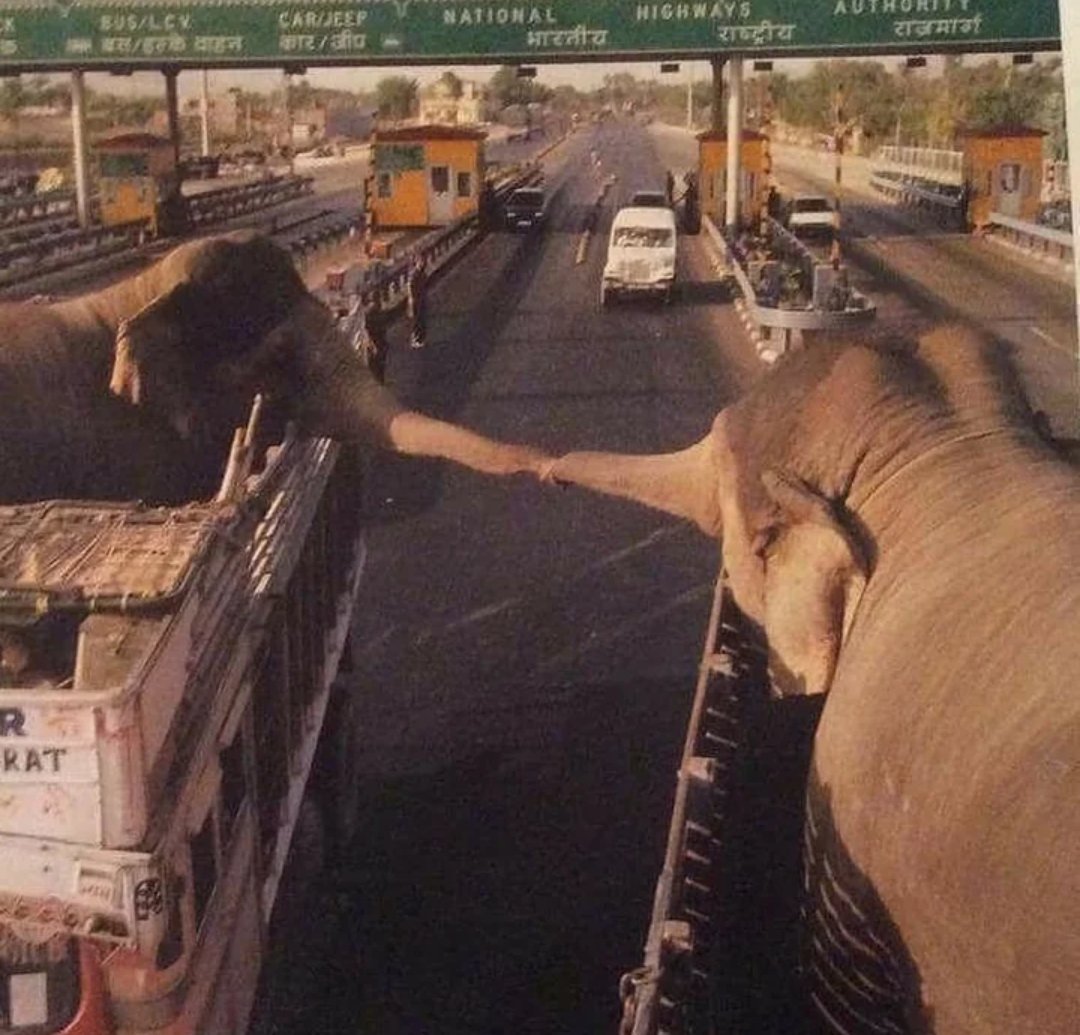
The "Final Goodbye" - the viral photo capture the two captive Asian elephants stretching their trunks toward each other from separate transport trucks, one final time before being separated forever....
In December 2016, a photograph taken on an Indian highway captured a moment that moved people worldwide. Freelance writer Sowmya Vidyadhar shared the image online, highlighting a moment of connection before both animals entered a lifetime of human service.
This interaction shows that animals experience deep emotional responses.
Elephants live in close family groups led by older females, forming lifelong bonds.
They raise calves together, share food, and support each other during times of distress.
"Elephants have a remarkable capacity for empathy," notes animal behavior researcher Dr. Ananya Rao.
"They remember family members for decades, mourn their dead, and show clear sadness when losing a companion. When taken from their herds, they experience significant grief."
The highway photograph illustrates the impact of captivity.
As traffic passed, the elephants focused entirely on each other, using their trunks to comfort one another.
"You could hear them making soft rumbling sounds. It was clear they did not want to separate."
For decades, elephants have been captured for work in temples, tourism, and heavy labor. While valued for their physical strength, the emotional strain of separation is often overlooked.
Being removed from a herd leads to long-term isolation.
Looking at that photograph, we are left to reflect on how we interact with the natural world. By recognizing animal emotions, we can support better protection and freedom for future generations of elephants.
This heartbreaking farewell is not an isolated incident; it is the everyday reality of an industry that treats living, feeling beings as mere tools for human profit.
Until we refuse to support businesses that exploit wild animals, we remain complicit in their suffering.
Real compassion means speaking up against animal abuse and demanding that these emotional, intelligent creatures be allowed to live free in the wild where they belong.
#archaeohistories
Jason Arday, the former University of Cambridge professor, has been found dead.
Mr Arday was found “unresponsive” at an address in Battersea, London, on Friday afternoon and later pronounced dead at the scene.
🔗 https://t.co/gM6vNStTFb
NEW: @SadiqKhan has announced 5,000 more street trees in high heat-risk areas to help cool London.
Great to speak to @BBCLondon about the 640,000 trees planted since 2016, part of 8 million across London, helping cool temperatures by up to 6°C. Next: 10% more canopy by 2050 🌳
THE MISSION SHIFTS. THE COMPASS HOLDS.
This was never the plan. Initially, the plan was to climb just G2. But just before setting off for Pakistan, I ran the numbers on my 8000m summits. That’s when it hit me: if I tick off Broad Peak whilst I’m here , only one remains “Cho Oyu.” Then I become the FIRST person in history to climb all 14 eight-thousanders twice. Without oxygen.
This wasn’t planned. The Hattrick project was the focus because it carried a bigger mission. But opportunities don’t scream: they whisper to those already working in silence.
Here’s the secret I’ve carried through every expedition: I never competed with anyone else. My only battle was against the man I was yesterday. Every single day, pushing my own limits. Because the moment you look sideways: at what others are doing, saying, achieving: you drift off your compass. Your heading is YOURS. Guard it fiercely.
They criticized me when I climbed the 14 without O’s during Project Possible. If you haven’t seen what that took, watch 14 Peaks on Netflix. That film is the unfiltered truth. I was there doing multiple rescues of climbers left behind by other expeditions, raising the funds myself, leading from the front, fixing our own lines, dealing with the Shishapangma permit with China, being at hospitals for my mum’s operation and so much more. And now? Now I’m heading for the double without oxygen: triple in total. The noise hasn’t stopped. I just stopped listening.
To those who still doubt: I already climbed all 5 of Pakistan’s 8000ers in just 26 days. Leading. Guiding. Without oxygen. Breaking the records of those who broke mine with oxygen. The receipts are there.
Broad Peak, I ask for nothing but safe passage up and back down. I take zero mountains for granted. Not one. The moment my foot leaves basecamp, it’s 100%. Always has been. Always will be.
This one is dedicated to everyone who carried me here. Supporters. Critics. All of you. Without both sides, there is no fire. So thank you genuinely.
My purpose has never been about me. It’s about what I represent. It’s about showing YOU that your own mountains—whatever they are—are climbable.
#nimsdai #eliteexped #everest
Renowned mountaineer Nirmal Purja died in an avalanche on Broad Peak in Pakistan’s Karakoram range, his expedition company said on Saturday. https://t.co/lrTq7BoGls
New blog on Teaching the British Empire in Schools.
The Spectator couldn’t resist misrepresenting the way the Empire is taught in their attacks on @DalrympleWill and @ZackPolanski
Here’s the truth.
https://t.co/tO9lMXSlcF
Yes, 43°C in India feels different to 43°C in Europe. Allow me to explain.
1. Europe is much more north on the planet, compared to the tropical location of India. For example, Paris is even north of Toronto in Canada. In India, the sun hits from the top. In Europe, it hits at an angle, and significantly longer summer days can yield strong solar loads through the course of a day. So the sun feels different.
2. India’s air pollution (suspended particulate matter) dulls the sun a bit. The sun feels sharper in Europe due to the clear skies, while pollution in India scatters and dissipates heat differently.
3. The recent heat waves in Europe have been accompanied with very low or zero winds. The leaves on trees don’t have a hint of movement. So it feels suffocating in a different way. In India, the warm winds and humidity might have different effects.
4. Europe has historically been cooler, so its buildings have been designed to remain warm in winters, while Indian buildings are designed to remain cool in summers. For example, stone or tiled floors in India dissipate heat quickly in summers, but also mean that you can’t walk bare feet in winters. Meanwhile European households might have wooden floors that don’t feel cool in the summers. Some European cities also have black roofs as a norm, which trap heat.
5. Much of Europe has had very limited number of warm days through history, so air conditioning is not a norm. Why would households invest in ACs when it crosses 25°C (minimum) for less than 7 days a year? New York has 4-5x more frequent warm days than Paris, for example. But that’s now changing. As it gets warmer, the case for ACs is obvious.
6. Much of Europe values aesthetics and public spaces a lot. So buildings associations oppose ugly heat-blowing external AC units facing the streets. This is why European cities are the most beautiful and walkable on the planet. Would you sit down to have wine and pasta on a street side cafe if an ugly AC unit was blowing hot air onto you? But of course, it’s too hot during heat waves now, so buildings associations will be forced to relent and change their rules. (You can also find some examples of some activists or institutions opposing ACs for climate change reasons, but I think that has a much smaller impact on decisions than actual building rules).
But the ultimate reality is this: as heat waves get hotter and longer, ACs will become the norm in Europe as well. Most offices and shopping centres are already air conditioned. Households are increasingly purchasing them too.
And the other reality is that Indians suffer a lot from heat waves too, even at 43°C. We just don’t report human interest stories the same way. Many don’t have ACs, live under tin roofs, and are hit by a constant stream of hot AC exhaust air from neighbours. We all need to prepare better for our respective heat waves.
You created them. Every single one of those NEETs is a product of your former party's choices. The ones you made while you were in Cabinet.
Adult education and apprenticeship spending: 25% lower in 2024-25 than when your former party took office (IFS, Nuffield Foundation).
Publicly funded adult further education courses: fell from 5.4 million in 2004 to 1.7 million by the time you left office. A 70% reduction, the majority of it on your watch (IFS, January 2026).
College funding per student: 11% lower in real terms than 2010. Sixth-form funding per student: 23% lower (IFS, January 2025).
Adults taking qualifications at GCSE level and below: down 50%. At A-level equivalent: down 33% (IFS, Nuffield Foundation).
Intermediate apprenticeship starts, the entry-level route for young people without degrees: collapsed from 200,000 in 2010 to fewer than 50,000 by 2020. Your government did that (IFS).
Youth services: cut by 70% since 2010 (Mind, Big Mental Health Report 2025) .
You had 14 years to invest in British young people. You cut adult education by 25%. You cut FE courses by 70%. You cut college funding. You cut sixth-form funding. You cut apprenticeships for the people who needed them most. You cut youth services. Then you left office and started tweeting bollocks about NEETs as though they materialised from thin air.
The £5,000 Reeves is offering is a reimbursement of the Immigration Skills Charge, a levy your own government introduced in 2017 to fund domestic skills training. You created the charge. You collected the money. And you still cut the training budget by 25%.
And these visas are for high-skilled workers: doctors, engineers, specialists in fields where your 14 years of cuts left a workforce gap so deep that British employers cannot fill it domestically. They are not competing with NEETs. They are filling holes your government drilled.
You were Home Secretary. You were Attorney General. You sat in Cabinet while all of this happened. You do not get to set the house on fire and then complain about the smoke.
Sources:
Adult education and apprenticeship spending 25% below 2010 levels: Institute for Fiscal Studies / Nuffield Foundation, October 2022 (https://t.co/ptZIX5c4b8)
Adult FE courses fell from 5.4 million to 1.7 million (70% reduction): Institute for Fiscal Studies, January 2026 (https://t.co/ViEuIX7qIj)
College funding per student 11% lower, sixth-form funding 23% lower: Institute for Fiscal Studies, Annual Report on Education Spending in England, January 2025, cited in House of Commons Library (https://t.co/c6qLKyCyjA)
Adults taking Level 2 qualifications down 50%, Level 3 down 33%: Institute for Fiscal Studies / Nuffield Foundation (https://t.co/1veNy8CJcY)
Intermediate apprenticeship starts collapsed from 200,000 to fewer than 50,000: Institute for Fiscal Studies / Nuffield Foundation, same source as above
Youth services cut by 70% since 2010: Mind, Big Mental Health Report 2025 (https://t.co/zTQbfpIdQq)
Immigration Skills Charge Regulations 2017: (https://t.co/IcciQZPTer)
Skills policy and apprenticeship data: House of Commons Library (https://t.co/trQjEw6FEZ)
Immigration Skills Charge parliamentary debate: Hansard, 21 March 2017 (https://t.co/yD8OvAthBl)
A 24-year-old Polish tennis player arrived in Paris last week ranked 114th in the world, with no sponsors, no guaranteed income, and no certainty she could even pay for her hotel room.
She had to win three qualifying matches just to enter the French Open main draw. Prize money is only paid at the end of the tournament, so a Polish sports drink brand quietly stepped in and covered her hotel bill.
Her name is Maja Chwalinska. And today, she plays in the French Open final.
Before this tournament, she had won exactly one Grand Slam main draw match in her entire career. She had battled depression so severe that in 2021 she couldn't get out of bed. She underwent knee surgery in 2022. She spent years grinding through small tournaments across Europe just to stay afloat.
Then she arrived in Paris, won three qualifiers, and kept winning. Zheng Qinwen. Elise Mertens. Maria Sakkari. Diana Shnaider. Nine straight matches. One set dropped.
She is now the first qualifier in French Open history to reach the final. The last time a qualifier reached a Grand Slam final, it was Emma Raducanu at the 2021 US Open. Raducanu won.
By simply making the final, Chwalinska has earned more prize money than her entire career combined. The runner-up cheque alone is $1.6 million. If she wins today, she takes home $3.25 million.
One week ago she couldn't pay for her hotel room.