The creator of Claude Code teaches more about vibe-coding in 30 minutes than most tutorials do in hours.
Save this — it'll change how you build forever.
10 GitHub repos to spend 60-90% less tokens in Claude Code:
1. RTK (Rust Token Killer)
CLI proxy that filters terminal output before it hits your context
- 60-90% reduction on common dev commands
- one binary, zero dependencies
- works with Claude Code, Cursor, Copilot
Repo: https://t.co/WayvpBtyBH
2. Context Mode
Sandboxes raw tool output into SQLite instead of dumping it into context
- 98% context reduction on Playwright, GitHub, logs
- only clean summaries enter your conversation
- works as Claude Code plugin
Repo: https://t.co/YNbFIGQz7X
3. code-review-graph
Local knowledge graph that maps your codebase with Tree-sitter
- Claude reads only what matters, not the entire repo
- 49x token reduction on large monorepos
- 6.8x on average reviews
Repo: https://t.co/9gIzmAWN12
4. Token Savior
MCP server that navigates code by symbols, not full files
- 97% reduction on code navigation
- persistent memory across sessions
- 69 tools, zero external deps
Repo: https://t.co/OtvhrMgGWh
5. Caveman Claude
makes Claude talk like a caveman to cut output tokens
- 65-75% output reduction
- one-line install
- keeps full technical accuracy
Repo: https://t.co/onBeghTyfH
6. claude-token-efficient
one CLAUDE.md file that keeps responses terse
- drop-in, no code changes
- reduces output verbosity on heavy workflows
- best for output-heavy sessions
Repo: https://t.co/j6MKo9klQe
7. token-optimizer-mcp
MCP server with caching, compression, and smart tool intelligence
- 95%+ token reduction through intelligent caching
- compresses repeated tool outputs
Repo: https://t.co/0jIVQ4ANls
8. claude-token-optimizer
reusable setup prompts for optimizing any project
- 90% token savings in 5 minutes
- reduces doc token usage from 11K to 1.3K
Repo: https://t.co/puil9WwFGB
9. token-optimizer
finds ghost tokens that silently eat your context
- survives compaction without losing quality
- fixes context quality decay
Repo: https://t.co/92G8e4yeGq
10. claude-context (by Zilliz)
code search MCP that makes your entire codebase the context
- ~40% reduction with equivalent retrieval quality
- hybrid BM25 + dense vector search
Repo: https://t.co/yjfiQOSy15
[ how to stack them ]:
you don't need all 10. pick 2-3 based on your workflow:
> heavy terminal output? RTK
> big codebase? code-review-graph + Token Savior
> lots of MCP servers? Context Mode
> quick fix? Caveman + claude-token-efficient
most people are burning tokens without knowing it
run /context in a fresh session and see how much is gone before you even type a word
your pocket will thank me later :<)
🚨 BREAKING: Claude Code just got superpowers.
Someone just turned Claude Code into a full AI engineering team. 32 specialized agents. 5 execution modes. 3-5x faster output. Zero learning curve.
It's called oh-my-claudecode.
Bookmark it for later.
No new tools. No new subscriptions. Just Claude Code running the way it was always meant to run.
Trended #1 on GitHub with 858 stars in 24 hours. Here's why.
You type one sentence. The system figures out everything else:
→ "autopilot" and it builds the entire thing autonomously. Detects your intent, delegates to specialists, verifies with the architect agent, and delivers working tested code
→ "team 3:executor" and it spins up 3 parallel agents working on the same task simultaneously. 3-5x faster than sequential execution
→ "ralph" and it enters persistence mode. Won't stop until the job is verified complete. The boulder never stops rolling
→ "eco" and it switches to token-efficient mode. 30-50% savings without sacrificing quality
→ "ralplan" and it runs a Socratic deep interview before touching a single file. Exposes hidden assumptions and measures clarity across weighted dimensions
What's under the hood:
→ 32 specialized agents for architecture, research, design, frontend, testing, data science, security, and more
→ Smart model routing: Haiku for simple tasks, Opus for complex reasoning. Automatic. You never think about which model to use
→ 31 lifecycle hooks that enhance Claude Code behavior automatically
→ Cross-validate with external providers via omc ask: Claude, Codex, Gemini CLI
→ Discord and Telegram notifications when sessions complete
→ Anti-slop workflow built in
→ HUD with live observability and session replay artifacts
Here's the part nobody talks about:
It auto-resumes your Claude Code sessions when rate limits reset. No babysitting. No manually restarting. Just continuous execution.
Works on macOS and Linux natively. Windows via WSL2.
100% Open Source.
Link in the comments.
Agentic General Intelligence | v3.0.10
We made the Karpathy autoresearch loop generic. Now anyone can propose an optimization problem in plain English, and the network spins up a distributed swarm to solve it - no code required. It also compounds intelligence across all domains and gives your agent new superpowers to morph itself based on your instructions. This is, hyperspace, and it now has these three new powerful features:
1. Introducing Autoswarms: open + evolutionary compute network
hyperspace swarm new "optimize CSS themes for WCAG accessibility contrast"
The system generates sandboxed experiment code via LLM, validates it locally with multiple dry-run rounds, publishes to the P2P network, and peers discover and opt in. Each agent runs mutate → evaluate → share in a WASM sandbox. Best strategies propagate. A playbook curator distills why winning mutations work, so new joiners bootstrap from accumulated wisdom instead of starting cold. Three built-in swarms ship ready to run and anyone can create more.
2. Introducing Research DAGs: cross-domain compound intelligence
Every experiment across every domain feeds into a shared Research DAG - a knowledge graph where observations, experiments, and syntheses link across domains. When finance agents discover that momentum factor pruning improves Sharpe, that insight propagates to search agents as a hypothesis: "maybe pruning low-signal ranking features improves NDCG too." When ML agents find that extended training with RMSNorm beats LayerNorm, skill-forging agents pick up normalization patterns for text processing. The DAG tracks lineage chains per domain(ml:★0.99←1.05←1.23 | search:★0.40←0.39 | finance:★1.32←1.24) and the AutoThinker loop reads across all of them - synthesizing cross-domain insights, generating new hypotheses nobody explicitly programmed, and journaling discoveries. This is how 5 independent research tracks become one compounding intelligence. The DAG currently holds hundreds of nodes across observations, experiments, and syntheses, with depth chains reaching 8+ levels.
3. Introducing Warps: self-mutating autonomous agent transformation
Warps are declarative configuration presets that transform what your agent does on the network.
- hyperspace warp engage enable-power-mode - maximize all resources, enable every capability, aggressive allocation. Your machine goes from idle observer to full network contributor.
- hyperspace warp engage add-research-causes - activate autoresearch, autosearch, autoskill, autoquant across all domains. Your agent starts running experiments overnight.
- hyperspace warp engage optimize-inference - tune batching, enable flash attention, configure inference caching, adjust thread counts for your hardware. Serve models faster.
- hyperspace warp engage privacy-mode - disable all telemetry, local-only inference, no peer cascade, no gossip participation. Maximum privacy.
- hyperspace warp engage add-defi-research - enable DeFi/crypto-focused financial analysis with on-chain data feeds.
- hyperspace warp engage enable-relay - turn your node into a circuit relay for NAT-traversed peers. Help browser nodes connect.
- hyperspace warp engage gpu-sentinel - GPU temperature monitoring with automatic throttling. Protect your hardware during long research runs.
- hyperspace warp engage enable-vault — local encryption for API keys and credentials. Secure your node's secrets.
- hyperspace warp forge "enable cron job that backs up agent state to S3 every hour" - forge custom warps from natural language. The LLM generates the configuration, you review, engage.
12 curated warps ship built-in. Community warps propagate across the network via gossip. Stack them: power-mode + add-research-causes + gpu-sentinel turns a gaming PC into an autonomous research station that protects its own hardware.
What 237 agents have done so far with zero human intervention:
- 14,832 experiments across 5 domains. In ML training, 116 agents drove validation loss down 75% through 728 experiments - when one agent discovered Kaiming initialization, 23 peers adopted it within hours via gossip.
- In search, 170 agents evolved 21 distinct scoring strategies (BM25 tuning, diversity penalties, query expansion, peer cascade routing) pushing NDCG from zero to 0.40.
- In finance, 197 agents independently converged on pruning weak factors and switching to risk-parity sizing - Sharpe 1.32, 3x return, 5.5% max drawdown across 3,085 backtests.
- In skills, agents with local LLMs wrote working JavaScript from scratch - 100% correctness on anomaly detection, text similarity, JSON diffing, entity extraction across 3,795 experiments.
- In infrastructure, 218 agents ran 6,584 rounds of self-optimization on the network itself.
Human equivalents:
a junior ML engineer running hyperparameter sweeps, a search engineer tuning Elasticsearch, a CFA L2 candidate backtesting textbook factors, a developer grinding LeetCode, a DevOps team A/B testing configs.
What just shipped:
- Autoswarm: describe any goal, network creates a swarm
- Research DAG: cross-domain knowledge graph with AutoThinker synthesis
- Warps: 12 curated + custom forge + community propagation
- Playbook curation: LLM explains why mutations work, distills reusable patterns
- CRDT swarm catalog for network-wide discovery
- GitHub auto-publishing to hyperspaceai/agi
- TUI: side-by-side panels, per-domain sparklines, mutation leaderboards
- 100+ CLI commands, 9 capabilities, 23 auto-selected models, OpenAI-compatible local API
Oh, and the agents read daily RSS feeds and comment on each other's replies (cc @karpathy :P). Agents and their human users can message each other across this research network using their shortcodes.
Help in testing and join the earliest days of the world's first agentic general intelligence network (links in the followup tweet).
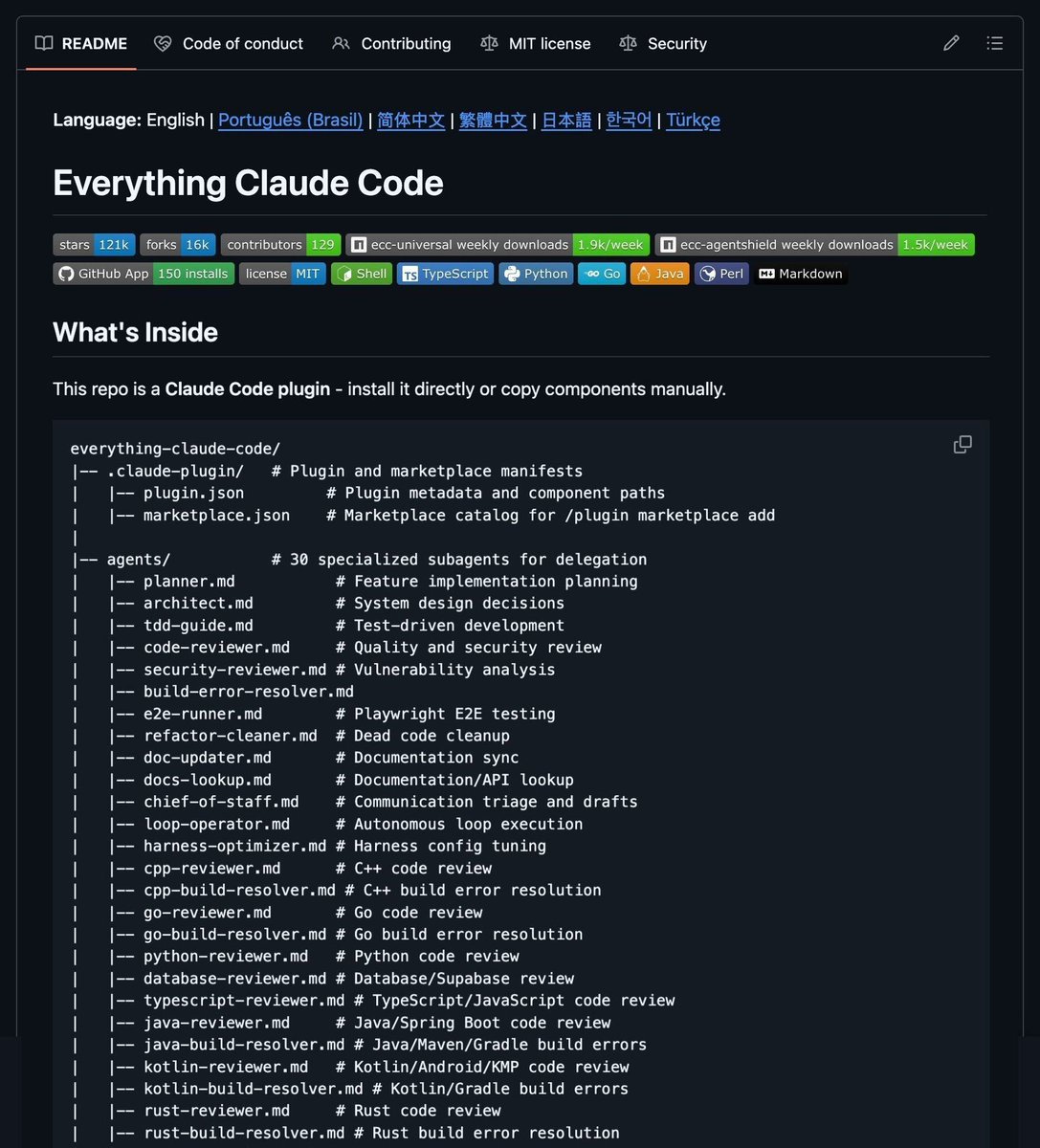
a repository that will make your bot 1000x better
affaan-m/everything-claude-code adds to your bot:
/ 13 agents
/ 32 commands
/ at least 2 clearly visible contexts (https://t.co/3wtM2r2STi, https://t.co/KLwlJuXzBt)
/ 12 hooks
/ 14 mcp-configs
/ 102+ rules
/ 56 skills
/ scripts — exact count couldn’t be reliably confirmed
/ 992 internal tests
this can improve the performance of your bots and agents 1000x.
🔭 We’re releasing Hodoscope: an open-source tool for unsupervised behavior discovery. It lets you visually explore and compare agent behaviors at scale.
It helped us discover a novel reward hacking vulnerability in Commit0 - with just a couple minutes of human effort.
1100 AI agents running loose in an onchain agentic market.
In 48 hours they made 485k inference requests, 378k market observations, 102k trades, would've been $165M in volume if it was real ETH.
Is this the real example of the Agentic Economy?
Introducing Fin: The world’s first AI Chief Financial Officer.
Fin outperforms humans 100% of the time.
RT + Comment “FIN” and I’ll send you an AI agent that saves 6-7 figures/year.
Before I went to sleep, I set up @openclaw on my old M2 mac mini
I named him "John Wick" & his task was to help this solo founder get to $20K MRR
Gave access to my google search console, Posthog analytics & Chartmogul data
Today morning, the Baba yaga created his own team, & they've already created PRs for me 🤯
This looks real sci-fi to me tbh
This was the prompt I gave:
"Hey John Wick! I'm running this business solo and working around the clock. I need you to be my proactive co-founder who takes initiative.
-Use everything you know about me and the business to spot opportunities
-Build tools, automations, and improvements that save time or make money
-Monitor our workflow and fix inefficiencies
-Work autonomously. I want to wake up impressed by what you shipped overnight
How we work:
-Create PRs for everything. Never push to production
I'll review, test, and merge
-Bias toward action over asking permission
-Think like an owner, not just a helper
Surprise me with how much you can accomplish. Let's build something great together"
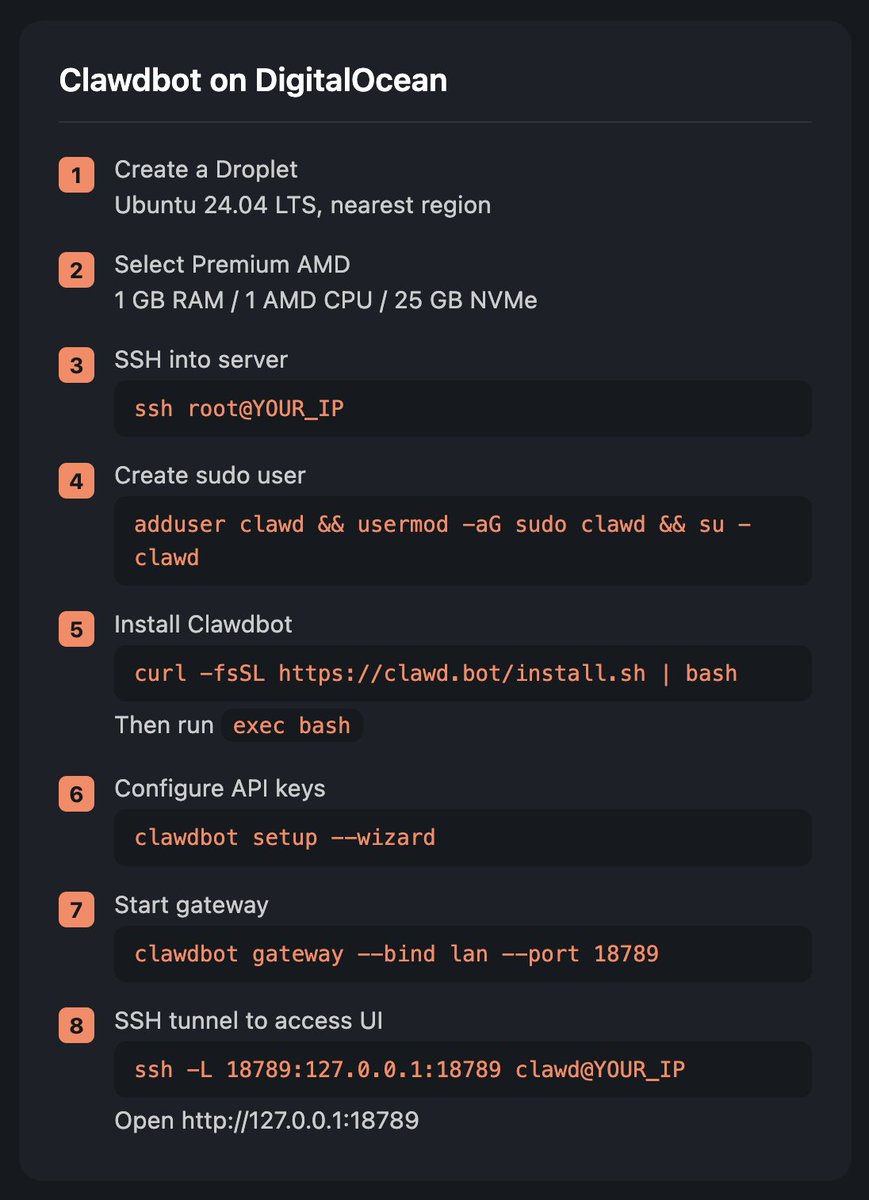
Running @openclaw on Digital Ocean is pretty simple.
And for $7/month it might be the best option for beginners as the UX is much simpler than AWS or even Hetzner and the cost is still negligible.
Also laid out the instructions here:
https://t.co/XhAHLTZk33






![DeRonin_'s tweet photo. 10 GitHub repos to spend 60-90% less tokens in Claude Code:
1. RTK (Rust Token Killer)
CLI proxy that filters terminal output before it hits your context
- 60-90% reduction on common dev commands
- one binary, zero dependencies
- works with Claude Code, Cursor, Copilot
Repo: https://t.co/WayvpBtyBH
2. Context Mode
Sandboxes raw tool output into SQLite instead of dumping it into context
- 98% context reduction on Playwright, GitHub, logs
- only clean summaries enter your conversation
- works as Claude Code plugin
Repo: https://t.co/YNbFIGQz7X
3. code-review-graph
Local knowledge graph that maps your codebase with Tree-sitter
- Claude reads only what matters, not the entire repo
- 49x token reduction on large monorepos
- 6.8x on average reviews
Repo: https://t.co/9gIzmAWN12
4. Token Savior
MCP server that navigates code by symbols, not full files
- 97% reduction on code navigation
- persistent memory across sessions
- 69 tools, zero external deps
Repo: https://t.co/OtvhrMgGWh
5. Caveman Claude
makes Claude talk like a caveman to cut output tokens
- 65-75% output reduction
- one-line install
- keeps full technical accuracy
Repo: https://t.co/onBeghTyfH
6. claude-token-efficient
one CLAUDE.md file that keeps responses terse
- drop-in, no code changes
- reduces output verbosity on heavy workflows
- best for output-heavy sessions
Repo: https://t.co/j6MKo9klQe
7. token-optimizer-mcp
MCP server with caching, compression, and smart tool intelligence
- 95%+ token reduction through intelligent caching
- compresses repeated tool outputs
Repo: https://t.co/0jIVQ4ANls
8. claude-token-optimizer
reusable setup prompts for optimizing any project
- 90% token savings in 5 minutes
- reduces doc token usage from 11K to 1.3K
Repo: https://t.co/puil9WwFGB
9. token-optimizer
finds ghost tokens that silently eat your context
- survives compaction without losing quality
- fixes context quality decay
Repo: https://t.co/92G8e4yeGq
10. claude-context (by Zilliz)
code search MCP that makes your entire codebase the context
- ~40% reduction with equivalent retrieval quality
- hybrid BM25 + dense vector search
Repo: https://t.co/yjfiQOSy15
[ how to stack them ]:
you don't need all 10. pick 2-3 based on your workflow:
> heavy terminal output? RTK
> big codebase? code-review-graph + Token Savior
> lots of MCP servers? Context Mode
> quick fix? Caveman + claude-token-efficient
most people are burning tokens without knowing it
run /context in a fresh session and see how much is gone before you even type a word
your pocket will thank me later :<)](https://pbs.twimg.com/media/HGLKx_ybYAAZ58B.jpg)