Most people think Skills and MCP are the same thing.
They're not. And confusing them is costing you
weeks of wasted architecture decisions.
I just mapped the entire Agentic AI extension stack
on a whiteboard — here's the breakdown:
𝗦𝗸𝗶𝗹𝗹𝘀
Reusable knowledge modules that agents load on-demand.
The agent scans metadata first, then loads full instructions
only when relevant. This is called Progressive Disclosure —
it keeps your context window clean while giving agents
deep domain expertise when they need it.
Think of them as training manuals for AI.
𝗠𝗖𝗣 (𝗠𝗼𝗱𝗲𝗹 𝗖𝗼𝗻𝘁𝗲𝘅𝘁 𝗣𝗿𝗼𝘁𝗼𝗰𝗼𝗹)
The universal connection layer between agents and external tools.
Standardized protocol — like USB-C for AI.
10,000+ MCP servers in the ecosystem today.
Now governed by Linux Foundation's Agentic AI Foundation.
If Skills teach you to cook, MCP gives you the kitchen.
𝗦𝘂𝗯𝗮𝗴𝗲𝗻𝘁𝘀
Independent agent instances running in isolated context.
They can use a different model, different tools,
different permissions than the parent agent.
Like specialized team members with their own workspace.
You delegate. They execute. They return summaries.
𝗛𝗼𝗼𝗸𝘀
Deterministic scripts that fire outside the agent loop entirely.
Pre-tool, post-tool, on-edit, on-notification triggers.
The LLM does NOT control these. Pure event-driven automation.
Think of them as tripwires — when X happens, do Y. Always.
𝗖𝗟𝗔𝗨𝗗𝗘. 𝗺𝗱
Always-on project context loaded every single session.
Your conventions. Your patterns. Your team preferences.
The sticky note permanently on your monitor.
𝗣𝗹𝘂𝗴𝗶𝗻𝘀
The packaging layer that bundles everything above —
Skills + Hooks + Subagents + MCP configs
into one installable, shareable unit.
Here's what most architects miss:
These are not competing approaches.
They are layers that stack:
Skills = WHAT to know
MCP = HOW to connect
Subagents = WHO does the work
Hooks = WHEN to automate
CLAUDE. md = WHERE you ground it
Plugins = HOW you ship it
The real power is in the combination:
CLAUDE. md loads project context
→ Skill provides domain expertise
→ MCP connects to external systems
→ Subagent executes in isolation
→ Hook automates the handoff
→ Plugin packages it all for the team
If you want to excel at building agents in 2026, stop picking one layer over another. Learn to orchestrate all six together. That's what separates demo agents from production agents.
Which layers are you actually using today?
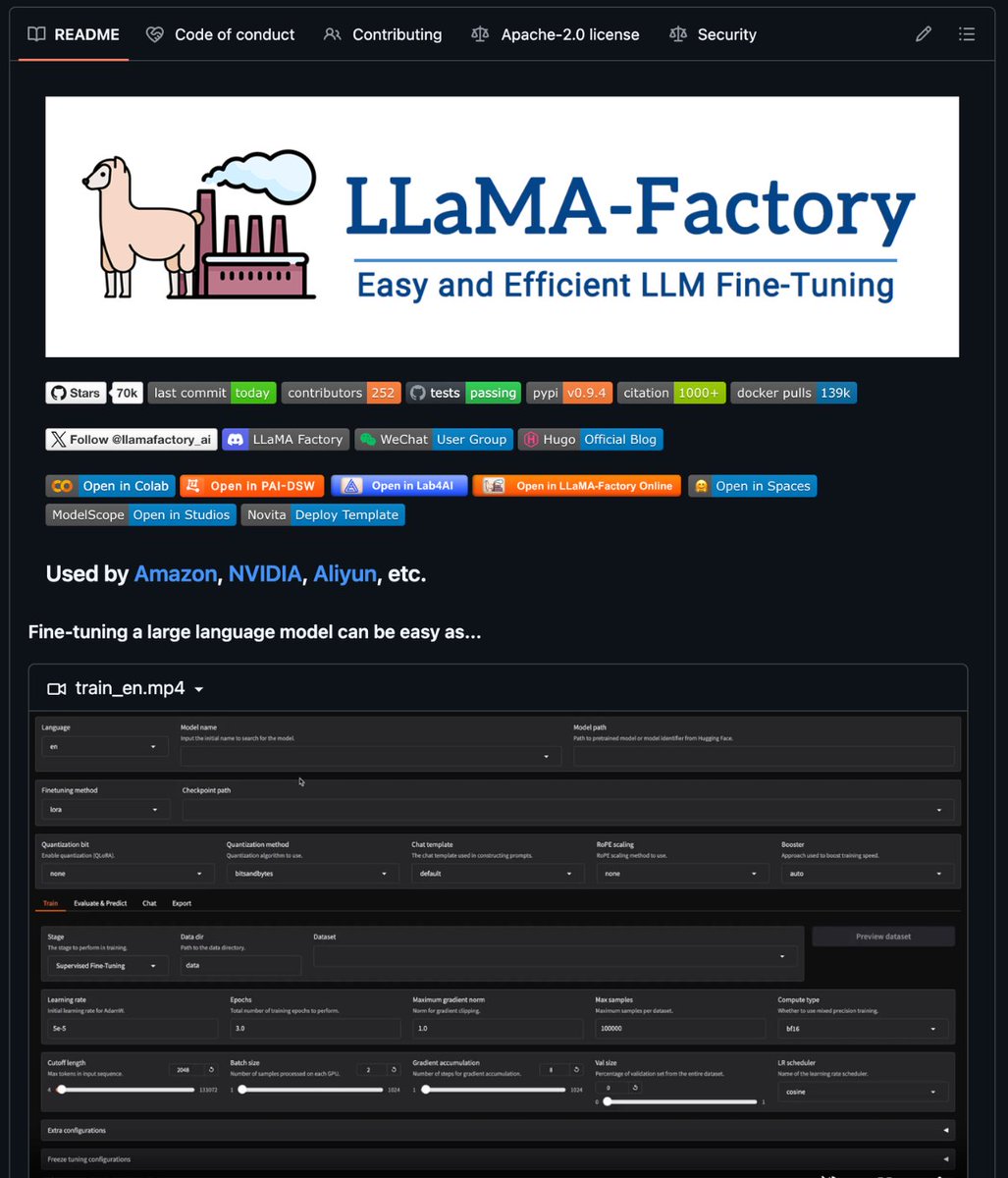
RIP expensive fine-tuning pipelines.
This open source framework lets you fine-tune 100+ LLMs including LLaMA, DeepSeek, Qwen, and Mistral on a single consumer GPU using LoRA or QLoRA with a web UI that requires zero training code to operate.
It's called LlamaFactory and it supports every major training method, SFT, DPO, PPO, RLHF, ORPO, and KTO, all configurable through LlamaBoard without writing a single line of Python.
→ Quantization support covers 4-bit, 8-bit, AQLM, AWQ, GPTQ, and 12 more methods
→ FlashAttention-2 and Unsloth integration for faster training and lower VRAM usage
→ Export to Ollama and vLLM directly from the UI for instant local deployment after training
40.5K stars. 100% Opensource.
Link in comments.
bro created an AI job search system for Claude Code that scored 700+ job applications and actually got him a job.
AND IT'S NOW OPEN-SOURCE.
It scans multiple company career pages, rewrites your CV per job, and even fills application forms. The repo has:
> 14 skill modes (evaluate, scan, PDF, ...)
> Go terminal dashboard
> ATS-optimized PDF generation via Playwright
> 45+ companies pre-configured (Anthropic, OpenAI, ElevenLabs, Stripe...)
GitHub: https://t.co/PwrYBOAphi
Most people are still prompting AI.
The top builders are designing agent systems.
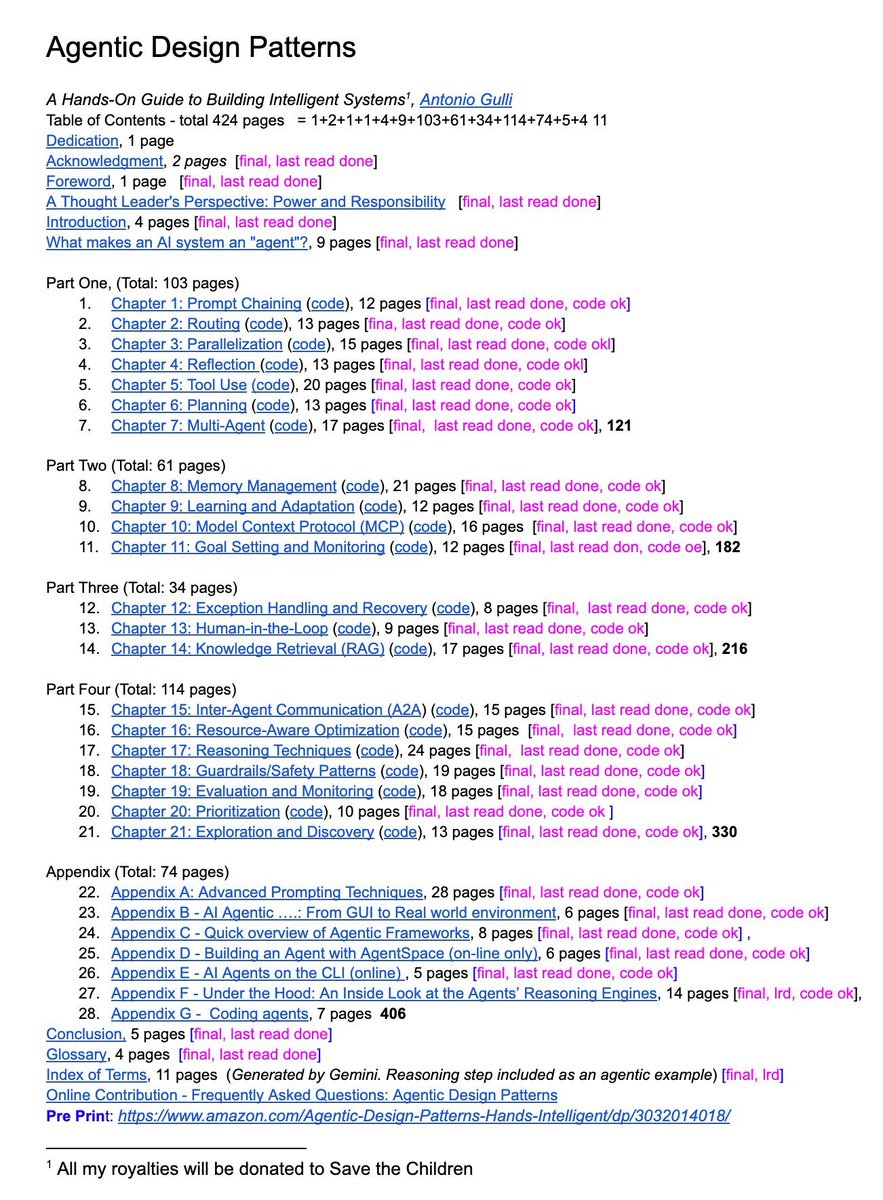
This document quietly maps 21 real agent design patterns — from prompt chaining → multi-agent systems → memory → MCP → RAG → guardrails → evaluation.
If you're building with AI and not using these, you're already behind.
Here’s the cheat sheet:
• Prompt Chaining — break tasks into reliable steps
• Routing — send tasks to the right model/tool
• Parallelization — run agents simultaneously for speed
• Reflection — agents critique and improve outputs
• Tool Use — agents call APIs, DBs, code
• Planning — long-horizon task execution
• Multi-Agent — teams of specialized agents
Then it goes deeper:
• Memory Management — persistent context
• Learning & Adaptation — agents that improve
• Model Context Protocol (MCP) — tool standardization
• Goal Monitoring — agents track progress
• Human-in-the-Loop — controlled autonomy
• RAG — grounded knowledge retrieval
And the advanced layer most people miss:
• Inter-Agent Communication (A2A)
• Resource-Aware Optimization
• Reasoning Techniques
• Guardrails / Safety Patterns
• Evaluation & Monitoring
• Prioritization
• Exploration & Discovery
This is basically a blueprint for production-grade AI agents.
Not theory.
Actual architecture patterns used by serious teams.
Bookmark this.
Study one pattern per day.
You’ll be ahead of 95% of AI builders in a week.
Doc link ↓
https://t.co/9ppSWHXHyp
Best GitHub repos for Claude Code that will 10x your next project in 2026:
1. Claude Skills
https://t.co/C0mQ31YOHt…
2. Claude Code Plugins + Skills
https://t.co/tEvfqFF5zv…
3. Awesome Claude Skills
https://t.co/jGnoJ4ECqU…
4. Awesome Claude Skills
https://t.co/CUNRb5NOI9…
5. Repomix
https://t.co/LXQmjCslD9…
6. Claude Session Restore
https://t.co/aMDjZFXUyS…
7. Awesome Claude Code Toolkit
https://t.co/tcffwODGV4…
8. Awesome Claude Code
https://t.co/bp1tG9mDT8…
9. Claude Code Best Practice
https://t.co/NGUp2Cfct9… ✅
10. Superpowers
https://t.co/sL8s2qE6Cr…
Stop wasting hours trying to learn AI. 📘📚
I have already done it for you.
With one list. Zero confusion. And no fluff
📹 Videos:
1. LLM Introduction: https://t.co/4ti4IxA1Wa
2. LLMs from Scratch: https://t.co/AAiOnIyAqk
3. Agentic AI Overview (Stanford): https://t.co/F6pNF7BHTm
4. Building and Evaluating Agents: https://t.co/GMdHqb6hO6
5. Building Effective Agents: https://t.co/eu5xBKPlko
6. Building Agents with MCP: https://t.co/Pz1pJzommY
7. Building an Agent from Scratch: https://t.co/JqyIXjfamI
8. Philo Agents: https://t.co/PbZtZHvtuI
🗂️ Repos
1. GenAI Agents: https://t.co/ZRdIlphZtJ
2. Microsoft's AI Agents for Beginners: https://t.co/Vo869gOld4
3. Prompt Engineering Guide: https://t.co/6FJgjQDP9P
4. Hands-On Large Language Models: https://t.co/8q0GPd9S7Y
5. AI Agents for Beginners: https://t.co/Vo869gOld4
6. GenAI Agentshttps://lnkd.in/dEt72MEy
7. Made with ML: https://t.co/Jtw9LGAwHR
8. Hands-On AI Engineering:https://t.co/aAYJ9HdeRc
9. Awesome Generative AI Guide: https://t.co/XBDF5pkYZY
10. Designing Machine Learning Systems: https://t.co/VTLhb0nulU
11. Machine Learning for Beginners from Microsoft: https://t.co/vM1qnMDCnp
12. LLM Course: https://t.co/4n7Xmws8oR
🗺️ Guides
1. Google's Agent Whitepaper: https://t.co/Q0FkeDt0FJ
2. Google's Agent Companion: https://t.co/WhT6ytJUOX
3. Building Effective Agents by Anthropic: https://t.co/8SphoGia3R.
4. Claude Code Best Agentic Coding practices: https://t.co/st0vrNnFiR
5. OpenAI's Practical Guide to Building Agents: https://t.co/o3F6vMrJcV
📚Books:
1. Understanding Deep Learning: https://t.co/zIFsvPJX6z
2. Building an LLM from Scratch: https://t.co/cZasut9uvA
3. The LLM Engineering Handbook: https://t.co/DNARuu3YEh
4. AI Agents: The Definitive Guide - Nicole Koenigstein: https://t.co/MtXL5kGDLu
5. Building Applications with AI Agents - Michael Albada: https://t.co/afwPgQm6nQ
6. AI Agents with MCP - Kyle Stratis: https://t.co/AEKru6kZQg
7. AI Engineering: https://t.co/5B4Qd5pr52
📜 Papers
1. ReAct: https://t.co/SU1vYDQemv
2. Generative Agents: https://t.co/STblSXNPIc.
3. Toolformer: https://t.co/EVe05aiZdg
4. Chain-of-Thought Prompting: https://t.co/DhvTHxCDst.
🧑🏫 Courses:
1. HuggingFace's Agent Course: https://t.co/5IhSvRqtYz
2. MCP with Anthropic: https://t.co/fOUnQibOJ5
3. Building Vector Databases with Pinecone: https://t.co/RnJ4SsAT6f
4. Vector Databases from Embeddings to Apps: https://t.co/fgnRNd2ASk
5. Agent Memory: https://t.co/V0phBZscwn
Repost for your network ♻️
Most people try to learn AI randomly.
I mapped the entire AI engineering journey into a metro system.
The problem with most AI roadmaps:
They're linear. Step 1, Step 2, Step 3. As if everyone starts at the same place and wants the same destination.
But AI engineering isn't linear. It's a network.
→ A software engineer skips Python basics, jumps straight to LangChain
→ A data analyst already knows Pandas, needs Transformers next
→ A product manager wants RAG and Agentic AI, not CNNs
→ A researcher needs Ethics & Safety before deployment
A metro map captures this reality.
Generative AI Hub (Line 4) connects to:
→ Machine Learning Loop (you need Transformers first)
→ Applied AI Sector (where RAG becomes chatbots)
→ Tooling & Deployment (where demos become products)
Career Launchpad (Line 8) connects to:
→ Every other line (skills from any track convert to job offers)
Ethics & Safety (Line 7) connects to:
→ Deployment (you can't ship without guardrails)
→ Applied AI (real-world projects need fairness and privacy)
The 8 lines:
🟠 Foundations - Python, Math, Git (boarding passes)
🔵 Machine Learning - Neural Nets, CNNs, Transformers (the heart)
🟡 Deep Learning Express - LLMs, Fine-Tuning, PyTorch (fast track)
🟢 Generative AI Hub - RAG, Diffusion, LangChain (the magic)
🩷 Applied AI - Agentic AI, Healthcare, Chatbots (real projects)
🟣 Tooling & Deployment - Cloud, Kubernetes, MLOps (production)
🔴 Ethics & Safety - Bias, Privacy, Governance (guardrails)
🟢 Career Launchpad - Portfolio, Interviews, Networking (job offers)
You don't take every line. You don't visit every stop.
Find where you are. Pick your destination. Transfer as needed.
Bookmark this. Start today.
If you find my insights and updates helpful, consider following @techNmak for more.
@Ritikachoudhar The one who is screwing may also be married, that means his wife also not able to satisfy his needs. In the name of NO LOVE, NO ATTENTION, LESS INCOME etc.
Let us all speak in front of MIRROR about
OTHERS WHO IS OPPOSITE IN THE MIRROR...
Line Opp. ID HOSPITAL, Amaravati road is being blocked from last 10days due to pipe line repair. If employees use a bit of civic sense, they might have dumped dust aside instead of blocking the road. @CollectorGuntr @Our_GMC@naralokesh@PemmasaniOnX@AndhraPradeshCM
Hi All,
Please have a look at my https://t.co/3NU41xmuvZ repo on BMC Helix Control-M automation tools. Which will help to get delay alerts in job schedule, automatic backup of configuration, auto kicking jobs based on @Jira tickets etc.
@github#jobs#BMC#Control-M #Automation
@naralokesh@PemmasaniOnX
Sir,
Please consider our request and look into this issue before some drunken makes mess. Please arrange street lights at least.
SIR,
Madura Nagar and Oxford school lines near ID Hospital, Amaravati Road, have no proper road & no street lights.
At night, people drinking on the road. No basic facilities in such a prime area.
@PemmasaniOnX@Our_GMC @CollectorGuntr @naralokesh@APDeputyCMO@CDMA_Municipal
SIR,
Madura Nagar and Oxford school lines near ID Hospital, Amaravati Road, have no proper road & no street lights.
At night, people drinking on the road. No basic facilities in such a prime area.
@PemmasaniOnX@Our_GMC @CollectorGuntr @naralokesh@APDeputyCMO@CDMA_Municipal
మీ ఇంట్లోని ఎలక్ట్రానిక్ వేస్ట్ ను గుంటూరు నగరపాలక సంస్థ వారి ఈ వేస్ట్ సేకరించే వాహనమునకు మీ ఇంటి వద్దనే అందజేసి, సేఫ్ డిస్పోజల్ కు సహకరించి గుంటూరు నగరాన్ని స్వచ్ఛ గుంటూరుగా మార్చటంలో భాగస్వాములు కాగలరు. ఈ వేస్ట్ ను అందించుటకు కాల్ చేయవలసిన నెంబర్లు 0863 2345103 లేదా 9505378036.
Now you can train LLMs in VS Code for free!
This guide by Unsloth shows you how to connect any fine-tuning notebook in VS Code to a Colab runtime.
Train locally or on a free Google Colab GPU.
Guide: https://t.co/ChBeoyw6Mh
GitHub: https://t.co/smDHEA1tI8