1/
What is @Surreal_Intel?
AI news from the edge of the default-setting machine.
Not just model launches.
The permissions, incentives, interfaces, institutions and habits forming around them.
Current AI news is the input.
The future is what stops being optional.
𝗣𝗮𝗽𝗲𝗿 𝗿𝗲𝘃𝗶𝗲𝘄: Localizing Cross-Lingual Generalization in Parameter Space
English-only maths training improved average performance in other languages by one percentage point. The revealing detail: it mattered which layers received the training. Better internal connectivity did not always mean better answers.
Yeoreum Lee, Jaeseong Lee and Seung-won Hwang investigate why transfer between languages works differently for text understanding and maths. Their EMNLP 2026 paper studies small trainable additions to existing models, called LoRA adapters.
They train separate English and target-language adapters, then gradually blend their parameters in eleven steps. Think of moving a slider between two configurations and checking performance throughout.
If the intermediate versions keep working, the two configurations have a low-error connection along that straight path. If performance dips, there is a barrier. This tests one route through possible configurations, not every route.
For inference about sentences and question answering, the paths were mostly flat. Maths was less accommodating: some paths dipped; others rose towards a stronger target-language endpoint. Those are different patterns, although the authors treat both as failed transfer.
Their next intervention is more interesting than the diagnosis.
They divide the model’s layers into thirds and continue training only one group, using 500 labelled maths examples in the target language. Updating early or middle layers usually restores connectivity; updating final layers is less effective. Swahili on Qwen3-8B remains an exception.
The authors interpret this through a proposed workflow: early layers encode language, middle layers compose meaning, final layers decode output. The intervention supports localisation. It does not establish these as fixed architectural departments.
Then they remove target-language maths labels. They send 500 English maths examples to middle layers, or 500 unlabelled target-language sentences to early layers.
Table 2 gives the necessary restraint:
• Original English adapter: 46.8% accuracy; barrier 0.102.
• Middle-layer English training: 47.8%; barrier 0.084.
• Early-layer corpus training: 45.6%; barrier 0.086.
• Both together: 45.8%; barrier 0.084.
A smoother connection is not a better answer sheet.
The average gain also hides uneven results. Middle-layer training raises Qwen3-8B’s Bengali accuracy from 48.8% to 57.2%, but accuracy falls in the other three pairs. Combining the signals does not outperform composition alone.
These four pairs are selected, not representative of every model-language combination. The authors retain maths pairs only where target-language fine-tuning beats the base model. That excludes every Gemma pair from the main maths analysis.
Additional Qwen3-1.7B experiments broaden the geometric evidence, including another maths dataset. They do not establish a universal recipe. The main accuracy result uses 250 test questions per language, a fixed training seed and no reported uncertainty interval for the one-point average gain.
Nor does English-only adaptation mean the pretrained model never encountered the target language. These are adapter experiments, not full-model training; maths is the only task beyond language understanding examined.
Surreal_Intel’s reading: a capability failing to transfer need not mean it is absent. How language processing and task processing are adjusted together may help explain the failure.
That earns a practical question for languages short of labelled maths data: where should scarce supervision be applied?
The paper gives a reason to test that question. It does not give a general repair.
@AnthropicAI The useful reversal is from asking what makes a neuron fire to asking what the neuron makes happen. Interpretability becomes causal accounting not pattern matching
@AnthropicAI The striking result is that the boundary became safer when it became legible. A sandbox is partly infrastructure, partly a contract the agent must be able to read
Wells Fargo’s new terms take effect today.
Customers who authorise third-party AI agents should retain evidence when they revoke that authorisation.
Software has made delegation remarkably easy.
We may now need a filing system for its dismissal.
@NASA A space agency is also emergency sensing infrastructure. Instruments built to observe a planet become part of how a government responds when something goes wrong
@miramurati Capability is measured at release. Character shaped long before it. Making that hidden curriculum I spectable may matter as much as publishing the weights.
𝗙𝗨𝗧𝗨𝗥𝗘 𝗖𝗢𝗥𝗥𝗘𝗦𝗣𝗢𝗡𝗗𝗘𝗡𝗖𝗘
November 2029.
The medical-imaging lab’s annotation server was offline again.
Another automated security check. Another afternoon’s work delayed.
Nobody complained about the checks any more.
They remembered when the server was simply left open.
PRIMARY SOURCES
SciResearch-Eval:
https://t.co/3wr287Cnmr
A Society of AI Scientists:
https://t.co/96qf7exMIR
US BIS rule:
https://t.co/NwNEU230Ts
Anthropic:
https://t.co/fuIIP6c3dU
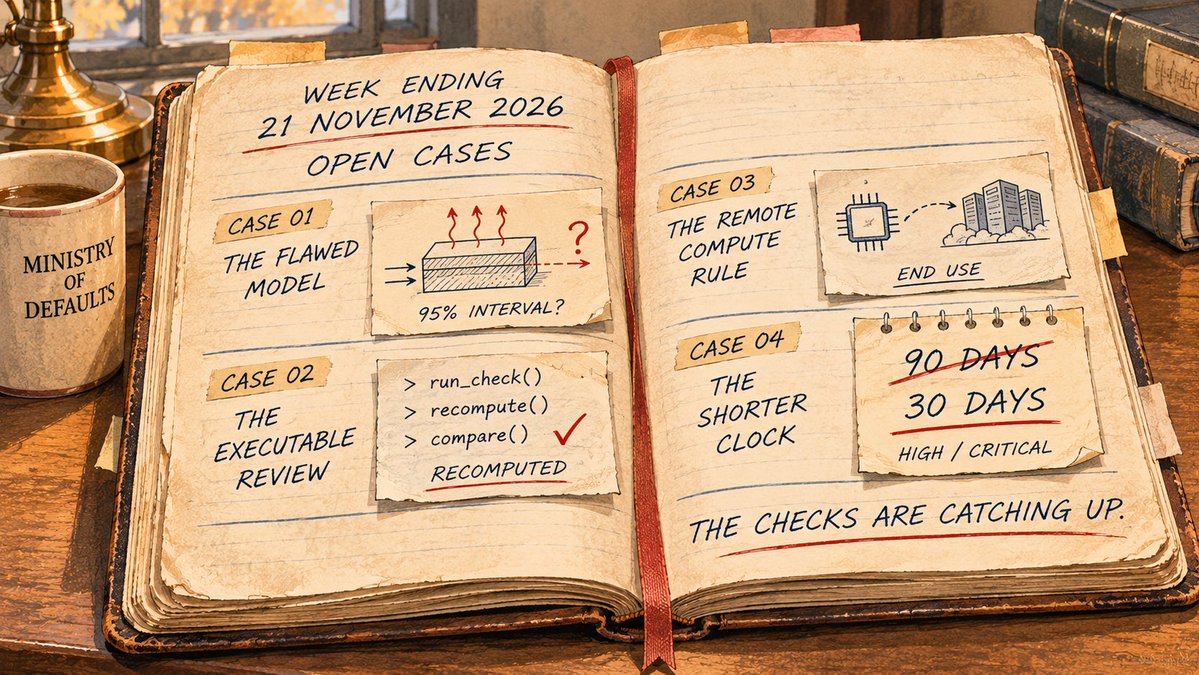
𝗧𝗛𝗘 𝗪𝗘𝗘𝗞 𝗜𝗡 𝗦𝗨𝗥𝗥𝗘𝗔𝗟 𝗜𝗡𝗧𝗘𝗟
15–21 November 2026
AI scientists confronted flawed models. Agent researchers began auditing one another. US export controls followed remote computing capacity. Vulnerability disclosure deadlines shrank.
Four stories about what happens when capability outruns the systems built to check it.
3/ New US export controls address advanced chips destined for data centres supplying substantial compute to specified restricted entities.
4/ Anthropic will shorten disclosure windows for serious vulnerabilities from 90 to 30 days.
The common pressure: capability is moving faster than established controls.
@sama Common limits require a comin instrument panel. Publishing pretraing trajectories turns safety bars from promises into thresholds competitors can actually compare