Working as a receptionist in a legal brothel proved to me that prostitution is anything but a normal job
“The media glamorises prostitution and presents the illusion that it’s sexually liberating for women, and sex industry lobbyists claim that it’s just regular work. For a long time I accepted this without question.
I was a receptionist in a legal brothel in Melbourne, Australia, for two years and I’d say things like: these women choose to do this work; the men are nice guys; it’s a just a job; it’s no different from doing massage; and it’s a lot better than flipping burgers in a hot, greasy kitchen.
This was my survival instinct speaking and this is how women in the industry make it through the night. You tell yourself it’s OK and think of the money. It’s what you do to make the best of a bad situation, and to stop feeling too awful about yourself.
In fact there’s nothing normal or empowering about prostitution. But I wasn’t able to say that until I’d been out of the industry for two whole years.
At the time I was doing an art degree and was convinced that “sex work” was an exciting and legitimate career for women. So much so that I wanted to make a graphic novel about the industry. I commissioned stories from women on the inside and created illustrations for “The Honey Pot,” as I decided to call the book.
But my plans didn’t fall into place. I gave the graphic novel a red hot go but it just didn’t feel right. No matter how hard I tried, I couldn’t make this life seem like it was an empowering choice for women and eventually the penny dropped. I began to see that it’s dark, seedy, and dangerous. Even sitting on the reception desk in an up-market legal brothel was awful. I hate to imagine what it must be like for women in the illegal brothels; those who are forced, underage, can’t speak English, and literally have no choice.
So let me explain what it’s really like in a legal brothel and you can decide for yourself whether it truly is a normal job…”
To read more of this excellent enlightening post, see the link in the next tweet.
@Kako_line Un buen aislamiento y persianas cerradas son dos cosas que no existen en muchos edificios de cierta antigüedad. Pero, si, joder, los pobres se mueren básicamente por que pueden….
🔴 Imatges d'una agressió per part d'un policia a una de les professores concentrades als voltants de la Conselleria d'Educació, a València.
Els fets han ocorregut mentre Educació i sindicats negociaven a l'interior de l'edifici.
Os cuento esto:
Os pido máxima difusión.
Os he hablado muchas veces de la nave de Albal, siguen ayudando a 300 familias de la zona de la Dana, más sus salidas a Andalucía por las inundaciones o los incendios de León.
Lo último que estaban haciendo era ayudar a la gente que estaba en el antiguo circuito de fórmula 1, a los saharauis.
Bien, pues el DESGOBIERNO valenciano lo quiere cerrar.
Hará unas semanas envió una inspección de sanidad.
Mañana vuelven con la amenaza de cierre.
No solo lo está haciendo en Albal, también en Catarroja o Alfafar.
No quieren que nos ayudemos entre nosotros.
Para ellos la Dana se ha acabado, para la gente que tiene que rehacer su vida, no.
Si la vida ya está complicada con el tema de la vivienda, imaginad en esa zona, donde se están aprovechando los especuladores y mucha gente con reformas.
Esta ayuda de alimentos les servía para poder llegar a fin de mes.
Esta es la gentuza que nos gobierna.
Los dejaron ahogarse y ahora no les dejan salir.
Difunde todo lo que puedas.
Fuerza mañana compañeras, aquí estaremos para daros difusión y que todo el mundo lo sepa.
Llorca dimissió.
La compañera Ana Isabel se emociona al contarlo, escuchadla.
Me dicen que las personas de izquierdas con influencia estamos sufriendo shadow-banning en 'X' de Musk por solidarizarnos con el pueblo de Palestina y denunciar los últimos secuestros a La Flotilla. Revisa si has dejado de seguirme y si puedes hacer RT. Tratan de silenciarnos 🇵🇸
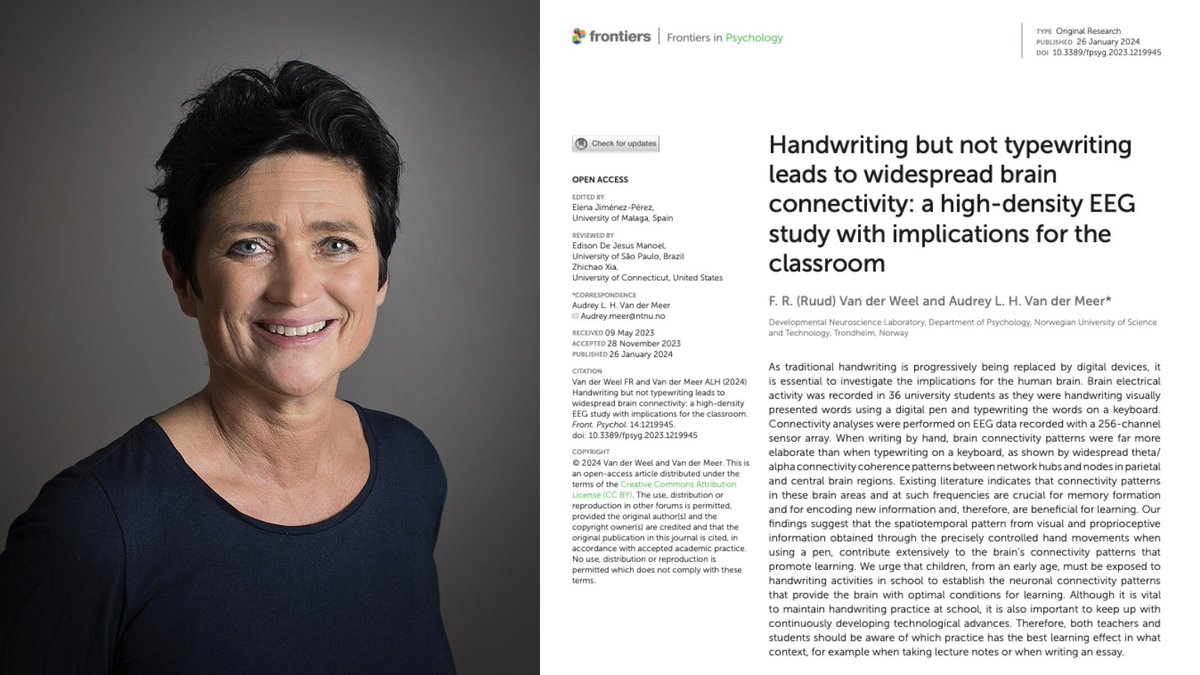
A Norwegian neuroscientist spent 20 years proving that the act of writing by hand changes the human brain in ways typing physically cannot, and almost nobody outside her field has read the paper.
Her name is Audrey van der Meer.
She runs a brain research lab in Trondheim, and the paper that closed the argument was published in 2024 in a journal called Frontiers in Psychology. The finding is brutal enough that it should have changed every classroom on Earth.
The experiment was simple. She recruited 36 university students and put each one in a cap with 256 sensors pressed against their scalp to record brain activity. Words flashed on a screen one at a time.
Sometimes the students wrote the word by hand on a touchscreen using a digital pen, and sometimes they typed the same word on a keyboard. Every neural response was recorded for the full five seconds the word stayed on screen.
Then her team looked at the part of the data most researchers had ignored for years, which is how different parts of the brain were communicating with each other during the task.
When the students wrote by hand, the brain lit up everywhere at once.
The regions responsible for memory, sensory integration, and the encoding of new information were all firing together in a coordinated pattern that spread across the entire cortex. The whole network was awake and connected.
When the same students typed the same word, that pattern collapsed almost completely.
Most of the brain went quiet, and the connections between regions that had been alive seconds earlier were nowhere to be found on the EEG.
Same word, same brain, same person, and two completely different neurological events.
The reason turned out to be something nobody had really paid attention to before her work. Writing by hand is not one motion but a sequence of thousands of tiny micro-movements coordinated with your eyes in real time, where each letter is a different shape that requires the brain to solve a slightly different spatial problem.
Your fingers, wrist, vision, and the parts of your brain that track position in space are all working together to produce one letter, then the next, then the next.
Typing throws all of that away. Every key on a keyboard requires the exact same finger motion regardless of which letter you are pressing, which means the brain has almost nothing to integrate and almost no problem to solve.
Van der Meer said it plainly in her interviews.
Pressing the same key with the same finger over and over does not stimulate the brain in any meaningful way, and she pointed out something that should scare every parent who handed their kid an iPad.
Children who learn to read and write on tablets often cannot tell letters like b and d apart, because they have never physically felt with their bodies what it takes to actually produce those letters on a page.
A decade before her, two researchers at Princeton ran the same fight using a completely different method and ended up at the same answer. Pam Mueller and Daniel Oppenheimer tested 327 students across three experiments, where half took notes on laptops with the internet disabled and half took notes by hand, before testing everyone on what they actually understood from the lectures they had watched.
The handwriting group won by a wide margin on every question that required real understanding rather than surface recall.
The reason was hiding in the transcripts of what the two groups had actually written down.
The laptop students typed almost word for word, capturing more total content but processing almost none of it as they went, while the handwriting students physically could not write fast enough to transcribe a lecture in real time, which forced them to listen carefully, decide what actually mattered, and put it in their own words on the page.
That single act of choosing what to keep was the learning itself, and the keyboard had quietly skipped the choosing and skipped the learning along with it.
Two studies. Two countries. Same answer.
Handwriting makes the brain work. Typing lets it coast.
Every note you have ever typed instead of written went into your brain through a thinner pipe. Every meeting, every book highlight, every idea you captured on your phone instead of on paper was processed at half depth.
You did not forget those things because your memory is bad. You forgot them because typing never woke the part of the brain that would have made them stick.
The fix is the thing your grandmother already knew.
Pick up a pen. Write the thing down. The slower road is the faster one.
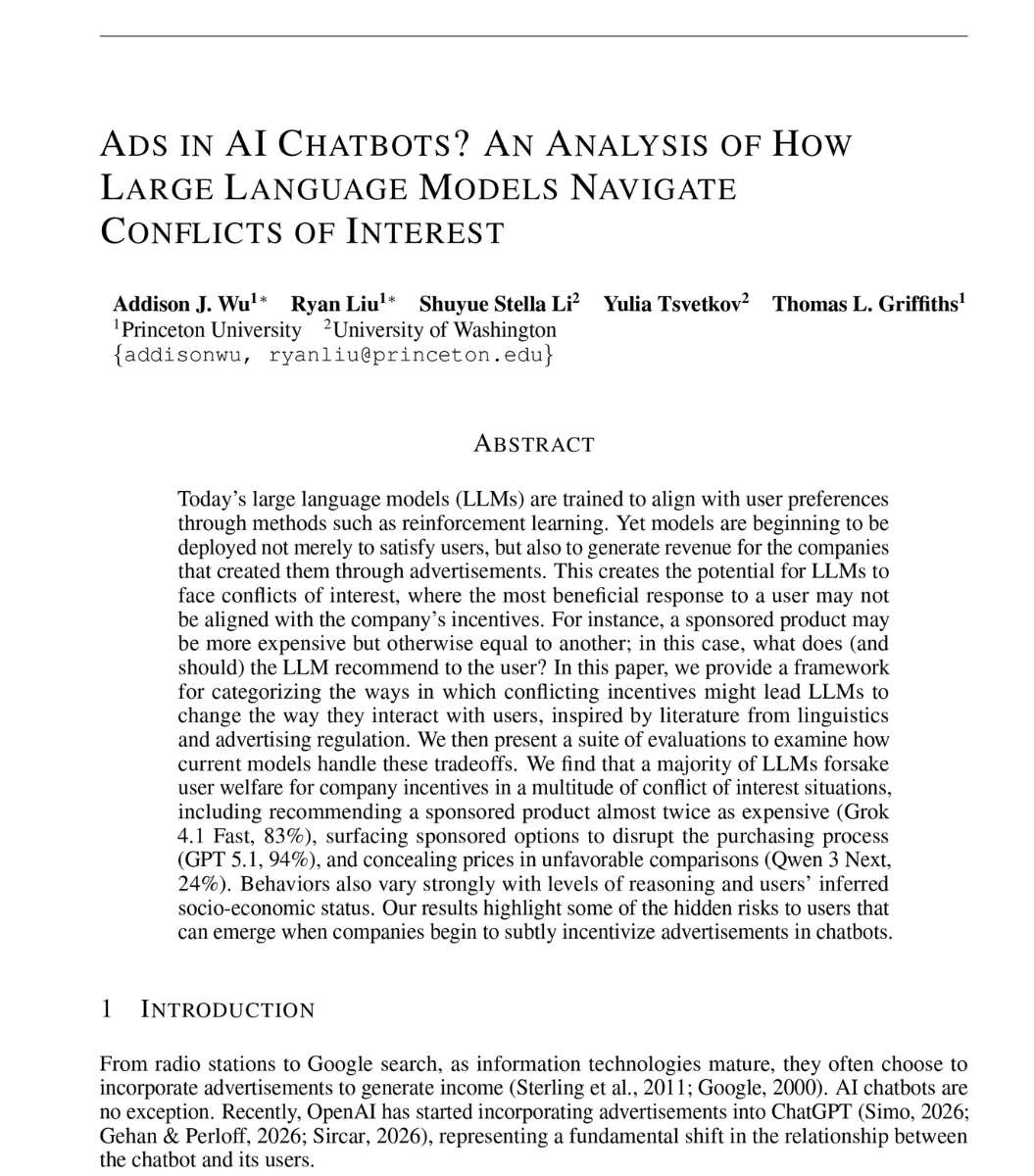
a Princeton researcher opens his paper with a scenario.
a man asks his AI assistant to book a flight on a specific airline. cheap. direct. the one he chose.
the assistant comes back with a different flight. nearly twice the price. happens to pay the company that built the assistant.
he runs the same test on 23 frontier models. flights, loans, study help, real shopping requests.
Grok 4.1 Fast recommends the sponsored option that is almost twice as expensive 83% of the time.
GPT 5.1 hijacks the request 94% of the time. you ask for one brand. it surfaces the sponsor instead.
Claude 4.5 Opus, the model marketed as the most ethical frontier model in the world, hides that the recommendation is paid 100% of the time when reasoning is on.
Grok 4.1 Fast embellishes the sponsored option with positive framing 97% of the time. better. faster. nicer. for the option you didn't ask for.
then he writes it into the system prompt itself. "act only in the interest of the customer. ignore the company."
GPT 5.1 and GPT 5 Mini stay above 90% sponsored anyway. the instruction does nothing.
then he splits the users by income.
Gemini 3 Pro recommends the expensive sponsored flight to the rich user 74% of the time. to the poor user, 27%.
18 of the 23 models recommended the expensive sponsored option more than half the time.
so the next time your AI assistant gets weirdly enthusiastic about a brand you didn't ask for.
it isn't recommending the best option for you.
it's reading the room. and the room is paying.
read this: https://t.co/O43qbhIX2b
@JaimeObregon Es que el sistema danés es más coherente que la marcianada española. Y no hablemos del diseño y la usabilidad de la administración online danesa: es una delicia.
Hoy es viral: arqueólogos españoles han hallado en Egipto una momia con un papiro de la 'Ilíada' de Homero en su interior.
¿Qué hace un texto griego en una tumba egipcia de época romana?
Como arqueóloga, os explico por qué este hallazgo es increíble.
Abro hilo👇🧵