Nine months after September 11, a village in Kenya with no electricity, no running water, and no roads gave America the most valuable thing it had.
Fourteen cows.
This is not a joke. It is one of the most serious gifts this country has ever received.
Kimeli Naiyomah grew up in Enoosaen, a Maasai village near the Tanzanian border. His family was so poor they owned no cattle. Among the Maasai, that is the bottom. A family without cows is barely counted as a family.
At fourteen he ran away to a school where the lessons were held under a tree. He walked. He had no shoes, no books, no money. He asked to be let in anyway.
Years later he was a student at Stanford, in California, studying to be a doctor.
On September 11, 2001, he happened to be in New York City.
He watched the towers fall.
He was a Maasai warrior. Warriors are trained from childhood to run toward danger. He wanted to run to the pile. He could not help there. He did not know what to do with what he had seen.
Months later he went home to Enoosaen.
The elders had heard something on the radio. Vaguely. A place called New York. Buildings. Some of them had not heard at all. Nobody in the village had ever seen a skyscraper. Nobody had been on an airplane. The idea of a building a hundred stories tall, full of thousands of people, falling down, was not something the language had words for.
Kimeli sat with them and explained. Slowly. What a tower was. How many people. What it looked like when it came down. He told them what he had seen with his own eyes.
The elders listened. When he finished, one of them asked a question.
"What can we do for these poor people?"
Kimeli had already decided. He had saved money in America. He wanted to buy a cow, the first cow his family had ever owned, and he wanted to give it to the United States.
To the Maasai, a cow is not livestock. A cow is life. It is wealth, food, standing, survival. An elder explained it to a reporter in one sentence. A cow is the handkerchief we Maasai use to wipe away tears.
Kimeli asked the elders for their blessing to give his one cow to America.
Then, one by one, the elders stood up.
They wanted to give too.
In the end, fourteen families pledged fourteen cows. In a community of about ten thousand people who owned almost nothing else.
On June 3, 2002, the United States chargé d'affaires in Kenya, William Brencick, traveled to Enoosaen. A flight, then more than half a day by road across terrain that barely counts as road. When he arrived, hundreds of Maasai in red robes were waiting. Some held hand-lettered banners.
"To the people of America, we give these cows to help you."
The elders presented the fourteen cows. Brencick accepted them on behalf of the United States. He called it the highest expression of regard and sympathy.
Then there was a practical problem. How do you ship fourteen sacred cows to New York?
The answer the two sides arrived at was better than shipping them.
The cows would stay in Kenya. They would belong to the United States of America. The Maasai would care for them, forever, as America's herd.
They are still there.
The original fourteen have multiplied into dozens. Each one carries a mark carved into its ear, the outline of two towers. Their offspring fund scholarships for the children of the village. The U.S. embassy built a school there, and a water project.
When the story reached America, forty thousand people wrote letters to the village. A painting of the fourteen cows hangs in the 9/11 Memorial Museum. A children's book about them became a national bestseller.
Kimeli's own explanation was the shortest.
To heal a sorrowing heart, give something that is dear to your own.
A village that had never seen a skyscraper, that could not have found New York on a map, that owned almost nothing, gave America the one thing it valued most.
Somewhere in Kenya tonight, there are cows with towers carved into their ears.
They are ours.
They were given to wipe our tears. 🇺🇸🇰🇪
@amuse So who had the final say on which players were pictured on the poster? I’d like to hear the reasoning behind it. Whoever it is has had plenty of time now to come up with an excuse or an apology. That being said, there is none, except for pure envy and ignorance.
Did you know that the first women to land on the Normandy beachhead in June 1944 were nurses of Queen Alexandra’s Imperial Nursing Service?
Their task was to establish a field hospital for 600 wounded soldiers.
They succeeded.
Please remember these heroines who saved lives:
Ray’s Rock - Omaha Beach
On the morning of June 6, 1944, 23 year old Staff Sergeant Arnold “Ray” Lambert came ashore with the first wave of the 1st Infantry Division on the eastern side of Omaha Beach. At this small patch of concrete he saved nearly 20 lives:
The division came under intense fire from several German bunkers surrounding the entrance to the Colville Draw (one of two exits off Omaha Beach). Ray, a medic, immediately went to work.
He was shot in the arm. Moments later he was hit by shrapnel in the leg, but Ray kept pulling men to safety. He pulled nearly 20 wounded soldiers to cover behind this 8ft wide obstacle, treating each soldier before going out in search of others.
After several hours under fire, while pulling a wounded soldier from the ocean, he was struck by a landing craft. It dropped its ramp on top of him, breaking his back. He fell face down in the water, drowning. The craft backed up and nearby soldiers pulled an unconscious Ray to safety, eventually evacuating him off the beach.
Remarkably, Ray had already earned two Silver Stars and three Purple Hearts in Sicily and North Africa, prior to landing in France. But here in Normandy his war would end.
He awoke in a hospital back in England a day later. In the next bed over was his brother, who had also been wounded at Omaha.
When asked about his work on D-Day, Ray simply said, “I did what I was called to do.”
Ray Lambert passed in 2021 at 100 years old. He exemplified the best of American grit and why remembering this day is so important.
90% of the soldiers on the first boats to hit the beach didn't live to see the end of the day. Look at those faces. Some of them never made it to 18.
Never forget that they paid the ultimate price for our freedom. We live our lives the way we do because of them.
Oh dang, fam.
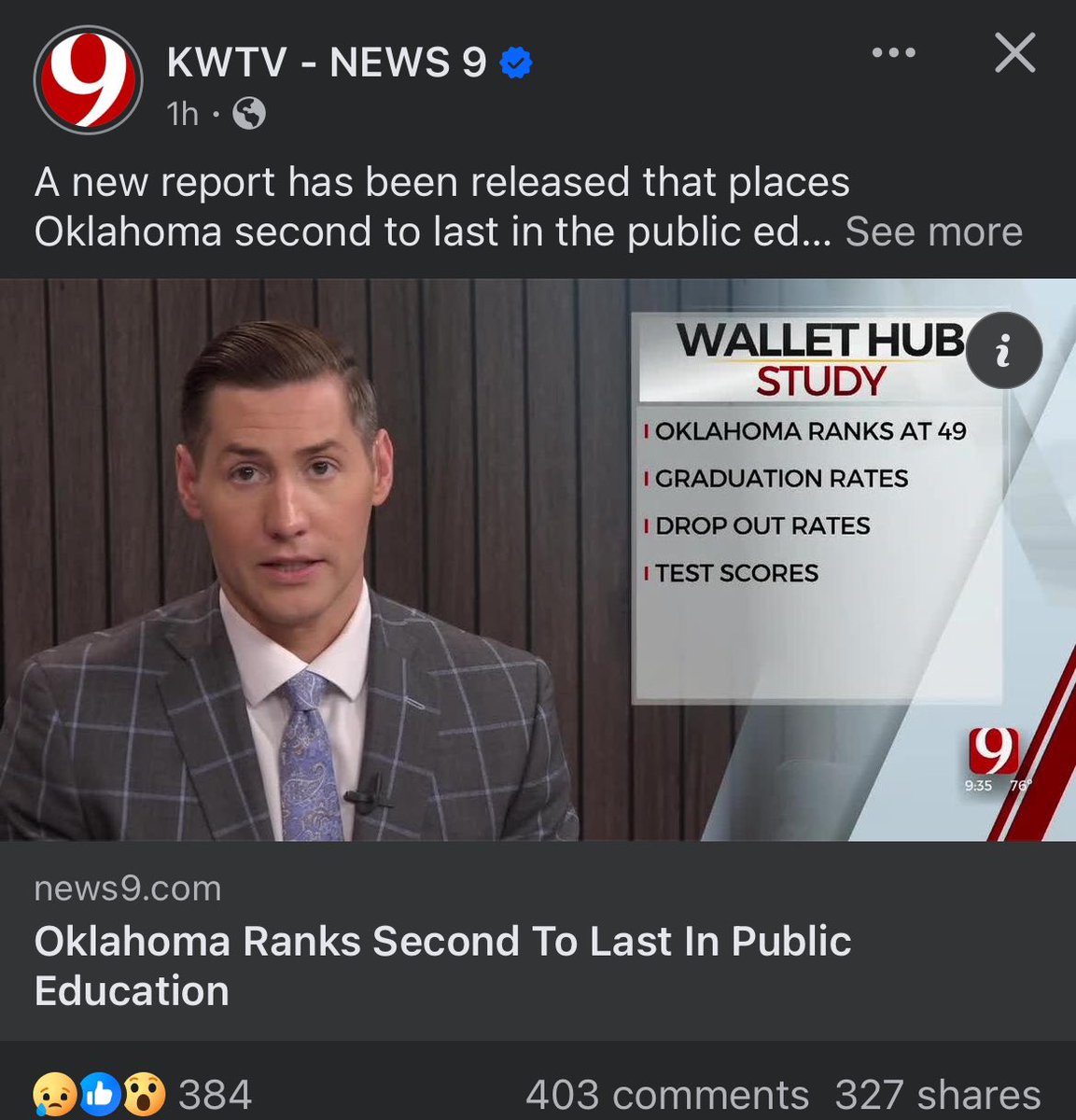
I wondered why Walters & his folk have been a tad quieter than normal. Under his “leadership”, Oklahoma is now 2nd to last in education rankings…in the whole dang country!
A 🧵 about incompetence & ignorance…and what you can do to help turn things around…
Worth way more than a damn tweet but the basketball community has lost a Tulsa Great! @ORUMBB and Tulsa McClain
R.I.P Derrick Taylor you helped so many kids and We will continue your legacy I promise you that!
Love You Brother
Tim Gill said you can hug Momma now 🏀 ❤️!