Gustav Klimt’s portrait is of Prince William Nii Nortey Dowuona, a leader of the Osu tribe in modern-day Ghana. Klimt painted the prince in 1897 after a visit to Vienna’s Tiergarten am Schüttel.
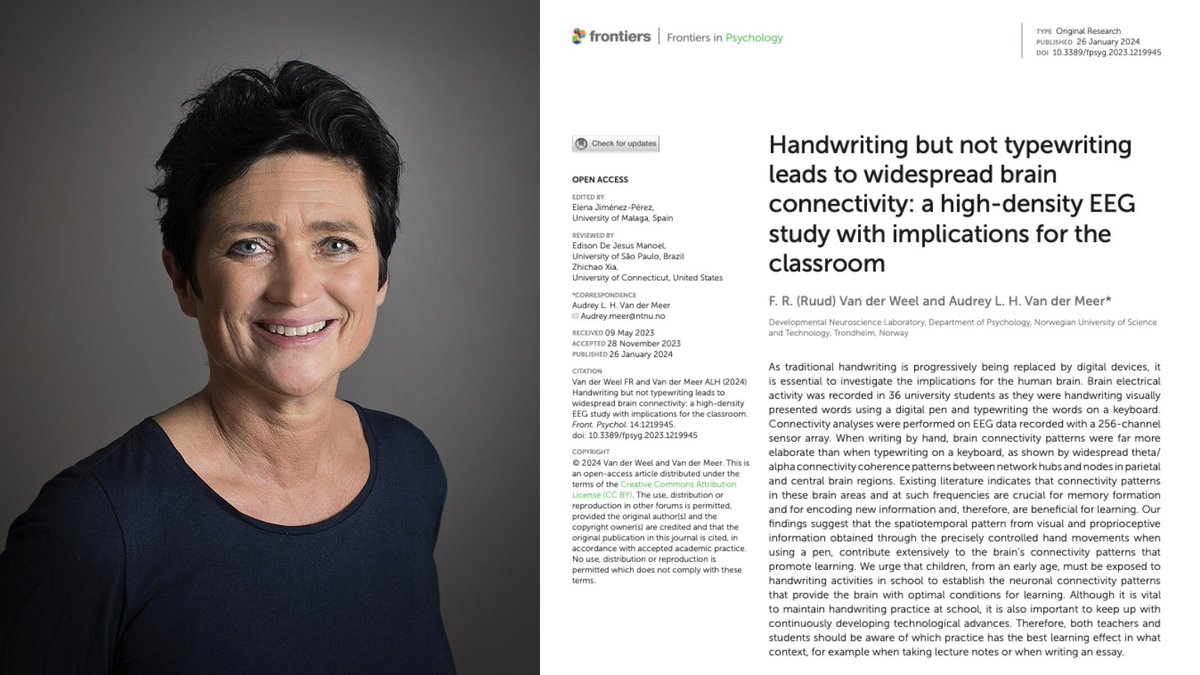
A Norwegian neuroscientist spent 20 years proving that the act of writing by hand changes the human brain in ways typing physically cannot, and almost nobody outside her field has read the paper.
Her name is Audrey van der Meer.
She runs a brain research lab in Trondheim, and the paper that closed the argument was published in 2024 in a journal called Frontiers in Psychology. The finding is brutal enough that it should have changed every classroom on Earth.
The experiment was simple. She recruited 36 university students and put each one in a cap with 256 sensors pressed against their scalp to record brain activity. Words flashed on a screen one at a time.
Sometimes the students wrote the word by hand on a touchscreen using a digital pen, and sometimes they typed the same word on a keyboard. Every neural response was recorded for the full five seconds the word stayed on screen.
Then her team looked at the part of the data most researchers had ignored for years, which is how different parts of the brain were communicating with each other during the task.
When the students wrote by hand, the brain lit up everywhere at once.
The regions responsible for memory, sensory integration, and the encoding of new information were all firing together in a coordinated pattern that spread across the entire cortex. The whole network was awake and connected.
When the same students typed the same word, that pattern collapsed almost completely.
Most of the brain went quiet, and the connections between regions that had been alive seconds earlier were nowhere to be found on the EEG.
Same word, same brain, same person, and two completely different neurological events.
The reason turned out to be something nobody had really paid attention to before her work. Writing by hand is not one motion but a sequence of thousands of tiny micro-movements coordinated with your eyes in real time, where each letter is a different shape that requires the brain to solve a slightly different spatial problem.
Your fingers, wrist, vision, and the parts of your brain that track position in space are all working together to produce one letter, then the next, then the next.
Typing throws all of that away. Every key on a keyboard requires the exact same finger motion regardless of which letter you are pressing, which means the brain has almost nothing to integrate and almost no problem to solve.
Van der Meer said it plainly in her interviews.
Pressing the same key with the same finger over and over does not stimulate the brain in any meaningful way, and she pointed out something that should scare every parent who handed their kid an iPad.
Children who learn to read and write on tablets often cannot tell letters like b and d apart, because they have never physically felt with their bodies what it takes to actually produce those letters on a page.
A decade before her, two researchers at Princeton ran the same fight using a completely different method and ended up at the same answer. Pam Mueller and Daniel Oppenheimer tested 327 students across three experiments, where half took notes on laptops with the internet disabled and half took notes by hand, before testing everyone on what they actually understood from the lectures they had watched.
The handwriting group won by a wide margin on every question that required real understanding rather than surface recall.
The reason was hiding in the transcripts of what the two groups had actually written down.
The laptop students typed almost word for word, capturing more total content but processing almost none of it as they went, while the handwriting students physically could not write fast enough to transcribe a lecture in real time, which forced them to listen carefully, decide what actually mattered, and put it in their own words on the page.
That single act of choosing what to keep was the learning itself, and the keyboard had quietly skipped the choosing and skipped the learning along with it.
Two studies. Two countries. Same answer.
Handwriting makes the brain work. Typing lets it coast.
Every note you have ever typed instead of written went into your brain through a thinner pipe. Every meeting, every book highlight, every idea you captured on your phone instead of on paper was processed at half depth.
You did not forget those things because your memory is bad. You forgot them because typing never woke the part of the brain that would have made them stick.
The fix is the thing your grandmother already knew.
Pick up a pen. Write the thing down. The slower road is the faster one.
One of the most dramatic recent framing changes has been the removal of the additional 16th century style replica frame from the narrow original moulding on this portrait by Ghirlandaio at the Ashmolean. These narrow portrait frames were once common, but have almost all gone.
@ahistoryinart That's really interesting. I have been battling them on my lawn without using weedkiller and I can confirm that they are wonderfully unruly.
"The secret of being happy consists of knowing how to enjoy yourself—enjoy being at table, in bed; enjoy standing up, sitting down; enjoy the nearest ray of sunshine, the slightest bit of landscape. In other words, love everything."
~ Gustave Flaubert
🎨 Henri Matisse
Been thinking about this. It all starts with the ingredients. Great quality fabric, be it cotton that does not wear out after a few washes, fine wool fabric or a nice linen weave. Just like a great meal. You can´t skimp the ingredients.
Hugely excited to announce our forthcoming conference on Gardens & Empires, co-organised with @EnglishHeritage and the @britishlibrary 27-28 June 2025, in person and online. It's a fantastic international line-up of speakers and panellists https://t.co/WEqQ0M1zVg
@MadameGilflurt Saw this beautiful gown when it was displayed in a jewellery store in central San Francisco in 2002. I was just there on holiday and popped in when I saw the display. It is absolutely stunning in real life. She must have been quite breathtaking in it.
@Merici502525@celemax21 So true for me also. I am processing the huge trauma of my parent´s divorce now and I am in my 50s. I don´t think its a black and white solution. Disfunction in a family is often generational and there are no quick fixes.
PhD on offer at Kew: Plants and their Products: Biocultural collections at Kew Gardens & the South Kensington Museum during the long nineteenth century
If only I could apply! Fascinating mutual interests of Kew and the V&A in plants. Closes 16 May
https://t.co/YBkwW3Uqna
Today marks the anniversary of Kristallnacht, or the "Night of Broken Glass," which took place on November 9, 1938. In remembrance, we joined a group in our neighborhood to clean Stolpersteine — small brass plaques embedded in the pavement that honor the memory of victims of the Holocaust. Each plaque is placed in front of the last known residence of an individual who was persecuted by the Nazis.
@BookLadyKaty I wonder if comics can´t be tested on the accelerated reader website? No test, no data for schools. It kills kids joy of reading what they want and when they want. The questions are rigid and it becomes a task. No more☹️
Many people assume I am talking about the leisure activity of a few housewives when I say that I study the history of lacemaking… no, it was a massive, international labor network of girls & women that major regional economies were dependent on. And it’s not an anomaly
Happy 65th birthday, Guggenheim! 🎉✨ On October 21, 1959, the museum opened its doors, with thousands flocking to Fifth Avenue. The film “Buildings & Crowd” captured the buzz as visitors experienced the iconic space and works by Arp, Brancusi, Chagall, Kandinsky, and more. 🌀🖼️ #Guggenheim65