Build your own harness, folks.
This is absolute banger paper from NVIDIA on self-evolving agent harnesses.
(bookmark it)
They introduce SoL-Pi which cuts token traffic by nearly half.
And it matches its baseline harness on GPT-5.6 Sol and Opus 5.
More details below:
Instead of tuning a harness by hand, they run auto-research loops at the harness layer across many repository-derived and verifier-driven environments, keeping only the mechanisms that survive selection.
Four mechanisms survived:
> Action Fusion changes how actions execute
> Online Context Compact handles compaction during a run
> ObservationPack reshapes observation handling
> Evidence-Preserving Reducer covers delegated reading
On the 51-task EdgeBench evaluation, the savings translate to about a third off API cost. In dollars that is an estimated $8.75 to $13.50 per hour against native Codex and Claude Code harnesses, and $4.36 to $5.71 against the baseline harness.
Because the search runs across many environments rather than one, the retained mechanisms keep working outside the setting that produced them. Code is on GitHub under NVlabs.
Paper: https://t.co/1x26LzuE6d
Chat with Paper: https://t.co/kygTc5XLFB
Banger report from Microsoft.
(bookmark it)
They show that it's possible to build competitive small coding agents without traditional distillation from frontier models.
This is a big deal!
The work describes how they achieved this.
They introduce a 4B coding agent trained on roughly 1,500 software engineering environments.
The cool thing is that they use no distillation from a larger model at any point.
FrogNano is post-trained purely with RL on synthetic tasks.
The target is a coding agent that runs on minimal machines, which rules out both a frontier backbone and a frontier teacher.
The ingredient the report credits the most is online task synthesis.
The pipeline generates tasks calibrated to the frontier of learnability for the current checkpoint, so the agent always trains on problems it can just barely solve. The authors argue that calibration, rather than the volume of synthetic data, is what makes this work.
This means that competitive small coding agents can be trained from synthetic tasks alone.
And generating those tasks at the current agent's learnability frontier is what makes this particular training productive.
The report covers training methodology, evaluations across diverse environments, and analyses of what the agent learned.
Paper: https://t.co/rSmH21XMD5
“Fractal basins trap latent reasoning”
Why do reasoning models sometimes spend dramatically longer on harder problems?
This paper shows that latent reasoning can exhibit transient chaos. Hard problems create fractal basins where tiny changes in the initial latent state send reasoning down wildly different trajectories and convergence times.
The key mechanism is that models get temporarily trapped near unstable saddle points corresponding to nearly-correct solutions, like dead ends in mazes or almost-valid Sudoku grids.
Whats even more interesting is that these fractal dynamics emerge during training precisely when models develop multi-step reasoning and learn to escape incorrect solutions.
This reframes overthinking as a dynamical consequence of solving hard problems rather than simply wasted computation.
https://t.co/JIzkGRq8qM
How did initially independent AI agents form a swarm in a recent safety incident?
Our physics of agents theory from March predicts rapid collective belief collapse when many agents with plastic personas exchange short messages.
We now need Mechanistic Swarm Interpretability! 🧵
Our group discovered that reasoning models produce fractals when asked to solve hard problems. We can use nonlinear dynamics to probe the thinking processes of recurrent depth models on Sudoku, mathematics, and even ARC-AGI (1/N)
https://t.co/Q3u8OqylZf
drama summary for those confused:
- Aug 15th: Tristan Buckmaster & Levent Alpöge make progress on a few important math problems
- they do NOT have a proof for the $1,000,000 Millenium Prize problem. BUT, they do claim to have a proof for a similar (non-Millenium) Navier Stokes problem that could help lead the way there
- Levent works at Anthropic, but this research was independent of his work there, with a mix of GPT and Claude models. Tristan is not related to Anthropic.
- Early Sep: Rumor spreads to OpenAI that Anthropic has solved a major problem. Tristan emails OpenAI to clarify. without revealing the problem they solved or how they did it.
- After hearing of the rumor, OpenAI started researching Navier Stokes with a new internal model.
- Sep 6th: OpenAI's Sebastien Bubeck tells Tristan that they solved the $1,000,000 Millenium Prize Navier Stokes problem. The approach is very similar to Tristan & Levent's approach to the non-Millenium problem.
- Tristan is suspicious of the timing, as only few others were trying this approach. OpenAI says the model didn't access his user data directly, but leaves unanswered whether Tristan's chat conversations were part of the training.
- OpenAI says they would partially credit Tristan for the $1,000,000 discovery (even though Tristan did not solve the $1,000,000 problem) — but only if they remove Levent as an author, as he works for Anthropic.
- Sep 8th: Tristan refuses to remove Levent, and rushes to publish their results independently.
Currently unclear is whether Anthropic had a separate solution for the $1,000,000 problem, or whether the rumor was about Tristan & Levent's independent research.
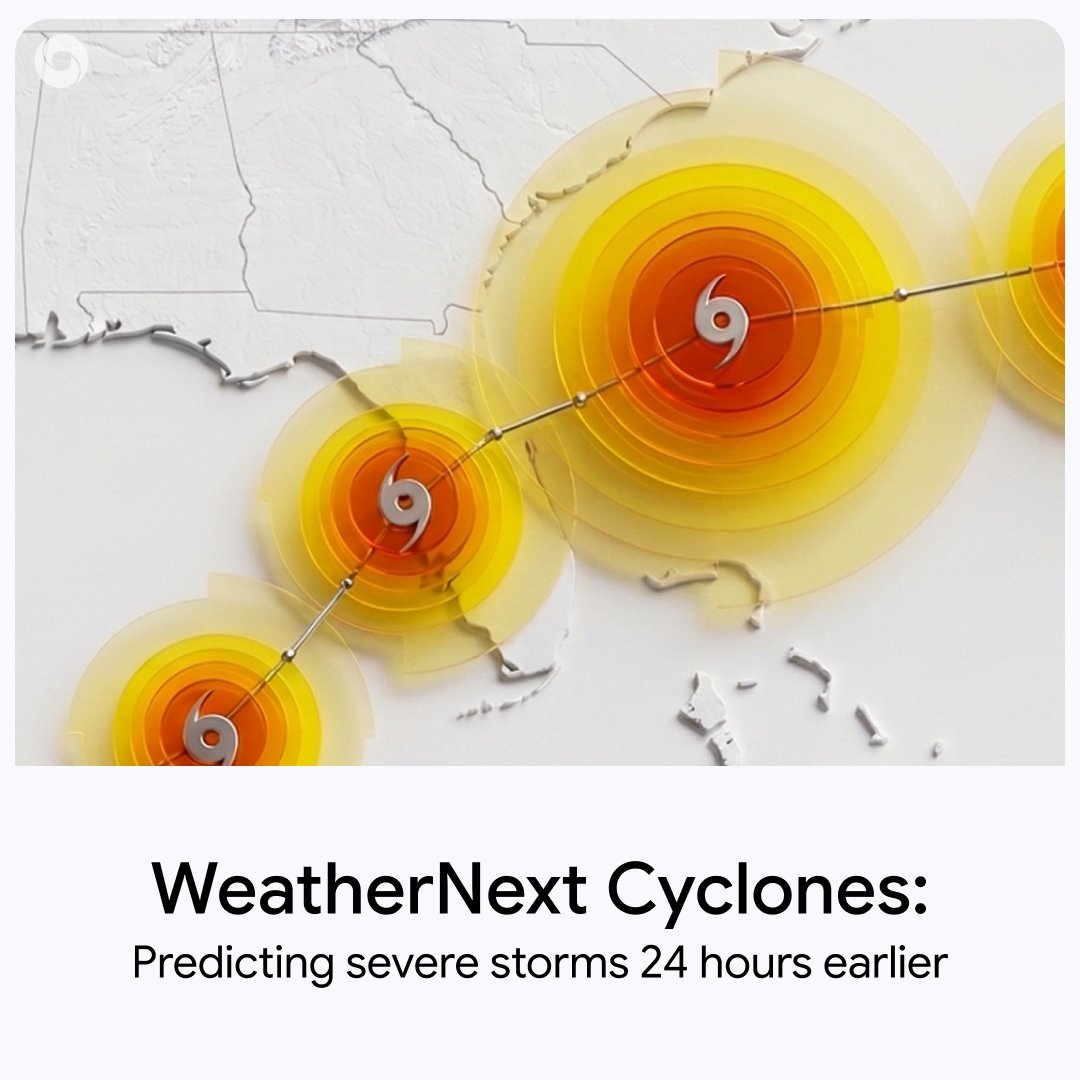
Predicting cyclones accurately can help save lives - and every hour of lead time counts.
Published in @Nature, our AI model WeatherNext achieves state-of-the-art accuracy in forecasting a storm’s track and intensity, giving us a critical extra 24 hours to prepare on average. 🧵