🧬Happy Transposon Day!
🎉Each year on the 16th of June we commemorate the birthdate of the founder of transposable element research, Barbara McClintock (1902-1992).
Check out quotes from editors and popular content on our #TransposonDay2025 page
👉https://t.co/Z6BVlGq00J
Genomes encode biological complexity, which is determined by combinations of DNA mutations across millions of bases
In new @arcinstitute work, we report the discovery and engineering of the first programmable DNA recombinases capable of megabase-scale human genome rearrangement
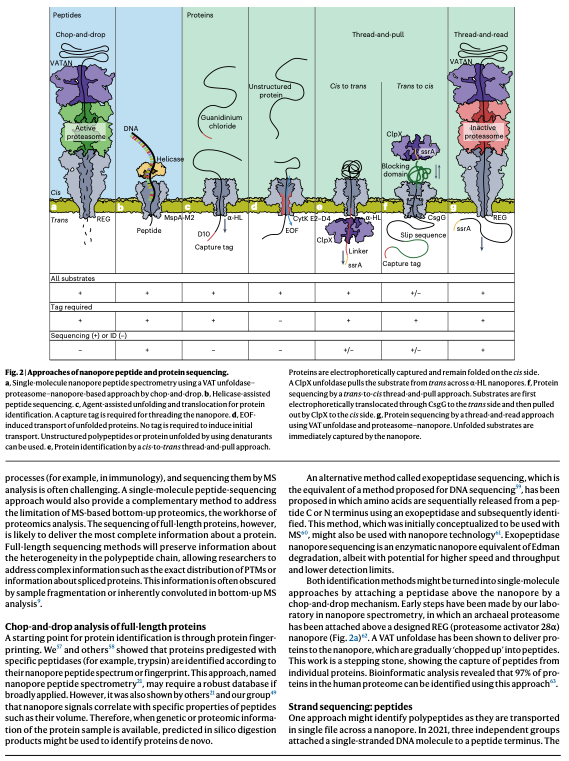
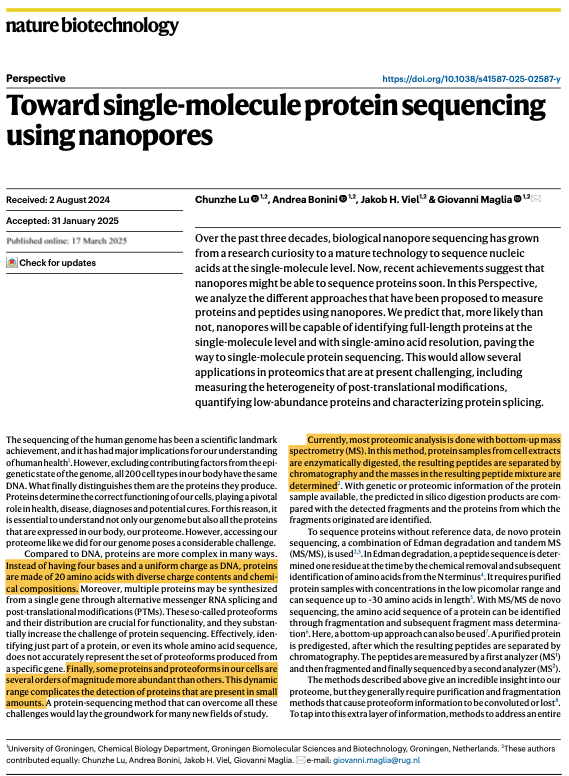
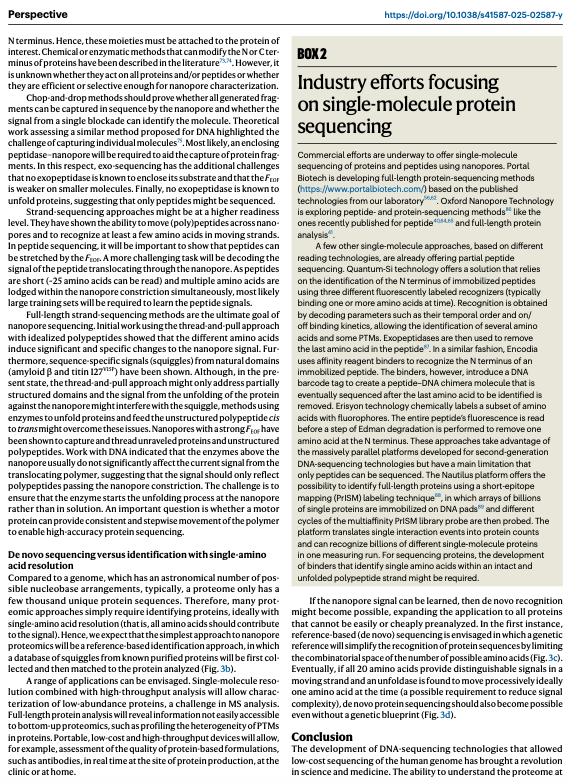
This is a great review on using nanopores to sequence proteins. Out today.
It covers how nanopores work, why they haven't historically been able to sequence individual proteins, and how researchers are adapting them to solve those problems.
Clear writing throughout.
🌾 Exciting News! 🌾
I'm thrilled to announce the publication of my first article "Multivariate analyses of rice indigenous germplasm for identification of high yield potential genotypes based on yield and its attributes" in Genetic Resources and Crop Evolution (GRCE) journal.
I would like to express my heartfelt gratitude to my chairperson Dr. M Reddi Sekhar for his mentorship which has been instrumental in shaping me. I thank my members of the my advisory committee. Thank you to everyone who has supported and believed in our work.
@RConsortium@rstatstweet Hey, I am a Master’s student in Genetics and Plant Breeding. I am posting this in regard to a problem I have encountered and couldn’t find a solution. I need to visualise PCA plots in R and I already have PC components data. Please help.
Day 29/30 of great biology papers.
"Phylogenetic structure of the prokaryotic domain: The primary kingdoms," by Carl Woese & George Fox (1977).
Perhaps the most important paper in evolutionary biology. It established a "third domain" of life.
***
This paper is just 2.5 pages in length. It contains a single table as its figure. Its publication went largely unnoticed by biologists, but The New York Times printed a story about a "third type of life" on its front page.
Prior to this study, all life was divided into two categories: Cells that have a nuclear membrane (eukaryotes), and cells that don't (prokaryotes).
Francis Crick first proposed "comparing sequences to infer relationships" as early as 1958. But this paper heralded the dawn of molecular phylogenetics.
Woese and Fox claimed, provocatively, that "all cellular life falls into one of three large relatedness groups: eukaryotes...eubacteria, and archaebacteria."
(See https://t.co/JqGIpcfGJu)
They made this claim by sequencing a single, highly-conserved gene across many organisms: Ribosomal RNA. This is the catalytic part of ribosomes, the protein-making machines inside of cells. By studying how rRNAs had mutated over eons and eons, Woese and Fox inferred the evolutionary connections between cells.
Many well-regarded microbiologists at the time believed that the relationships between microbes could not be determined without a fossil record. This sounds hilarious in hindsight. But it was a real, mainstream belief.
Roger Stanier, who helped modernize microbiology and was a respected professor at UC Berkeley and the Pasteur Institute, wrote in his textbook, The Microbial World, in 1970:
"[r]eflection and experience have shown, however, that the goal of a phylogenetic classification can seldom be realized. The course that evolution has actually followed can be ascertained only from direct historical evidence contained in the fossil record. This record is at best fragmentary and becomes almost completely illegible in Precambrian rocks more than 400 million years old."
Overturning dogma and telling professors that they're wrong is fun! A classic.
One more day to go!
Paper: https://t.co/Phthq9tutl
भारत का स्वर्णिम गौरव!
Fifty students from #KV Sehore, got selected for the inaugural run of the Vande Bharat Express between Sehore and Indore. Here is a glimpse of our students singing the KV Song on board #VandeBharatExpress.
#ProudKVians#KVS@RailMinIndia@EduMinOfIndia
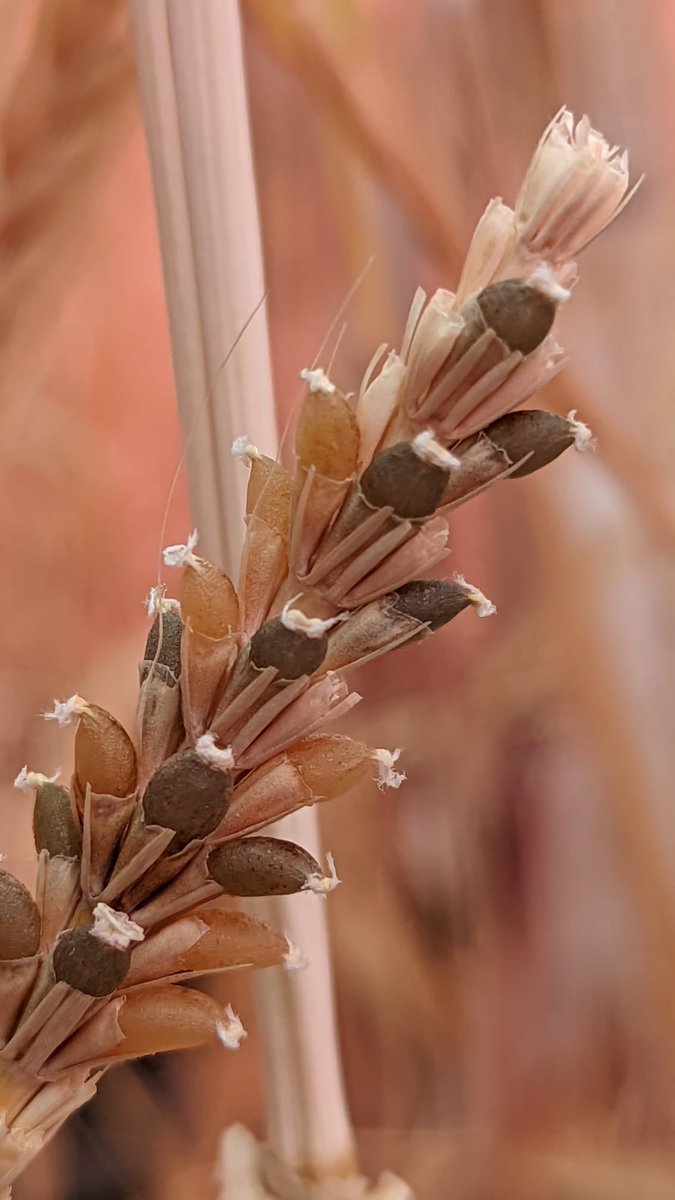
Barley double crosses in our speed breeding facility
Beautiful segregation for seed colour as a result of 4 landrace parents coming together, selected using our AI-guided crossing methodology
Thanks to the mad crossing skills of Dilani Jambuthenne
@BleacherReport@gerardromero Haha!! They are not allowing a player to go and the once that want to stay are being thrown out. What else we gonna see from the club




![NikoMcCarty's tweet photo. Day 29/30 of great biology papers.
"Phylogenetic structure of the prokaryotic domain: The primary kingdoms," by Carl Woese & George Fox (1977).
Perhaps the most important paper in evolutionary biology. It established a "third domain" of life.
***
This paper is just 2.5 pages in length. It contains a single table as its figure. Its publication went largely unnoticed by biologists, but The New York Times printed a story about a "third type of life" on its front page.
Prior to this study, all life was divided into two categories: Cells that have a nuclear membrane (eukaryotes), and cells that don't (prokaryotes).
Francis Crick first proposed "comparing sequences to infer relationships" as early as 1958. But this paper heralded the dawn of molecular phylogenetics.
Woese and Fox claimed, provocatively, that "all cellular life falls into one of three large relatedness groups: eukaryotes...eubacteria, and archaebacteria."
(See https://t.co/JqGIpcfGJu)
They made this claim by sequencing a single, highly-conserved gene across many organisms: Ribosomal RNA. This is the catalytic part of ribosomes, the protein-making machines inside of cells. By studying how rRNAs had mutated over eons and eons, Woese and Fox inferred the evolutionary connections between cells.
Many well-regarded microbiologists at the time believed that the relationships between microbes could not be determined without a fossil record. This sounds hilarious in hindsight. But it was a real, mainstream belief.
Roger Stanier, who helped modernize microbiology and was a respected professor at UC Berkeley and the Pasteur Institute, wrote in his textbook, The Microbial World, in 1970:
"[r]eflection and experience have shown, however, that the goal of a phylogenetic classification can seldom be realized. The course that evolution has actually followed can be ascertained only from direct historical evidence contained in the fossil record. This record is at best fragmentary and becomes almost completely illegible in Precambrian rocks more than 400 million years old."
Overturning dogma and telling professors that they're wrong is fun! A classic.
One more day to go!
Paper: https://t.co/Phthq9tutl](https://pbs.twimg.com/media/F0eF-eXX0AEZ_zC.png)








![NikoMcCarty's tweet photo. Day 29/30 of great biology papers.
"Phylogenetic structure of the prokaryotic domain: The primary kingdoms," by Carl Woese & George Fox (1977).
Perhaps the most important paper in evolutionary biology. It established a "third domain" of life.
***
This paper is just 2.5 pages in length. It contains a single table as its figure. Its publication went largely unnoticed by biologists, but The New York Times printed a story about a "third type of life" on its front page.
Prior to this study, all life was divided into two categories: Cells that have a nuclear membrane (eukaryotes), and cells that don't (prokaryotes).
Francis Crick first proposed "comparing sequences to infer relationships" as early as 1958. But this paper heralded the dawn of molecular phylogenetics.
Woese and Fox claimed, provocatively, that "all cellular life falls into one of three large relatedness groups: eukaryotes...eubacteria, and archaebacteria."
(See https://t.co/JqGIpcfGJu)
They made this claim by sequencing a single, highly-conserved gene across many organisms: Ribosomal RNA. This is the catalytic part of ribosomes, the protein-making machines inside of cells. By studying how rRNAs had mutated over eons and eons, Woese and Fox inferred the evolutionary connections between cells.
Many well-regarded microbiologists at the time believed that the relationships between microbes could not be determined without a fossil record. This sounds hilarious in hindsight. But it was a real, mainstream belief.
Roger Stanier, who helped modernize microbiology and was a respected professor at UC Berkeley and the Pasteur Institute, wrote in his textbook, The Microbial World, in 1970:
"[r]eflection and experience have shown, however, that the goal of a phylogenetic classification can seldom be realized. The course that evolution has actually followed can be ascertained only from direct historical evidence contained in the fossil record. This record is at best fragmentary and becomes almost completely illegible in Precambrian rocks more than 400 million years old."
Overturning dogma and telling professors that they're wrong is fun! A classic.
One more day to go!
Paper: https://t.co/Phthq9tutl](https://pbs.twimg.com/media/F0eGFOAXsAEOmXT.png)