I work for Dell Tech, tweets are my own. I’m a follower of Christ/lover of my family. Broken but saved by an ever pursuing Father who won’t let me go. 🇺🇦
Perhaps the cross isn't the mechanism of forgiveness. Perhaps the cross is simply man's brutality, and Jesus is suffering at our hands the very suffering we impose on one another. God taking on our wounds, and allowing himself to be slain. And yet... forgiving us anyway.
Professionally, I have the opportunity to show people the difference between the social construct of race & ethnicity (a better measure). We also have to account for cultural differences that tend to be the primary marker of differences. We need more awareness of this.
Scripture is death to those who hold power, because it promises to remove it from them.
Scripture is life to the oppressed and the broken, because it promises to restore them and raise them up.
@jovial_cynic Can u expound on this? I fully agree on D&D. The ouija board though I have no experience with and have heard nothing but negative things from people
Doctors told us to abort our son. We didn't.
He lived 19 months.
It began at 19 weeks.
The doctor saw he had a shrunk cerebellum. DORV (a heart problem). Couple of other issues.
They told us he'd likely die in utero before 28 weeks.
The doctors recommended the "merciful" choice: abortion.
And we were hit with the weight of the world.
We were forced to take the ultimate decision: Should our son live or die.
I still remember the silence as we drove home from hospital.
Later that evening my wife and I talked. About what we'd been told. What was the situation. Could it be wrong.
We got a second opinion.
Same conclusion.
At that point, all we could do was surrender.
And we chose life for him.
"If God takes him, that's His choice. It's not ours to take."
And survive he did.
He was born at 35 weeks - beyond the doctors' prescriptions - and rushed straight to NICU.
This was August 2021. The height of COVID restrictions.
We were living in Thailand at the time and the hospital refused to let us see our son.
We went in anyway. Every day.
This caused a lot of conflict with the hospital staff, but as far as we were (and are) concerned?
We didn't care if every nurse there hated us if we got to see our son.
My wife struggled with this. It added extra pressure on her as she was still recovering from birth.
After 5 weeks of constant conflict, they let him go home with us.
And that's where the reality of having a son with Cerebral Palsy set in.
Oral therapy. Physical therapy. Re-inserting feeding tubes.
My wife was the star. She quit her job. Became his primary carer. Learnt more about physical therapy than any non-professional wants to know.
But we soon realized we needed to be closer to one of our families.
We had friends in Thailand - one couple helped us beyond expectations, and we'll never forget that - but friends are not the same as family.
So we moved to Indonesia when he was 6 months old.
And are thankful we were able to spend over a year there with our family.
Due to my wife's diligence, he improved.
He could roll. Laugh. Follow us with his eyes.
But his life was hard. Every tiny win was a monumental effort. And he fought. And fought. And fought.
Through this time I had my own internal fight. I was angry at God. Angry at why he'd done this to us. Angry at the pain my son suffered.
And confused as to why. Why would he punish me? Why would he punish my son?
Then 3 months after our second son's birth, he had a seizure and passed away.
Burying your son is something I wouldn't want anyone to experience.
It's hard to explain to those who haven't been through it.
But he had a hard life. Every day was a struggle. Now he's at peace.
And it taught me something I needed to learn:
Humility.
I was proud. Arrogant. Self-aggrandizing.
And the 19 months we got to spend with my son humbled me.
It took me months after his passing before I got it.
Those 19 months weren't a tragedy.
They were a gift from God.
A gift to let us get to know him.
A gift so that when we meet again in heaven, we won't be strangers.
A gift we received because we trusted Him with the outcome.
For anyone going through pain. Tragedy. Heartbreak.
I feel you.
The doubt. The confusion. The question of "why me?"
But you're being given this burden to strengthen you. To force you through the flames. To shape you into who you're meant to become.
It may not seem like that when you're living it. It didn't for me. But it all becomes clear in hindsight.
My son taught me this lesson.
His name was Jake.
Teach Your Children - MonaLisa Twins ft. Papa Rudi👨🏻🦱
(CSN & Young Cover)
Happy Birthday to MonaLisa Twins👩🏼🎂👩🏻🦰
https://t.co/AROAlGfg65
#MonaLisaTwins🎈🎈
#BOTD✨
We've always known that Generation X is a unique breed. Listen to this guy explain it perfectly—it all makes complete sense.
We now live in a world that feels completely foreign compared to the way we were raised.
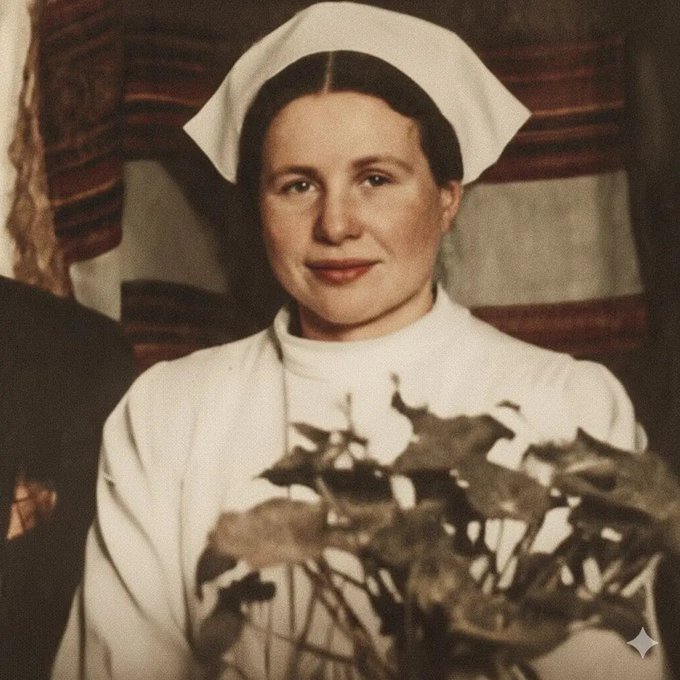
In the autumn of 1942, a slight, 32-year-old Polish social worker named Irena Sendler passed through the gates of the Warsaw Ghetto with a carpenter’s toolbox in her arms. Beneath the hammers and nails lay a drugged six-month-old infant, breathing softly, utterly silent. One cry would have meant instant death for both of them. Irena smiled at the guards; they waved her through. They never suspected that this quiet woman would repeat the journey 2,499 more times.
The ghetto was a slow-motion extermination. Starvation, disease, and random murder stalked every street. Jewish parents faced a choice no human being should ever have to make: keep their child and watch them waste away, or hand them to a stranger who promised a chance—however thin—at life.
Irena came officially to inspect for typhus. In reality, she came to steal children from death.
Babies left in toolboxes or ambulances under false bottoms. Toddlers sedated and tucked into potato sacks. Older children led by the hand through the stinking, lightless sewers while German boots marched overhead. “Not a sound,” she whispered as rats scurried past their feet.
She knew that the rescued children would be given new names, new religions, new families. Their pasts would vanish unless someone remembered. So, on fragile scraps of tissue paper, Irena wrote each child’s real name, their parents’ names, and their new hiding place. She rolled the papers tight, slipped them into glass jars, and buried them beneath an apple tree in a neighbor’s garden. If she were caught and killed, the truth might still survive.
She was caught.
On October 20, 1943, the Gestapo kicked in her door. They took her to Pawiak Prison and demanded the list. When she refused, they smashed both her legs with iron bars. Then her feet. Then her arms. For weeks the beatings continued. She never spoke. They scheduled her execution. On the appointed morning, guards dragged the broken woman from her cell.
Instead of a firing squad, she found herself outside the prison walls—alive. The Polish underground council Żegota had bribed a guard to mark her file “shot while trying to escape.” Officially dead, Irena Sendler limped back into the shadows to keep working.When the war finally ended, the first thing she did was dig up the jars under the apple tree. She spent years trying to return the children—now scattered across convents, farms, and foster homes—to whatever family might remain.
Almost no parents had survived. But the children had. Because of her, 2,500 Jewish boys and girls lived to grow up, to marry, to have children and grandchildren of their own—an entire secret branch of the human family tree that the Nazis never managed to cut down.For decades her story stayed buried deeper than the jars themselves. Then, in 1999, four high-school girls in rural Kansas stumbled across a brief mention of her name. They found the old woman still living quietly in Warsaw and brought her courage back into the light.
Journalists called her the greatest rescuer of the Holocaust. Irena only shook her head.“I could have saved more,” she said. “That regret follows me to the grave.”Irena Sendler—armed with nothing but a ghetto work permit, a toolbox, and a refusal to look away—proved that even in the heart of the worst evil humanity has ever devised, one determined person can still keep the darkness from winning completely.
A 17-year-old just built a mind-controlled prosthetic arm for $300.
Yes, $300.
For something that usually costs $450,000.
Let that hit you.
A teenager, working from home, used AI, cheap materials, and 23,000 lines of code to build a device that reads brain signals without surgery, without implants, and without a $450K price tag.
This is not a feel-good story.
It’s a warning shot.
How can a high school student build something 1,500× cheaper than the industry standard?
What does that say about innovation?
About pricing?
About who gets access to life-changing technology?
Of course, medical prosthetics are expensive for real reasons:
materials, testing, regulation, customization.
But let’s be honest — not all of that justifies a half-million-dollar price.
This story exposes a simple truth:
The future of accessibility won’t come from the system.
It will come from the outsiders who dare to challenge it.
If a 17-year-old can match top-tier prosthetics for a fraction of the cost…
why aren’t these solutions available to the millions who need them?
What do you think — breakthrough moment or the start of a bigger revolution?
#AI #Innovation #Healthcare #Accessibility #FutureOfTech
May be the #1 parenting mistake of the past 20 years: parents treating iPads/tablets like mini-televisions. iPads/Tablets significantly damage a child’s brain. How can we stop parents from giving their child tablets? What can be done to get schools to stop using tablets?